

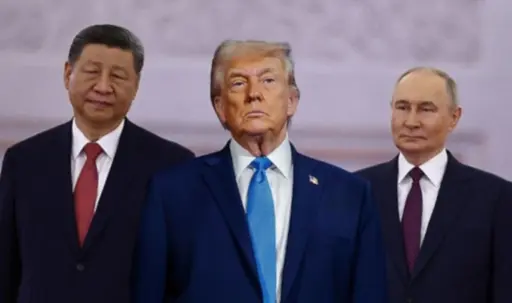
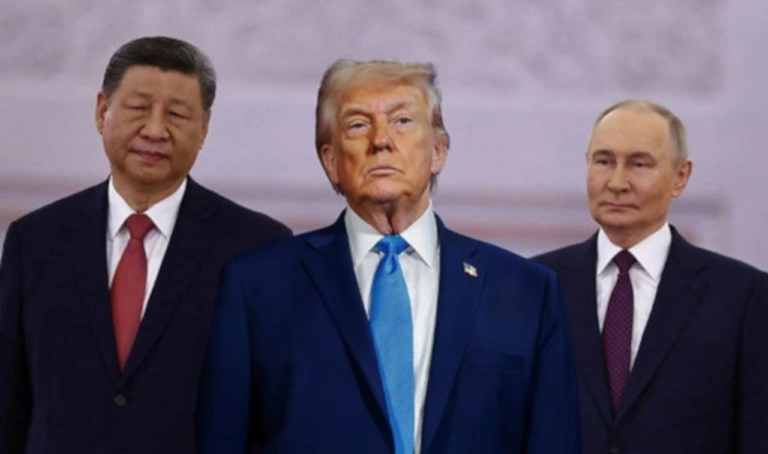
Putin Xi Trump APEC summit in Shenzhen will address nuclear arms control, U.S.-Iran tensions, and global strategic stability.
Related: Mossad and CIA Discuss Iran Strategy in Washington
Putin Xi Trump APEC Summit: 3 Leaders to Discuss Nuclear Limits
A trilateral meeting between U.S. President Donald Trump, Russian President Vladimir Putin, and Chinese President Xi Jinping is planned for November 19 during the Putin Xi Trump APEC summit in Shenzhen, China. The talks will focus on strategic security, nuclear arms control, and international stability.[telesurtv]
The meeting will take place on the sidelines of the Asia-Pacific Economic Cooperation (APEC) summit in Shenzhen, Guangdong province. Although no definitive agreement is expected, the leaders are expected to address persistent differences over nuclear capabilities and future diplomatic understandings.[telesurtv]
The White House communications team confirmed the dialogue through official channels. Russian presidential adviser Yuri Ushakov had previously said that plans were underway for an exchange between the Russian and U.S. presidents during the regional event.[telesurtv]
New START at the Center
One of the main agenda items will be the possible restoration or replacement of the New START treaty. The agreement had set limits on the strategic nuclear arsenals of Washington and Moscow before expiring in February 2026.[telesurtv]
The talks will explore alternatives to replace the treaty. Officials say the goal is to establish a new framework for arms control that reflects the current strategic balance between the United States and Russia.[telesurtv]
The absence of a binding successor to New START raises concerns about transparency and verification. Without agreed limits, both countries could expand their arsenals or deploy new systems without reciprocal monitoring.[telesurtv]
U.S. Department of State – Arms Control
Nuclear Asymmetry Between the Three Powers
The United States and Russia each possess arsenals exceeding 5,000 warheads. China’s nuclear capacity is significantly smaller, estimated at around 600 warheads.[telesurtv]
That asymmetry complicates any attempt to bring Beijing into an arms-control framework similar to the one previously applied between Washington and Moscow. U.S. officials have acknowledged the difficulty of fully incorporating China into such arrangements.[telesurtv]
China has expressed reservations about accepting commitments equivalent to those of countries with much larger nuclear inventories. Beijing argues that any new framework must account for the differences in arsenal size and strategic posture.[telesurtv]
The result is a three-way negotiation in which each power has different priorities. Washington and Moscow focus on bilateral limits, while Beijing is more cautious about binding commitments that could constrain its modernization program.[telesurtv]
United Nations Office for Disarmament Affairs
U.S.-Iran Tensions on the Agenda
Beyond arms control, the delegations will discuss a range of international issues, including tensions between the United States and Iran. The debate will take place amid persistent differences over the conditions for advancing future diplomatic understandings.[telesurtv]
The inclusion of Iran on the agenda reflects the broader regional stakes. Any escalation between Washington and Tehran could affect energy markets, shipping routes, and security across West Asia.[telesurtv]
The meeting will test whether the three powers can find common ground on crisis management. It will also reveal whether China is willing to play a more active role in mediating disputes that directly affect global stability.[telesurtv]
A Summit Shaped by Strategic Competition
The Putin Xi Trump APEC summit takes place amid intense strategic competition among the world’s major powers. According to the Global Firepower 2025 report, the United States ranks first in global military capability, followed by Russia, while China is third and India fourth.[telesurtv]
That hierarchy shapes the discussion on security. The United States and Russia remain the central actors in nuclear arms control, while China’s growing military and economic power gives it increasing leverage in any future framework.[telesurtv]
The summit also reflects a broader shift in global governance. The traditional bipolar structure of the Cold War has given way to a more multipolar system in which China, Russia, and the United States each pursue distinct strategic interests.[telesurtv]
Geopolitical Context
The Putin Xi Trump APEC summit carries implications far beyond the Asia-Pacific. It comes at a moment when nuclear arms control, regional conflicts, and great-power competition are converging into a single strategic equation.
The expiration of New START removes the last major bilateral constraint on U.S. and Russian strategic arsenals. Without a replacement, the risk of miscalculation and unchecked expansion increases.[telesurtv]
China’s role is especially important. As its nuclear arsenal grows, Beijing is becoming a central actor in any future arms-control architecture. Its willingness to accept limits will determine whether a trilateral framework is possible.[telesurtv]
The meeting also takes place amid ongoing tensions between the United States and Iran. Any discussion of Iran will need to address not only military escalation but also the broader question of regional security and the role of external powers in West Asia.[telesurtv]
What Comes Next
The immediate question is whether the three leaders can agree on a framework for future talks. A joint statement or a commitment to continue negotiations would be a meaningful step, even if no binding agreement is reached.[telesurtv]
The longer-term challenge is to build a new arms-control architecture that reflects current realities. That will require addressing not only U.S.-Russia limits but also China’s growing arsenal and the role of other nuclear powers.[telesurtv]
For now, the Putin Xi Trump APEC summit represents a rare opportunity for direct dialogue among the world’s three most powerful states. Whether it produces results will depend on whether the leaders can move beyond symbolic engagement and address the hard choices ahead.[telesurtv]
From teleSUR English via This RSS Feed.