

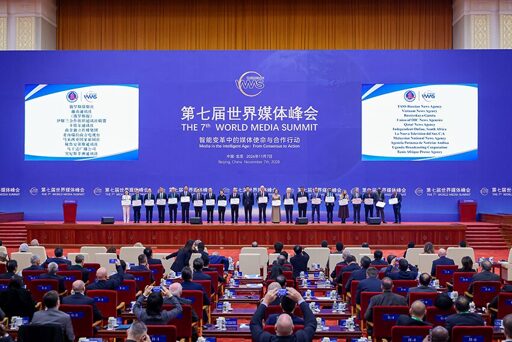
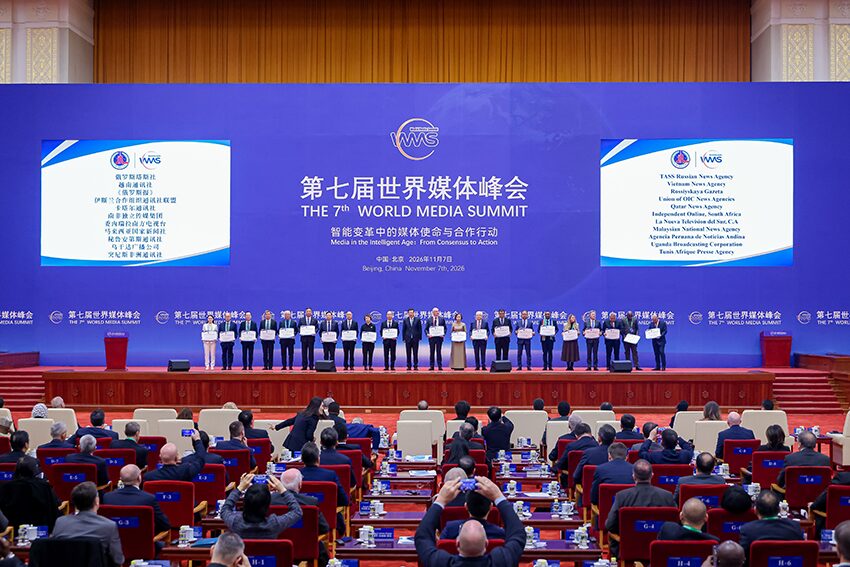
Media leaders from more than 100 countries gathered in Beijing and agreed on Saturday to build shared standards for the use of artificial intelligence, adopting the Beijing Consensus and launching an initiative backed by 22 founding organizations.
The 7th World Media Summit, held in Beijing from November 5 to 9 under the theme “Media in the Intelligent Age: From Consensus to Action”, drew nearly 500 representatives from some 330 media outlets, think tanks and institutions from 112 countries, in what organizers described as the sector’s broadest gathering at a time of rapid technological change and competing global narratives.
The event, led by China’s state news agency Xinhua, focuses on artificial intelligence, disinformation and international cooperation among media organizations.
RELATED: Artificial Intelligence Pioneers Call for International Body to Oversee Cybersecurity Standards
Delegations from Latin America include outlets from Cuba, such as Prensa Latina, Juventud Rebelde and Ideas Multimedios, and from Venezuela, through teleSUR. Public and community media from Nicaragua are also attending, along with journalists and delegations from Chile, Colombia, Argentina, Peru and Mexico.
Participants also come from Iraq, represented by the Iraqi Media Network, Japan and several Gulf countries, in addition to the host, China, through Xinhua and the Beijing municipal government. Agencies like CNN, Reuters and AFP were also present.
Ver esta publicación en Instagram
Una publicación compartida de teleSUR English (@telesurenglish)
Artificial Intelligence on Agenda
The main discussions examine the transformative impact of AI on content creation, as well as its ethical, social and economic challenges. Delegates stressed the need to balance technological innovation with professional responsibility.
AI governance in communication holds a central place, with emphasis on algorithmic transparency, data security, content traceability and the creation of international standards.
The agenda also covers developing AI solutions for the media sector, sharing technological resources and narrowing the digital divide between developed countries and the Global South. Speakers noted that Southern nations have historically been excluded from control over platforms, satellites, cables and algorithms.
In the summit’s sub-forums, one idea was repeated: AI does not merely improve old production systems but reshapes the global communication landscape, and its limit lies where journalistic professionalism, ethics and commitment to the truth prevail.
Disinformation and Sovereignty
Delegates also discussed global strategies to curb fake news and protect the accuracy of information in fast-moving digital ecosystems. Participants analized the role of media in promoting a safer international environment through information exchange, data verification and cooperation against disinformation.
Some speakers framed the issue in geopolitical terms, arguing that disinformation promoted by Western conglomerates is used to justify blockades, coups and interventions. Another line of debate addressed how media from the Global South can use technology to strengthen their media sovereignty and promote inclusive development, challenging what participants described as traditional information hegemony.
A further topic was the potential of new technologies to expand dialogue between civilizations, preserve cultural diversity and strengthen exchanges among peoples, as an alternative to what speakers called a single way of thinking that seeks to homogenize languages, memories and identities under market logic.
The summit also includes a section on China’s modernization, showcasing Beijing’s experience in urban development, heritage preservation and green growth.
🤖As AI reshapes how news is gathered, produced and distributed, how should the #media industry respond?
🎬🌐At the 7th World Media Summit in Beijing, global media leaders share insights on how to harness AI while preserving accuracy, credibility and public trust.#AI… pic.twitter.com/8Ziyzj14d1
— Chinese Embassy in Kenya (@ChineseEmbKenya) November 11, 2026
Beijing Consensus Adopted
Among the anticipated results are the Beijing Consensus of the 7th Summit, the report “AI Plus Media on World Development 2026,” the launch of the first biomimetic humanoid news presenter, the Xinhua Dictionary AI Agent, and the Global Media Initiative for common AI standards. The delegates approved the Global Initiative for the Joint Development of Standards for the Application of Artificial Intelligence in Media. The public debut of bionic humanoid robots working as news anchors was also highlighted.
The Beijing Consensus treats artificial intelligence as a force the industry must steer rather than passively absorb. The document urges media organizations to work together to push forward the sector’s transformation in this new era. It also commits signatories to promoting an inclusive and responsible rollout of the technology, one that benefits outlets at every stage of development and in every country.
For the organizers, the stated goal was to move from consensus to action. The summit offered a concrete vehicle for that shift with the release of the Global Media Initiative for the Joint Development of AI Application Standards. The consensus acknowledges the expanding role AI already plays, from automated translation to algorithmic news recommendations, and frames cooperation as the safeguard against fragmentation.
Ver esta publicación en Instagram
Una publicación compartida de teleSUR English (@telesurenglish)
The initiative also calls for a global database of AI applications, a shared reference meant to show news organizations what has been tried and what actually works, aiming to replace that isolation with a common framework built and tested across borders.
What emerged from Beijing is a commitment to draft standards and compile a database, a two-year agenda whose value will be judged by whether the promised rules materialize and whether newsrooms actually adopt the database as a working tool.
From teleSUR English via This RSS Feed.