

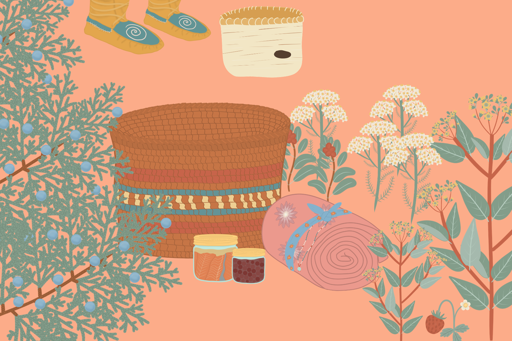

Graphic by Lauren Marchand
The clanking of pots and pans and the ringing of laughter while moving around the kitchen were always calming sounds to me growing up.
The most important lessons I’ve learned about food came as I stood at the hips of my grandmothers, watching them peel potatoes and listening to their stories.
I am a culinary storyteller of syilx foodways. In my work at Smoke on the Plateau, I teach through food. I share stories about my syilx/Okanagan homelands through a fully embodied experience bringing together taste, sight, smell and sound. My research has been lifelong and has taken place in kitchens, in berry patches, and while waiting for salmon and deer to return so I could help prepare it for the people.
There is a beauty to this way of knowing and living, because it is what taught me to be slow and patient with the offerings of our land.
The work I do honours the relationships that collapse time and place into story. It is a way of ensuring we never forget the importance of our Four Food Chiefs system. In essence, this is a reaffirmation of our governance system.
Now, today when you enter the Okanagan Valley, you see another food story being told. A palate cleanser for the gentrification of our foodways.
What’s missing from culinary discussions
A rising culinary hotspot, the Okanagan has dressed itself in words like “local,” “seasonal,” “farm-to-table.” While wine glasses clink and tasting notes are murmured, words like “terroir” roll off the tongue as a somewhat promise to its authenticity.
It is a beautiful and comfortable story.
Terroir is a French term embraced by the culinary industry to speak to “the taste of place.” The concept itself describes how the climate and land conditions of an area affect the flavour profile of local food crops.
In the Okanagan this is popularized through the wine industry. It’s often the terroir of a wine that is showcased through wine tastings. It speaks to the soil, weather, topography and tradition that shape what consumers taste.
“Local” has now become a premium label, “farm-to-table” has become marketing copy, and “terroir” has become a way to charge more for the same soil that syilx Peoples have been tending since the time of our Creation, without acknowledging who did the tending, or what was given back in return.
This is gentrification.
Not just through the extractive wine industry, but it’s become the gentrification of taste itself.
When terroir is extracted from its French roots and planted in the Okanagan, it lands on soil that is already alive with syilx knowledge and responsibility.

First Foods Board, Smoke on the Plateau Catering, An assortment of homesmoked deer and elk sausages, cedar smoked candied salmon, accompanied by homemade xusem raspberry compote, and siya jam. Photo by kelsie marchand (kilawna)
As a syilx culinary storyteller, I am responsible for reminding people of this, that our foodways should not be minimized for the sake of an entertaining evening.
Our foodways have and always will be prayed over. Ceremonies of health, and gratitude are held for all our homelands offer us. Young people go through their Coming of Age ceremony learning to pray for the health of our waterways. All of this is the missing spirit of the term terroir.
So I’ve been working to name what’s missing. One word, something that can hold the weight of kinship, of reciprocity, of generations coiled into one. Something that reminds us we are part of the land, not separate from it.
So I call it by it’s name, tmixʷ.
tmixʷ is the nsyilxcen word for life-force, the aliveness of every being that makes a place what it is, it speaks far beyond just soil and climate. Rather it speaks to the kinships between all of it, our reciprocity, and our syilx/Okanagan obligation to give back, so that what you take can live again.
The syilx/Okanagan understanding of place is through tmxʷulaxʷ, which speaks to the life-force-place. It is a dynamic, regenerative relationship between all beings, which the culinary industry’s shallow “local” label cannot contain.
The Okanagan culinary industry wants you to taste place, so what they’re selling is terroir, but what its missing is tmixʷ.
What tmixʷ tastes like
Let me tell you a story about xusem (soapberries).
There’s a small spot in the Okanagan mountains that has the sweetest soapberries my family has ever tasted.
The oldest person in my family shared that those berries are special, he’s had xusem berries from all areas of the Okanagan Valley, and these are unique because of their sweetness. xusem is typically a rather bitter berry. But from this one particular spot, they are very sweet.
They hold memories for their sweetness. Our family talks about that spot and visits it every year just to give it thanks.
As I research the micro-climate of that place each year, I notice a specific dappling of sun unique to that area. It is rather open, so the berries get enough sun to sweeten but not so much that it kills them, because xusem loves its darker, cooler places.
The taste comes from the sun in that area, but it also comes from the water that feeds that place. I know the families who carry the ceremonial responsibility to caretake it, to pray over it, to give thanks for it, to ensure it remains healthy so that the berries can continue to sweeten, year after year, generation after generation. I know the specific prayer and ceremony said over that place.
And this is data — or knowledge — sovereignty. We have a story now about that particular place in our homeland, a story that helps us understand the relationship between land, its specific environment, and the taste of place.
But more than that, we have a responsibility. We know who holds the ceremonies, we know who carries the prayers, and we know that the taste of that berry is inseparable from the health of that water, and the health of that water is inseparable from the people who tend it with reverence.
That taste, the taste of that specific dappling of sun, of the hands that harvest, of the water that was prayed over, of the generations who knew to return, that is tmixʷ. That is the kinship I am speaking of that is missing from terroir.
Terroir speaks to what the land gives.
tmixʷ speaks to the responsibility, love and gratitude we have for how we are built into the system of a place.

skʷəkʷiw̓ (Rosehip) gathered from my great great grandmother, Julia Tonaskets rosehip bush, I make a cranberry and rosehip sauce and share stories of her life while serving it. Photo by kelsie marchand (kilawna)
The missing spirit
But to fully understand tmixʷ, you have to understand its shape.
In syilx-centric understanding, time and relationship do not move in straight lines. They coil, they spiral, and they return. Like a rope being twisted, strand by strand, year after year, generation after generation.
tmixʷ is often described as the action of many strands continuously being bound and unified with each other to form one strong rope or thread, this coiling over time is what creates a living future.
Our name, syilx, carries this image. It loosely translates to those-who-twine/coil-(many)-into-one. This is who we are, and this is what we do as people, we coil the strands of life into a thread that carries us forward, so we may move into the future unbroken, generation after generation.
And there is another word that is used to describe us, sqilxʷ. It is the word for our people. And it translates as “to dream in a spiral.”
We are the ones who dream in spirals. We have the mind power to envision what could be, to create into reality whatever we can dream. So, unlike salmon, unlike roots, unlike bears, we humans do not automatically know how to live in ways that contribute to the wellbeing of future generations. It’s our responsibility to learn it, to dream it, and to choose it, again and again, this is our spiraling forward.
This is what it means to be syilx/Okanagan. We are the coil and the spiral, and we hold the past while we dream the future. We are the ones who must remember, and in that remembering, we create.
So when we harvest, we are coiling, and when we give thanks, we are coiling. As part of our agreement as people here it is up to us to ensure that what we take can be revived, we are adding our strand to the thread. And when we dream, when we envision a future where all life-forces can revive, we are spiraling, we are bringing the future into the present. This is how we collapse time and place and can share it as story.
The taste of place, through tmixʷ, is the taste of something being coiled, year after year, generation after generation, towards a time where all life-forces can revive. That rests on our responsibility as The People of this land.
People-eaters logic
The Okanagan culinary industry has taken the flavour of place and stripped it of the relationships that made it possible, but they don’t sell the obligation to give back.
Because you can’t sell what you don’t know, and you can’t taste what you’ve forgotten.
When you forget that you are part of a coil, a thread being twisted, strand by strand, generation after generation, you begin to believe that you are separate. That the land is just resources and that food is a product, that taste is just flavour.
This is the logic of extraction. It is the logic of the people-eaters, nəɬnasqilxʷtn, the monsters that Coyote, our teacher and trickster, was sent to transform. They consume without giving back, they take without gratitude, and they believe they are the only ones who matter.
I do not want to say that the Okanagan culinary industry is Coyote, because it doesn’t mean to be a monster, however it is dressed in the same forgetting. It has adopted the language of terroir without adopting the responsibility of relationship, and it speaks of a place without knowing who ceremonies for the water.
And so the coil weakens. The thread frays. The spiral loses its way.
To be sqilxʷ, to dream in a spiral, is to remember that we are the ones who must keep it coiling, and we are the ones who must keep it turning. We are to remember that we are torn from the earth and that our responsibility is to return.
To remember that we are not the only ones, that the water, the berries, the salmon, they are our relatives. They have their own life-force, and they have their own right to regenerate.

My sister and I spend a lot of time in the mountains each year gathering different berries and medicines, a family favourite is st̓xałq (huckleberries), a berry that requires a very specific environment to grow, talking to the plants, laughing with our loved ones amongst our Plant People, clearing away debris so they can grow strong, praying with its water sources, we become kin. We are part of that ecosystem as helpers of our Plant People. Photo by kelsie marchand (kilawna)
To remember that we are not just consumers, but we are participants, we are co-creators, we are the ones who must give back.
So what I know to be true, is that the taste of tmixʷ is still here, has always been and will always be. It is reaffirmed in the xusem berries that my family harvests every year. It’s reaffirmed in our salmon relatives that still swim up the rivers, it’s reaffirmed by the roots that still push through the soil, it’s reaffirmed by the berries that will continue to sweeten in the dappled sun of a place that has been tended by syilx Peoples for generations.
It will all remain and stay alive, surrounded by the sound of pots and pans and laughter moving about the kitchen where our children learn to stand and watch at the hips of their grandmothers. It’ll remain alive in the stories that collapse time and place into a single moment.
A note on language
tmixʷ (pronounced tuh-MEE-kwuh) is the syilx word for life-force, the aliveness of every being that makes a place what it is.
sqilxʷ (pronounced skee-lkhw) refers to the syilx people. It translates as “the dream in a spiral.”
syilx (pronounced see-ilkh) means those-who-twine/coil-(many)-into-one.
xusem (pronounced hoo-sem) is the syilx word for soapberry.
The post The taste we’ve been missing appeared first on Indiginews.
From Indiginews via This RSS Feed.