

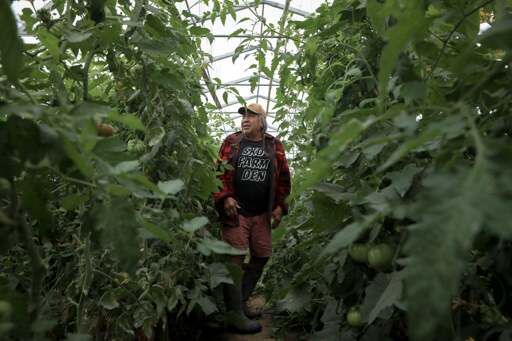

Dixon Terbasket, the founder of ntámłqən Community Garden in smǝlqmíx homelands, walks through the farm’s greenhouse on Sept. 15, 2026. Photo by Aaron Hemens
The potato plants are so tall that their stems reach Dixon Terbasket’s eyes.
He remembers walking through his family’s garden when he was three or four years old, more than 60 years ago, in a community where his mom, all his aunties and uncles, grew food in gardens and orchards — and stored them in root cellars, too.
Now, Dixon finds himself leading his own food sovereignty initiative that he hopes will equip the next generation of smǝlqmíx (Similkameen) people with the knowledge and skills to farm on their own.
“I want to give them at least a running chance, man,” Dixon told IndigiNews.
The ntámłqən garden is in unceded smǝlqmíx territory in the lower Similkameen Valley, in the southern Interior of “B.C.” It shares its nsyilxcən name with the adjacent community elementary school, meaning “gathering place.” Dixon said his people have gathered here since time immemorial.

The ntámłqən Community Garden in smǝlqmíx homelands on Sept. 28, 2026. Photo by Aaron Hemens
At ntámłqən, a 7.5-acre community garden and food hub on Lower Similkameen Indian Band (LSIB) land near “Cawston,” he works with a small but dedicated crew of staff and volunteers to teach people life skills — from growing their own food; to sharing it with the community; and how to preserve what they grow.
At the peak of the harvest season, the garden hosted a free barbeque for the community on Sept. 28, in collaboration with the Indigenous Food Sovereignty Association.

Rumy Muenala helps prepare food for a community BBQ at the ntámłqən Community Garden in smǝlqmíx homelands on Sept. 28, 2026. Photo by Aaron Hemens

Staff at ntámłqən Community Garden prepare salads during a community BBQ event at the farm in smǝlqmíx homelands on Sept. 28, 2026. Photo by Aaron Hemens
Dozens of people — Indigenous and non-Indigenous — came together around meals made with ingredients provided by the garden and its partners. Between all the mingling and laughs, they feasted on stuffed-peppers, colourful salads, watermelon, goat meat, apple pie and more.
“It’s all about taking care of people,” Dixon said, echoing the farm’s slogan of “For The People.”

Hannah Field, who co-manages the ntámłqən Community Garden as its coordinator, stands in a prayer circle before a community BBQ event at the farm in smǝlqmíx homelands on Sept. 28, 2026. Photo by Aaron Hemens

Community members fill their plates with food during a community BBQ event hosted at the ntámłqən Community Garden in smǝlqmíx homelands on Sept. 28, 2026. Photo by Aaron Hemens
The garden is working towards giving the community the ability to make decisions about their food — and having the knowledge, land and facilities to provide for one another. A processing facility expected to be completed by March 2027 will add space to prepare and store harvests, with opportunities for community food businesses.
Dixon’s niece, Coven Terbasket, joined the crew in 2024, a couple of weeks after moving back to her ancestral homelands. She was 29 and looking for work when she ran into Dixon at an insurance office in small-town Keremeos.
For most of her life, Coven had lived south of the colonial border in “Spokane, Washington.” During childhood summers, her mom would send her up to “roam around” LSIB lands with family, usually in their ancestral community of nkʷrulauxʷ (Blind Creek, Place of Yellow Dirt).
Like her uncle, she remembers family gardens all around Blind Creek, and the work that kept households fed beyond the growing season.
“Everyone had made the time to grow their own food, can their own food, to preserve,” she said.

Coven Terbasket, the administrative assistant at the ntámłqən Community Garden, is pictured at the farm in smǝlqmíx homelands on Oct. 5, 2026. Photo by Aaron Hemens
Coven hadn’t seen Dixon since she was a child. As they reconnected in the insurance office two years ago, he learned she needed work and offered her a job at the community garden he had been building with a small crew of workers and volunteers for more than a year.
“He told me to show up at the garden the next day at 10 a.m., so I did,” she said.
Coven describes the encounter as fate, saying her uncle “found me” shortly after her return, during a difficult period in her life.
“It’s freaky how crazy it worked out … me looking for a job; me freshly back in the homelands after years of not living here – and being stuck in a really dark spot in life,” she said.
“Needing something to prove to myself that it’s worth living. That it’s worth giving another try.”
Working at the garden over the past two-and-a-half years, she said, “has been the growth and the movement that I needed in my life to be able to move through some of that.”
“It’s providing support for those who have once gotten forgotten about. It provides a place of well-being,” she said.
“This is a place where people can come and get grounded.”

A view of the ntámłqən Community Garden from the farm’s food processing building in smǝlqmíx homelands on Aug. 31, 2026. In the distance to the left is the Lower Similkameen Indian Band Office, while the building to the centre-right is the ntámłqən Band School. Photo by Aaron Hemens
Learning to feed one another
The garden’s published priorities include supporting Elders, single-parent families and households with low incomes. Produce is available free or by donation to Indigenous and non-Indigenous community members experiencing food insecurity.
For eight weeks, beginning at the end of August, more than a dozen Elders received weekly “Elder Boxes” full of fresh produce from the garden for free. The program was carried out in partnership with LSIB’s health department, who helped deliver the boxes to the Elders’ homes.

Community members harvest produce from the ntámłqən Community Garden in smǝlqmíx homelands on Sept. 28, 2026. Photo by Aaron Hemens

Staff at ntámłqən Community Garden prepare Elder Box deliveries in smǝlqmíx homelands on Sept. 15, 2026. Photo by Aaron Hemens
The garden also has a library of seeds — from flowers, to herbs and vegetables — that community members can have access to, so that they can plant and garden at their own homes.
Workshops extend that work into the community’s kitchens and pantries, teaching people how to process and preserve what is available locally.

Canned pickles, salsa and other processed foods are labelled following a food processing and preservation workshop led by Rumy Muenala at the ntámłqən Community Garden in smǝlqmíx homelands on Aug. 31, 2026. Photo by Aaron Hemens
With support from the Indigenous Food Sovereignty Network (IFSA), ntámłqən has brought in Rumy Muenala of Ayapacha to lead harvesting, processing, and preserving sessions.
Participants learn to turn produce into meals, canned peaches, pickles, salsas and more. Muenala has also helped put on staff appreciation feasts and community dinners using ingredients from the garden. He was the lead chef at ntámłqən’s September community barbeque.

Baked potatoes for a community BBQ are prepared using a ground oven at the ntámłqən Community Garden in smǝlqmíx homelands on Sept. 28, 2026. Photo by Aaron Hemens
“To me, that’s food sovereignty: you have to adapt, you have to get creative with what’s available — and not depend so much on going to a grocery store,” said Muenala, whom Dixon met through Tea Creek.
Muenala, who is Quechua from Ecuador, delivers workshops and dinners at community farms around “B.C.,” most of them Indigenous-owned or Indigenous-led.

Rumy Muenala of Ayapacha at the ntámłqən Community Garden in smǝlqmíx homelands on Aug. 31, 2026. Photo by Aaron Hemens
“It takes more work … to go out and find these ingredients. But at the end of the day, that’s more important to me, because it builds relationships: relationships to each other; to the land,” said Muenala.
“For me, Indigenous food sovereignty is reclaiming that power of not feeling like you need to depend on somebody anymore. The only people you should depend on are your close relatives, your community, to help one another.”

Rumy Muenala and Dixon Terbasket spark up the grill during a community BBQ event at the ntámłqən Community Garden in smǝlqmíx homelands on Sept. 28, 2026. Photo by Aaron Hemens
Before joining ntámłqən, Coven had spent about a decade working in hospitality. Her administrative job includes marketing and social media, but she spends just as much time out on the land, getting her hands dirty. She knows her way through the long rows of fruits, vegetables, sunflowers, tobacco and other plants.
“Harvesting, seeding, transplanting, weeding — all of it, man,” she said.
She arrived knowing little about farming. Over the past two and a half years, she has learned how to grow watermelons, squash and tomatoes, and to preserve what she harvests. Working on the land every day has been, as she put it in October, “probably the biggest culture shock I’ve ever experienced.”

A staff member in a tractor tends to the crops at the ntámłqən Community Garden in smǝlqmíx homelands on Oct. 5, 2026. Photo by Aaron Hemens
Coven sees the work as part of building a food system guided by the community’s needs and its responsibilities to the land. She envisions being able to feed one another on their own terms, so that “we don’t rely on the food systems that have been set up, as far as the whole capitalistic ideal.”
Learning to grow food has also changed how she understands her place in that system.
“I feel like there’s a sense of self in growing your own food. You identify with that food – you know what it took, and what it takes to grow.”

Staff prepare food for a community BBQ at the ntámłqən Community Garden in smǝlqmíx homelands on Sept. 28, 2026. Photo by Aaron Hemens
The Okanagan Nation Alliance’s teaching resources describe syilx food knowledge learned through the territory’s seasonal changes. When saskatoon bushes first bloom, bitterroot is ready to harvest. Learning when to gather one food means paying attention to other life around it.
“I’ve found this calling here at the garden,” Coven said. “To be a good person. And to give back – to have this reciprocal way of living. I give as much as I take, and find that nice balance between the two.”
Returning to the simplicity of farming has taught Coven the patience and sustained care that living things need to thrive.
“To take care of the things that take care of us … a deeper appreciation and understanding of where food comes from, and how water feeds every source of life that surrounds us on a daily basis.”

Peppers grow in the fields of the ntámłqən Community Garden in smǝlqmíx homelands on July 22, 2026. Photo by Aaron Hemens

Staff at ntámłqən Community Garden sort through tomatoes as they prepare for Elder Box deliveries in smǝlqmíx homelands on Sept. 15, 2026. Photo by Aaron Hemens
Through the garden’s volunteer program, people can help tend to crops, process produce or clean seeds, and leave with a harvest bundle. First-time volunteers receive a site and cultural safety orientation.
Earlier this fall, Hannah Field, who co-manages the ntámłqən Community Garden as its coordinator, said more than 600 people — including volunteers and guests — had come through the farm this year alone.
At an Okanagan Food System Summit gathering at Okanagan College in kiʔláw̓naʔ (Kelowna) in October, Field described ntámłqən as a place where people could find belonging and learn to “work together in a good way.”
“I’m from England. I showed up on Dixon’s doorstep in 2023, and became entwined in making this vision a reality,” she said.
Coven remembers how different community life felt while she was living south of the border.
“That’s the beauty of it – you could be from any walk of life and come here, and feel comfortable and feel welcome,” said Coven.
“The sense of community is something that I very much lacked living in the States. I didn’t really know what that meant, as far as what it means to show up for each other.”

Hannah Field and Dixon Terbasket, the managers of ntámłqən Community Garden in smǝlqmíx homelands, pictured together at the farm on Sept. 15, 2026. Photo by Aaron Hemens
A place to keep the harvest
The garden’s development drew on years of community planning and consultation. LSIB has supported the project through core funding and an in-kind land lease, according to the garden’s published history.
Funding includes a $193,873 grant through the federal Local Food Infrastructure Fund grant for the farm and food hub and $747,704 listed among the province’s 2024-25 rural development awards for the processing facility. A separate $289,759 federal contribution supports a well, irrigation equipment and facilities to preserve and store food.
The garden’s irrigation system is sourced from a well, which was implemented during the farm’s development.
About two acres of the site are devoted to infrastructure, including a greenhouse, chicken coop, office, workshop and community space above a root cellar. Some buildings are finished, while others are nearing completion.
The two-storey food-processing facility will have a walk-in cooler and freezer downstairs, with storage that can be used for commercial purposes. The commercial kitchen downstairs is equipped with meat grinders, dehydrators, and other tools to help support food processing and preserving.
A ramp leads upstairs to a rental kitchen, a podcast room and washrooms.

Dixon Terbasket looks out towards the ntámłqən Community Garden in smǝlqmíx homelands on Oct. 5, 2026. Photo by Aaron Hemens
“You can start to imagine the kinds of things the community can do once they have these types of infrastructure in place,” said Field.
“You can chop a thousand pounds of peaches through there, can it, and take it up to the North Okanagan. Or store apples in the walk-in cooler. There are endless possibilities, really.”
Power for the facilities is currently being funded by grants. But Field said that within the garden’s operational business plan, they envision a future where diverse revenue streams can support the garden’s operation costs.
Potential revenue streams include different workshop programming; wholesale produce distribution; and renting out the commercial kitchen and other facility spaces, like the freezer or cooler.
Kwantlen Polytechnic University’s 2021 Okanagan study describes how spending at locally owned food businesses can circulate among growers, suppliers and repair services. It also identifies concentrated supply chains as a vulnerability during disruptions.
The garden donates fresh produce to community members and gives people a place to spend time together. Dixon said people can learn to fix a chainsaw or take part in growing, processing and preserving their own food.

Staff harvest fruits at ntámłqən Community Garden as they prepare for Elder Box deliveries in smǝlqmíx homelands on Sept. 15, 2026. Photo by Aaron Hemens
The teaching model also helps democratize practical knowledge by offering paid training and describes every team member as a potential mentor, with local Knowledge Holders involved in particular tasks.
“That’s the whole thing — we want people to come here and just hang out,” said Dixon.
In a 2026 YMCA online survey, 64 per cent of people in “Canada” wished their communities had more “third places,” or informal gathering spaces outside of home and work.
Longtime residents and newcomers to the valley are welcome to volunteer at ntámłqən, with no gardening experience required.
“A lot of people believe in — they want to help. There are a lot of settlers who want to do something, and feel like they’re contributing. This is an opportunity for that,” Field said.

Staff at ntámłqən Community Garden prepare Elder Box deliveries in smǝlqmíx homelands on Sept. 15, 2026. Photo by Aaron Hemens
In a 2023 account published by the Economic Trust of the Southern Interior, Dixon outlined a plan to feed the community first and sell surplus produce, with processing and storage eventually bringing in income to help keep the garden running.
The garden’s apprenticeship program describes it as an organic operation. Its training plan includes cover cropping, composting and seed saving, alongside irrigation and food preservation. Keeping seeds gives growers something to sow the follow season; compost returns organic matter to the soil, helping it retain water and nutrients. Cover crops help protect the soil between harvests.
A nursery for native plants is also in the works at the garden. Its 2026 growing list includes native seedlings and cuttings intended to restore the territory, including black huckleberry and wild strawberry.
Connections with Young Agrarians, Tea Creek and the Indigenous Food Sovereignty Association have also supported the garden’s development.
Dixon sees opportunities for the community to farm elsewhere on reserve land, too. He said soil mapping had identified 7,200 acres of Class 1 agricultural land, opening possibilities for community members to grow food for their families and earn a living from farming.

Dixon Terbasket cruises through the ntámłqən Community Garden in smǝlqmíx homelands on July 22, 2026. Photo by Aaron Hemens
‘The garden was everywhere’
In 1978, when he was 21, Dixon planted his first garden at his mother’s place, next door to where he lives now by the ntámłqən garden. The plot was no bigger than his kitchen.
He developed a business plan to farm on a larger scale and involve more of the community. On the same lands where ntámłqən garden would be built nearly 40 years later, he launched the Similkameen Native Organic Produce company in 1987, beginning as a market garden and later moving into commercial growing.
“We had quite a few people — similar to what we’re doing right now — training people from the reserve,” he said.

Theresa Ann Terbasket, Dixon’s 93-year-old mother, leads the opening prayer of a community BBQ at the ntámłqən Community Garden in smǝlqmíx homelands on Sept. 28, 2026. Photo by Aaron Hemens
They started with five acres of potatoes. With help from his staff and a 100–horsepower irrigation pumping system, they started growing “rows and rows of vegetables,” he said.
“Putting in 5,000 tomato plants and 4,000 pepper plants. It got bigger and bigger.”
The tomatoes they were growing were a major seller – not just locally, but even into the U.S., he said.
He highlighted that the Similkameen Native Organic Produce company was producing 40,000 to 60,000 pounds of tomatoes every season for at least four years.
“I became quite the market. After a while, sometimes, I’d run out of tomatoes,” he said.

Dixon Terbasket tends to his chickens at the ntámłqən Community Garden in smǝlqmíx homelands on July 22, 2026. Photo by Aaron Hemens
By the end of the 1990s, Dixon got busy raising a family and returned to a life of local governance. He later worked as a natural resource technician with the Okanagan Nation Alliance and retired in 2024 after more than a decade in that role.
But even before he announced his retirement, Dixon was already making plans to return to farming.
In 2018, Dixon sought community support and permission to farm a piece of band land near his home. His request was approved.
“I just thought I was going to retire here, grow some tomatoes and some peppers. The good life,” he said.
Now, Dixon has found his fourth wind in life, passing on the lessons that began at an early age in his family’s garden.
“I think you die after you slow down,” he said of retirement.

Theresa Ann Terbasket, left, is embraced by a community member as she leads the opening prayer of a community BBQ at the ntámłqən Community Garden in smǝlqmíx homelands on Sept. 28, 2026. Photo by Aaron Hemens
Farming runs deep in his family history. Dixon’s 93-year-old mother, Theresa Ann Terbasket, grew up farming on a ranch operated by his great-grandfather Paul Terbasket at nkʷrulauxʷ.
But farming isn’t the way his ancestors traditionally lived, Dixon said.
“Maybe my grandfather did — maybe his grandpa, too. It’s a couple generations back. But prior to that, it was hunting. Everything was there — berries were there; the roots were here; the deer were here; the fish were here. The garden was everywhere,” Dixon said.
“Then they started putting us on the Indian reserves, and then we became farmers. We were good farmers.”

Dixon Terbasket at the ntámłqən Community Garden in smǝlqmíx homelands on Oct. 5, 2026. Photo by Aaron Hemens
The Working Group on Indigenous Food Sovereignty describes the right to food as sacred, alongside responsibilities to care for the lands, plants and animals that provide it.
As IndigiNews reported in 2022, Paul was farming 50 acres by 1909, diverting water from Blind Creek through an irrigation ditch.
That year, the province’s Water Act asserted Crown ownership over water and required licences to divert it. Indigenous water licences were often improperly recorded, altered or cancelled, according to legal researcher Kathryn Gullason’s history of water regulation.
Paul’s application for a water record was refused in 1911. Instead, the provincial Board of Investigation confirmed the Similkameen Fruitlands Company’s water record, historian Duane Thomson wrote in a 1994 study in BC Studies.
Author and historian Harold Rhenisch, who grew up with Dixon, said the attempt to block Paul’s water use dates back to 1913. In his 2022 account, he wrote that Paul carried on using the land and water because “he had never relinquished title to it, and he had been promised water long before.”
In 1923, the dispute went to court, Rhenisch wrote. Paul continued watering his orchard and was eventually jailed for contempt of court.
“We were banned from selling our food in the 1930s and ‘40s. They took away water licenses from us in the ‘50s and ‘60s. We were food sovereign until the end of the ‘60s – we were becoming reliant on a thing called social assistance,” Dixon said.

Dixon Terbasket, the founder of ntámłqən Community Garden in smǝlqmíx homelands, examines produce growing in the farm’s greenhouse on Sept. 15, 2026. Photo by Aaron Hemens
What the next harvest depends on
Dixon and the ntámłqən crew worry about climate change, political instability, and disruptions to food supplies.
This fall, cyberattacks reportedly disrupted the refrigeration systems that grocery stores depend on to keep food safe. In October, attackers reportedly remotely took control of cooling systems at hundreds of supermarkets and independent stores in France, forcing some to discard food.
Governments have also been emphasizing household preparedness. In 2025, the European Commission called for guidelines to help people meet their own needs for at least 72 hours during a crisis. Federal emergency guidance in “Canada” also advises households to keep enough food, water and other essentials for at least three days.
The federal National Food Security Strategy also calls for growing and processing more food domestically. It sets a target to increase the domestically produced share of healthy food available in “Canada,” measured against Canada’s Food Guide, from 75 to 85 per cent by 2032.
Closer to the garden, preparing for disruptions begins with helping people grow food and keep the harvest available year-round. That ability depends, in turn, on the health of the territory where the food grows.

Fresh melons harvested from the ntámłqən Community Garden in smǝlqmíx homelands on Sept. 28, 2026. Photo by Aaron Hemens

Hannah Field helps prepare Elder Box deliveries at ntámłqən Community Garden in smǝlqmíx homelands on Sept. 15, 2026. Photo by Aaron Hemens
In May 2026, the syilx Okanagan Nation declared a watershed emergency across the Similkameen and five other watersheds, citing drought, ecosystem decline and growing threats to water security. The Nation identified declining streamflows, threats to fish, and the early die-off of bitterroot as signs of a deepening crisis.
Nearby, nməlqytkʷ (the Similkameen River) winds through agricultural land and surrounding ecosystems. At nearly 200 km long, the waterway has been described as “the lifeblood of the valley” by LSIB Chief Keith Crow.
Coven remembers swimming in its waters as a child.
“I’ve seen the changes (in the river) since I’ve been a kid. I’ve seen how it’s getting grittier, nastier – something that I preferably don’t want to swim in anymore, which is really sad,” she said.
“We all have a responsibility to the land and to the water.”

Hannah Field leaves notes on the staff chalk board at the ntámłqən Community Garden in smǝlqmíx homelands on Oct. 5, 2026. Photo by Aaron Hemens
The region has also experienced how quickly transportation routes can fail. In November 2021, flooding and mudslides closed major highways and rail lines connecting the Lower Mainland and “B.C.’s” Interior, interrupting the movement of food.
“Food can become scarce. I think a lot of people don’t really know how much risk we’re at. How vulnerable we are. We take it for granted,” said Dixon.
In the event of an emergency situation where local food systems are disrupted, he explained that the garden would step-up and manage whatever food they have readily on-hand. Part of that process is to identify any food surpluses, which they would then compile into a “stockpile” to support the community’s needs.
“You have to manage it. You might even have to protect it,” he said.

Dixon Terbasket waves goodbye to a community member following a food pick-up event at ntámłqən Community Garden in smǝlqmíx homelands on Sept. 15, 2026. Photo by Aaron Hemens
Emergency response also includes working with other nearby farmers and ranchers to see how they can pool their resources together for the community, he added.
“It’s dependent on the time of year,” Field emphasized in November.
“If it’s now, obviously there’s nothing in the field. But what we’ve got in the cellar, or processed, would be what we would have.”
The food processing facility comes equipped with a back-up generator, so the community would still be able to access stored food and food processing equipment, in the event of an emergency food systems situation.
Dixon sees a “generational gap” in the knowledge needed to grow and preserve food. Teaching is his way of giving back to the community that taught and supported him through his years of farming.
“I care so much, man. … Why do I do it? I really think that people need to learn. As a young guy, I was trained. A lot of older men and women trained me. They showed me how to do these things.”
Passing those skills on is his way of giving back to the community that supported him through his years of farming.
“I didn’t realize how valuable it is, how to do that.”

Staff and crew at the ntámłqən Community Garden, following a community BBQ event they hosted at the farm in smǝlqmíx homelands on Sept. 28, 2026. Photo by Aaron Hemens
In the garden, Dixon can see the results of his work. He contrasts that with years spent in board meetings.
“You sit there for 20 years and don’t get any results. At least here, it feels like I did something,” he said.
Coven described her uncle as “a git-r-done kind of uncle,” and called it a privilege to work and learn from him.
“I see a man that is very vision-led, vision-driven. I see a man of action. The man just does, and will figure it out in the process,” she said.
For Coven, caring for the ntámłqən garden is part of revitalizing smǝlqmíx food systems, culture and customs. She imagines that work extending into people’s homes.
“I see a lot of the community members being able to sustain their own fridges, to sustain their own pantries,” she said.
The work gives her hope for a future in which her people can “survive and thrive.”
“The hope that we can do this as one people. Because it takes all of us.”
If there’s anything the community takes away from the garden, Dixon said that he hopes that people can develop the confidence to know that they can farm and grow food at home, too.
“You can do this. Grow a couple tomato plants. Grow some peppers. Grow a few potatoes. Grow some beets. Grow some carrots. Throw a couple onions in there – in your own little patch. That’s how I started,” he said.

Dixon Terbasket, fresh out of knee surgery, catches his breath at the ntámłqən Community Garden in smǝlqmíx homelands on Oct. 5, 2026. Photo by Aaron Hemens
The post ‘It’s all about taking care of people’: How a smǝlqmíx farmer is building food sovereignty at ntámłqən appeared first on Indiginews.
From Indiginews via This RSS Feed.