

Janine Jackson interviewed the Center for International Policy’s Sina Toossi about the Iran War and the midterms for the November 6, 2026, episode of CounterSpin*. This is a lightly edited transcript.*
https://media.blubrry.com/counterspin/content.blubrry.com/counterspin/CounterSpin261106.mp3
Janine Jackson: This week on CounterSpin: The midterm elections heralded many historical, or one could say long overdue firsts in terms of representation for Black, brown, Muslim, Native, disabled people, thereby upending a lot of corporate media conventional wisdom about who is electable and what voters actually care about. We will be talking about that going forward.
On today’s show, we’ll talk about what Trump offered as the main reasons Republicans lost across the board, and a point that apparently JD Vance plans to run on in his campaign for president: The war on Iran. I could complain about simplistic coverage that conflates Iran having a nuclear program with their having a nuclear weapon or about years of summarily silenced polling saying that people in the US have no interest in waging a new military war on people in Iran.
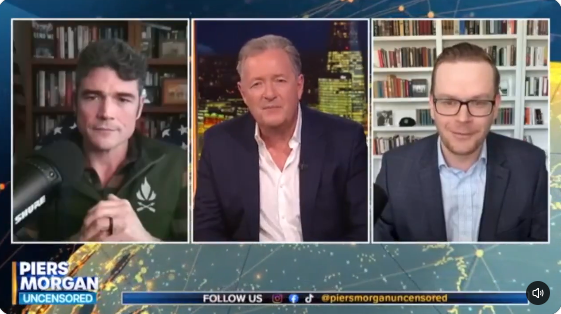
Piers Morgan Uncensored (4/9/26)
But it’s hard to introduce nuance into a debate that is shaped by conversations like that that Piers Morgan had with a guy called Will Chamberlain, who works for the outlet Human Events, run by white supremacist and Pizzagater Jack Posobiec. Not a famous human rights champion, Piers Morgan asked Chamberlain if Israel had a nuclear weapon, to which Chamberlain said, “Yes, almost certainly.” So why hasn’t Israel acknowledged its nuclear weaponry? “Because they don’t want to,” is what Chamberlain said.
Asked if that was not hypocritical, Chamberlain spoke for many, and this is the point saying, no, there is no hypocrisy, “because they’re our ally and Iran’s our enemy.” A sentiment that he re-expressed shortly thereafter, “Because we’re the good guys and Iran’s the bad guys.” Asked to clarify, “So our friends don’t need to be transparent about their nuclear capabilities, but our enemies do?” Chamberlain declared, “Yes, that’s exactly how it works.”
All of which is just to say that many people, including liberals, have accepted that there’s no such thing as hypocrisy when it comes to US actions in other countries. What we call universal principles just apply differently to different people. And “we’re good and they’re bad” is a legitimate overarching idea for foreign policy that thinking people are supposed to accept and internalize and propagate.
The midterm elections, and all the years of work leading up to them, because this was not a flash in the pan, tell us that many people are thinking past simplistic headlines and are thinking about the human beings living in the places on the map that we’re being told it’s okay to blow apart. We’ll talk about Iran with Sina Toossi, senior non-resident fellow at the Center for International Policy.
***
New York Times (11/2/26)
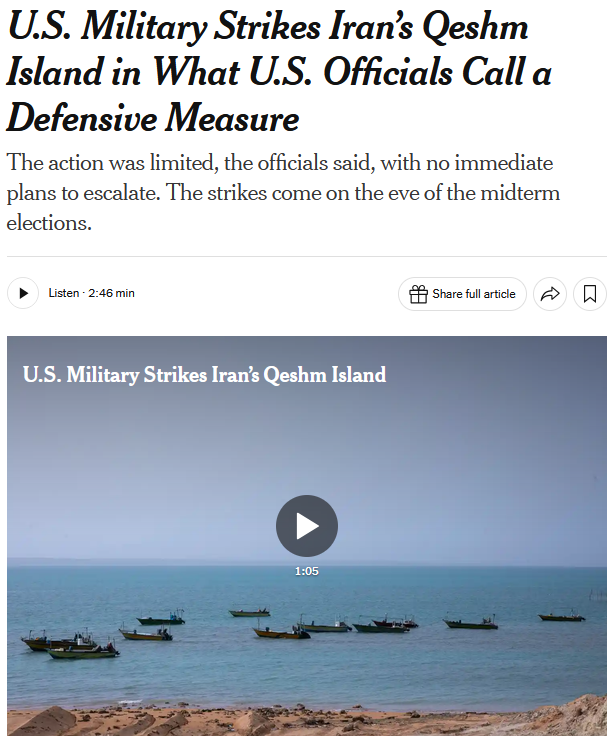
On November 2, the New York Times reported:
The US military struck Iran’s Qeshm Island on Monday in what American officials described as a small-scale defensive measure against Iranians accused of planning missile strikes against US assets. The US strikes were limited, the officials said, adding that there are no immediate plans to escalate. Yet the military action comes on the eve of the midterm elections. President Trump, meanwhile, has been considering renewed strikes against Iran after the elections.
As we record today on November 5, the Times is running a piece titled ”Political Losses Deepen the Stakes as Trump Contemplates Renewed Iran Attack: The midterm results laid bare the deep unpopularity of the war of choice that President Trump started and is now struggling to end.”
Well, that’s the sort of reporting we’ve been called on to make sense of. And while coverage has shifted over time, one piece of Iran coverage that has been missing chronically is attention to Iran’s people, what they want, whether conflicts with their leadership mean they’re asking to be bombed, and whether Iran is a full-fledged sovereign country that should have access to the same sort of levers of power that other countries do, or whether they’re something less, somehow to be defined and redefined as others see fit.
The idea we’re hearing now that Republicans’ losses in the midterms had a lot to do with the war on Iran doesn’t necessarily portend more humanistic or historically minded attention to what US attacks on Iran are or have been. Our guest has been thinking and writing about these things for years. Sina Toossi is a writer and researcher. He’s senior non-resident fellow at the Center for International Policy. He joins us now by phone. Welcome back to CounterSpin Sina Toossi.
Sina Toossi: Hi, thank you so much for having me.
The Nation (4/2/26)
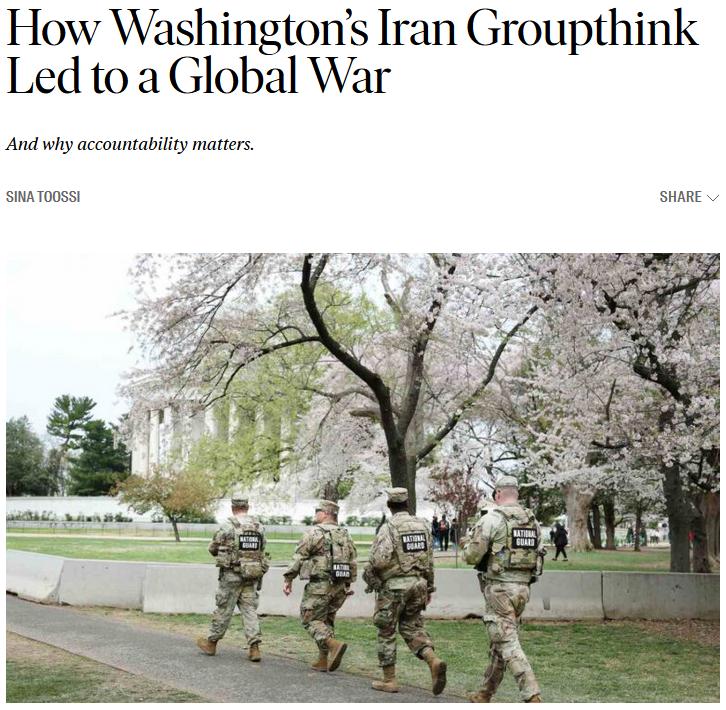
JJ: Here is my very heavily loaded first question: In your April piece for the Nation, before folks were even talking about the midterm elections, you started with, “The war now engulfing the Middle East is already making Americans less safe and less prosperous, yet it is exactly where Washington’s approach to Iran has led.” So I want to ask you to talk about that, but I want to add a little more, because the subhead to that piece, which was headlined “How Washington’s Iran Groupthink Led to Global War,” was “And why accountability matters.” So I just want to connect my “how we got here” question to the question of, what could accountability look like now?
ST: Yes. Well, in Washington, I’ve been working here for many years for advocacy organizations and in the “think tank” realm, basically these research organizations here that try to shape policy, and they come from all different parts of the political spectrum. We’ve long had the dominance of organizations, funders, donors, political groups, special interest groups that have been advocating for much more aggressive US foreign policies abroad. And we have this thing that we call the “foreign policy establishments,” basically the groups and pundits and analysts and government-adjacent folks who have played a leading role in shaping American foreign policy, who go inside government and then come outside of government and then go back inside government.
And for this foreign policy establishment, I mean, we’ve had many wars that they’ve advocated for, for many years now, and many wars that have turned out to be disastrous for American interests, I think however you define them, for our security interests, for the prosperity of the American people, the strength and resilience of the working class, the middle class.
And, nevertheless, you have many advocates of these more hawkish or pro-war or aggressive policies who haven’t been held accountable, whether that be in terms of just they failed upward, they’ve continued to get positions of influence in the government and in various institutions, they continue to be the dominant voices that we hear on the mainstream media.
We saw this play out with the Iraq War, with the “war on terror” that had all of these disastrous results and, nevertheless, these people, many of them are the same people who advocated for those wars and those conflicts who have been advocating for this Iran War.
Similarly, that’s why, in the article that you mentioned, I called it “groupthink,” because it really is groupthink. The dominant paradigm is an echo chamber of these people who think alike. There’s a lot of wishful thinking, there’s a lot of confirmation bias, and that led to this war that was really based on false assumptions.
I think about Iran, about, like you said, the Iranian people, the efficacy of military strikes, and was very predictable for those of us on the side that was more advocating diplomacy, deescalation. We’re not nearly as influential or powerful in Washington, but our voices were there; they weren’t listened to, and we saw that this war has become a predictable quagmire and disaster, and it’s had all of these economic costs for the American people, for the global economy.
And now Trump has paid the political price in these historic midterm elections, where it was directly connected to the war, I would argue, where it was a bread-and-butter issue. Americans are paying higher gas prices, higher diesel prices, the fertilizer issue for farmers and Kansas and elsewhere. These are all directly the result of what’s happening in the Middle East, Trump’s war of choice against Iran that had no coherent objective, that has led to disruptions in the Strait of Hormuz, this critical chokepoint in the international trading system, and has had all these economic costs for American families, and people want this war to end. I think that’s one of the main mandates that the American people are sending with this election.
The Nation (3/1/26)
JJ: Well, I’m not going to support JD Vance pretending that he was always opposed to it. It seems very like, “This polled badly and I want to be president,” and I think we can expect a lot of people to start saying they always were opposed to this war.
But in terms of those of us who are not in positions of power, we’re looking at news media to tell us what’s happening, what is going on, and I know that if we had a more complex rendering of Iranian society, which is what you’ve been talking about, that would change that perspective.
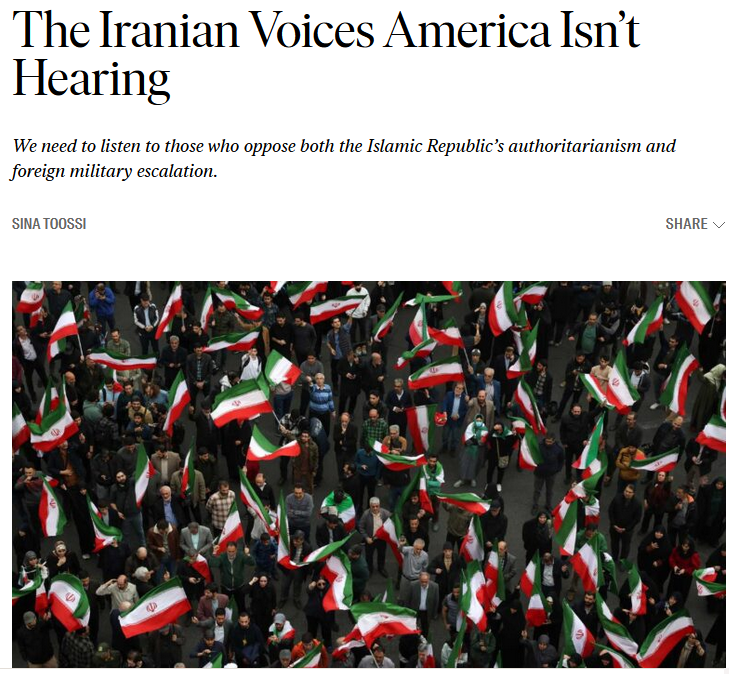
And so I just want to bring you back to a piece you wrote in March called “The Iranian Voices America Isn’t Hearing.” There’s a very crude depiction of Iran in the US press, and you were saying we have to listen to the complexity of Iranian society, including those who oppose both the Islamic Republic’s authoritarianism and foreign military escalations. How would that understanding change reporting, do you think?
ST: Yeah, I think that is critical. And you see that the more pro-war forces in our media, in the foreign policy establishment, in Washington, DC, people who are in government, they often, to justify their aggressive foreign policies, they will raise the plight of certain people abroad. Obviously it’s not uniform, and there’s a huge double standard, and it happens to align with their own cynical self-interest or their geopolitical interests.
So basically we’ve seen, time and again, whether in the Bush era or going back many decades, Vietnam, that people repress people in certain parts of the world where these forces have an interest, they are hailed as, “Oh, we need to save these people. We need to launch these wars to actually help these people.” And they will have people from those communities who are willing to be the face, to justify some of these aggressive foreign policies that, at the end, time and again, they don’t bring any benefit for the people who are targeted in these military campaigns, whether we see in Afghanistan, in Iraq, in Libya, in Syria.
I mean, this has played out time and again, where we will say, many people will try to justify these military campaigns in some pretty cynical terms of being for the liberation of certain people, when in reality it’s really material interest. And that’s long been the case with Iran, and we’ve seen that.
I mean, Iranian society is not monolithic, just like anywhere. It’s not black and white. The government there, this religious government that came to power after a revolution in 1979, they have been very repressive. They have engaged in very violent crackdowns during certain periods, including in January in the lead up to this war.
But that doesn’t mean that the vast majority of Iranians want to be bombed, do not want to be under these suffocating economic sanctions and blockades, just like we’ve done against Cuba as well, or against Venezuela before Maduro was captured.
Trump, actually, in a way himself, not necessarily all these foreign policy people around him, but Trump himself is much more brazen and naked with what he says he wants. He alluded, and he’s tried to play the card of, “Oh, the Iranian people, we’re going to save them” or whatever, but at the end of the day, he’s also like, “We want the oil. We’re going to take the Strait of Hormuz. We’re going to destroy Iranian civilization. We’re going to destroy their infrastructure. We’re going to have bridge day, power plant day,” all these things, all these threats he’s done.
We can’t forget that the opening blow of this war, on the Day One of February 28, the US actually launched a triple-tap military strike against an elementary school in southern Iran, killing over 160 schoolgirls, middle-school age, elementary school girls, that it was a triple-tap strike, that they hit it three times.
The investigations that have been done by outlets in the West and the US and Europe have really proven without a doubt that they should have known that that was a school, and there’s been investigations. The Trump administration has not been transparent, but that was just one of the many civilian costs of this war.
And there hasn’t been an uprising in Iran. The Iranian people have not risen up to topple their government. If anything, they rallied behind the flag, as happens in most countries, and pretty much all countries, when they come under foreign military attack, in defense of their country.
And so that’s how it’s really played out. So I think we have to, as Americans, be much more engaging in critical thinking when it comes to buying some of the narratives that these forces within our society, who want to get us entrapped in these quagmires and wars abroad, what their interests are, what all the interests at play are. We have to really engage in critical thinking to get to the bottom of what these military campaigns are all about.
JJ: Let me ask you quickly about worldviews, because when we talked to you years ago, I think it was 2019, we were talking about sanctions on Iran, you were saying that folks in Europe and others were trying to find ways to work around the US sanctions on Iran. There was kind of an understanding that the US is doing what it’s doing. Is there still a disconnect between, I will say, US/Israeli goals, and those of other countries? Is that dissonance still in play, and is that meaningful?
ST: Yes. Well, right now it’s certainly in play at this current juncture. I mean, nobody else wanted this war besides the US, meaning Donald Trump, and Israel, meaning Benjamin Netanyahu. They have wanted this war. Netanyahu has wanted it for decades, but Europe didn’t want this war. Other countries in the region, like Saudi Arabia, Qatar, other neighboring countries of Iran. Pakistan, for example, has been a mediator to end the war. Certainly China and Asian economies and other countries didn’t want it. And there’s a flurry of diplomatic activity, and there has been, to prevent further escalation.
But going back to 2019, this trend of escalating with Iran, and we really got on a war path with Iran going back to 2018, I would argue. When President Obama reached a nuclear deal with Iran in 2015, and that nuclear deal was widely hailed by people who are experts on nuclear issues, on preventing the spread and development of nuclear weapons, like scientists, experts who worked on these issues, they widely hailed it as being a very strong deal that prevented Iran from weaponizing its nuclear program.
And that deal was based on a compromise, as all diplomacy is, that we give and take. So Iran was to get sanctions relief in exchange for agreeing to these historically unprecedented restrictions on its nuclear program.
And it did that, and that deal was working. And that deal was being monitored by the International Atomic Energy Agency, which is a United Nations agency that is in charge of basically monitoring nuclear programs, and inspecting them and preventing them from being used to develop nuclear weapons. And so that deal was working. Even US intelligence agencies said it was working. Even the Israeli intelligence agency said it was working. Iran was abiding by all its limitations.
Nevertheless, Trump called it a terrible, historic bad deal, because basically Barack Obama negotiated it. He wanted to undo his legacy. He left that deal in 2018, and he pursued what he called the “maximum pressure campaign” that basically put us on the war path with Iran. He assassinated that Iranian general in 2020 in Iraq, which was a huge escalation. We had all these escalations with Iran that led inevitably, I would say, to in his second term continuing to escalate, and in lieu of that deal that was working, launching this regime change war—it really was regime change in its goals—and it’s become this predictable quagmire that many of us warned that it would be.
JJ: I just want to ask you a question about media, because we had so much conversation about how “nuclear program” for US news media, corporate news media, means “nuclear weapon,” right? And that’s an intentionally slippery thing. But we went through years of talk about inspections, and how it shows that enriched uranium doesn’t mean you’re making a bomb. And somehow we’d lost all of that context and all of that conversation in media’s current conversation, which is just so lamentable to me.
But back to right now, the New York Times is saying, “Yeah, we just striked Qeshm Island, but there’s a very good chance we could make a deal.” It stated matter-of-factly that American and Israeli officials have drawn up an expanded list of targets to strike, including energy infrastructure and other sites vital to the Iranian economy. I mean, we’re talking today, November 5. I know you can’t predict what’s going to happen, but what is media’s role, maybe, in what we understand about what’s going to happen?

Sina Toossi: “To say that Iran is the root of all these problems, and we had to go to these wars, and their nuclear program…was even weaponized, that’s categorically false.”
ST: Yeah. In general, I would say the mainstream media, [were] much like in the lead up to the Iraq War, sadly, I think in terms of really scrutinizing government claims, and distinguishing between government claims and what the reality of the situation is now, the Trump administration, Trump officials, Israeli officials, for their own interests, hyped this perceived threat of Iran. Not to say that there weren’t national security or security challenges in the Middle East from Iran, much like all these countries, and America has a role to play within all of that, but to say that Iran is the root of all these problems, and we had to go to these wars, and their nuclear program had developed nuclear weapons or was even weaponized, that’s categorically false, and no one who actually followed the nuclear program closely, or is involved in these kind of serious arms-control issues and nuclear non-proliferation debates about the Iranian nuclear program, we all know that.
The Iranians never weaponized their program. They, much like many countries, have developed a nuclear program that they say is for peaceful purposes, and they’re members of this thing called the Nuclear Non-Proliferation Treaty, which is an international treaty that actually allows countries that are part of it to benefit from peaceful nuclear technology, as long as they accept and not build nuclear weapons, and it actually obligates the nuclear weapons states to disarm. America and Russia and China are also part of this treaty, but they actually have not abided by their end of the deal to disarm the nuclear weapons.
Regardless, the whole debate over the Iranian nuclear program was it giving, ultimately, the capability to the Iranians to weaponize if they made the decision to do so, which they never did. So it was always poorly framed, and you see in many of the media articles, even in mainstream otherwise outlets that are known for being credible, that they’ll put “nuclear weapons program” instead of “nuclear program” or some way to allude, even though this is a critical distinction. And it’s just like we saw with Iraq, the Iraq War “weapons of mass destruction,” or these kind of things that have really been a pack of lies, that have misguided American people and manufactured consent for these terrible wars that haven’t benefited anyone.
JJ: Exactly. And I think more informed reporting, but also more communication from people in this country to people in another country. That’s something that news media finally, finally, something that news media could do would be to connect humans to humans.
ST: Absolutely. I think in the alternative media landscape, it is getting better and it’s healthier. You see much more independent outlets, whether on radio, on YouTube, other journalists online who are doing much more critical investigative reporting that is not necessarily within the same parameters that we’re usually seeing in more mainstream publications.
Not to say there aren’t plenty of very good journalists at mainstream publications. It’s just, the debates have largely been confined within official paradigms or worldviews that have been manipulated by special interest groups, that have basically been able to push their agendas without much scrutiny, I would argue.
JJ: I appreciate that, and our learning outside of official mainstream corporate outlets.
ST: Right.
JJ: We’ve been speaking with Sina Toossi. He’s a senior nonresident fellow at the Center for International Policy. His Substack newsletter is called Dissident Foreign Policy. Thank you so much, Sina Toossi, for joining us again this week on CounterSpin.
ST: Thank you. I really appreciate you having me.
From FAIR via This RSS Feed.