

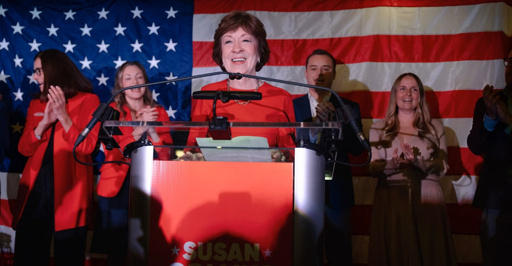
“Democrats…poured huge amounts of money into the campaign” to unseat Sen. Susan Collins, the New York Times (11/4/26) reported—not noting that Republicans spent 76% more on the race.
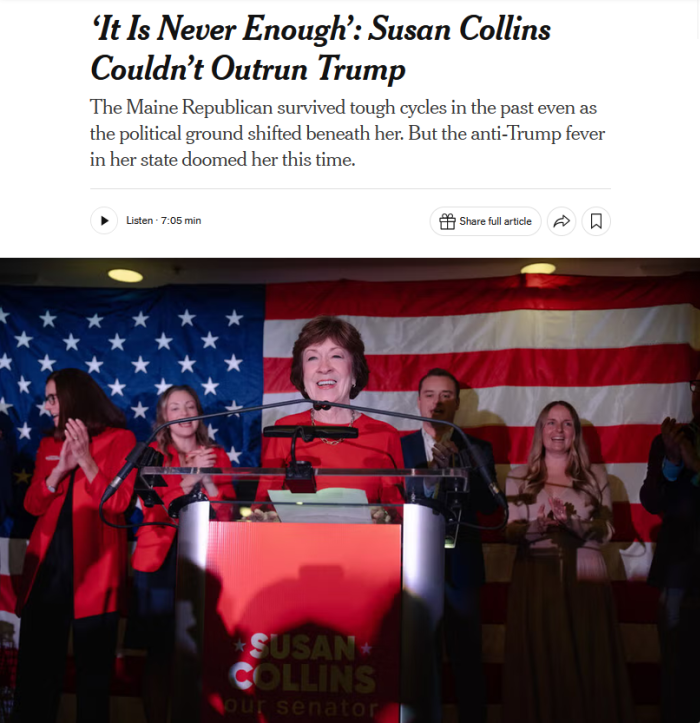
After long-serving Maine Sen. Susan Collins’ 6-point defeat to progressive challenger Troy Jackson, the New York Times (11/4/26) ran a panegyric to Collins that framed her defeat exactly the way she framed it herself: an unfortunate casualty of Trump’s unpopularity, rather than a repudiation of Collins’ own record. “‘It Is Never Enough’: Susan Collins Couldn’t Outrun Trump,” the headline declared, with the subhead arguing that “the anti-Trump fever in her state doomed her this time.”
Carl Hulse, chief Washington correspondent for the Times, introduced the piece with an anecdote from Collins about a woman who said she “absolutely loved” Collins, but wouldn’t vote for her because “it was the only way she could send a message to Trump.”
You’d think a journalist might be skeptical of getting voter sentiment directly from a candidate, but Hulse didn’t probe more deeply. Instead, he called the anecdote “the story of the election for Ms. Collins.” He followed with a quote from Collins that similarly acknowledged no failures of her own:
I was caught up in the Trump tsunami that swept away many incumbent Republican senators who have served their states well for many years and really care about our country.
It wasn’t just Collins’ words that painted that picture; Hulse wrote in his own voice that “Ms. Collins was brought down by a combination of factors, most of which were attributable to President Trump and the war with Iran.” Hulse listed some of those: fuel prices, tariffs and
an immigration crackdown that resulted in a fatal shooting by federal agents in one Maine community. And always the perception that she wasn’t doing enough to stand up to the president, even when she was one of the few Republicans to occasionally break with him.
“Everybody ignores the fact that I voted to convict him in the second impeachment trial,” Ms. Collins said. “What bigger break could there be? It is never enough. I want results and they want angry rhetoric.”
‘Some voters harbored resentment’
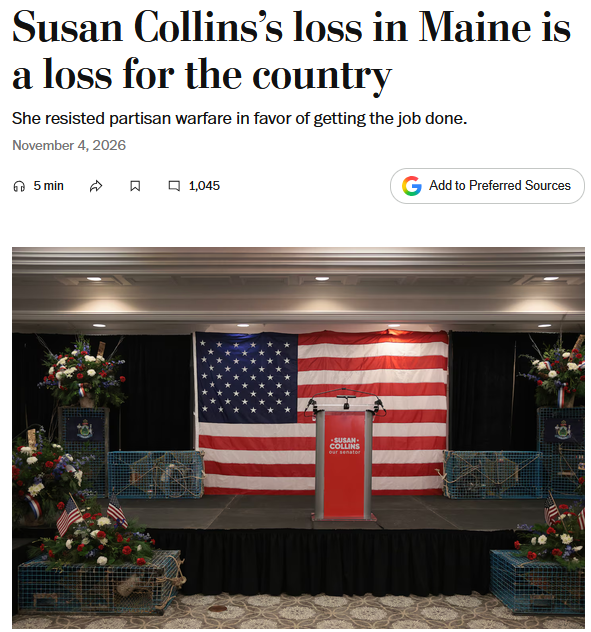
The Washington Post‘s Carine Hajjar (11/4/26) depicted Susan Collins as a politician who “resisted partisan warfare in favor of getting the job done.” If the “job” was overturning Roe and vastly expanding the US’s secret police force, that’s an accurate description.
Aside from Collins and her campaign manager—and the voter of Collins’ anecdote—Hulse only quoted two other people, both Maine voters who said they didn’t vote for Collins because of her support for Trump. “Susan Collins has voted with Trump on so many things,” explained one, while the other said, “I can’t support anybody that supports Trump.”
That’s apparently the closest Hulse could get to evidence supporting Collins’ argument, but really, those voters’ explanations are quite different from that of Collins’ apocryphal voter. They say nothing about loving Collins, and they don’t imply that their vote is not a judgment upon Collins herself; they’re talking about what she actually did as senator to support Trump.
Hulse lets Collins off the hook, scarcely looking at her actual “results.” He names the ICE crackdown and shooting as being only attributable to Trump. But Collins voted for Trump’s highly controversial $70 billion ICE budget, which lacked any sort of meaningful guardrails, at a time when Mainers already disapproved of ICE. When the agency killed a man in Maine shortly afterward, Maine voters blamed Collins not due to “anti-Trump fever,” but because she voted to give ICE carte blanche.
Maine voters also remembered her vote to acquit Trump in his first impeachment, and her role in helping advance Trump’s bill gutting Medicaid, even if she later voted against it. And, looming so large that even Hulse couldn’t ignore it, voters remembered Collins’ crucial support for Supreme Court nominee Brett Kavanaugh. (“Some voters harbored resentment” about that, Hulse allowed.)
Collins’ claim to independence and moderation stood in no small part on her pro-woman, pro-choice stance. Kavanaugh was credibly accused of sexual assault (and responded to those accusations in his hearing with a shocking display of partisan anger), and he wouldn’t give a straightforward answer about whether he would uphold Roe v. Wade (which, especially given his record, most took to mean he wouldn’t). Yet when Collins had the power to block him, she decided to give him a pass. To no one’s surprise—except Collins’, as she would later claim—Kavanaugh’s vote was instrumental in the 5–4 overturning of Roe.
‘Preservation of entrenched systems’
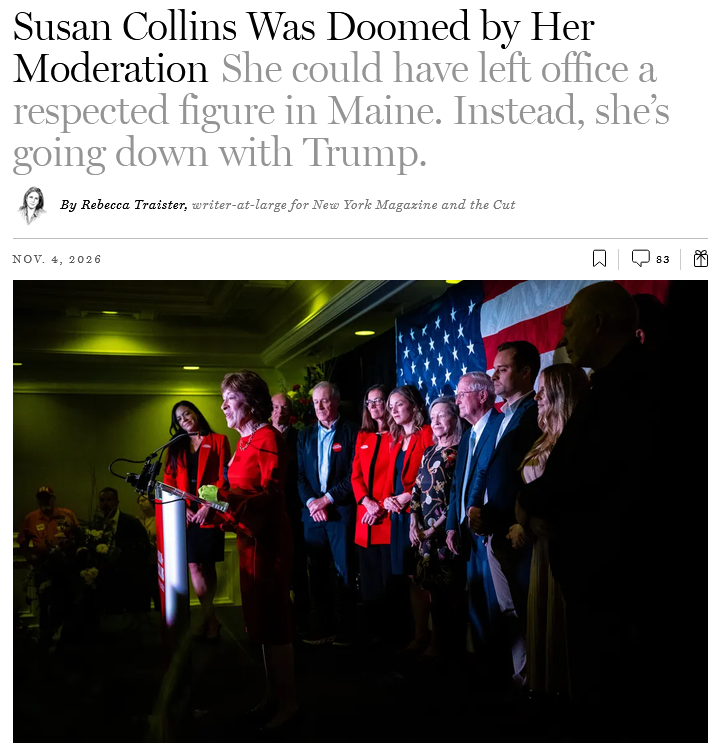
New York‘s Rebecca Traister (11/4/26) said Susan Collins’ defeat was a “rejection of purported moderation as some inherent political virtue”—but the New York Times hasn’t gotten the memo.
Journalists like Hulse regularly point out Collins’ supposed independence from the GOP, noting her second impeachment vote or that she at times breaks with her party—as if people are supposed to cheer for that. But, particularly in Trump’s second term, Collins has nearly always managed to defy Trump and the GOP only when her vote hasn’t made a difference. When asked by the moderator in a campaign debate to name a time that her vote against Trump and her party had significantly changed the outcome, she came up empty-handed.
Even Hulse’s colleagues at the New York Times (10/11/26) documented the ways Collins frequently maneuvered to maintain an image of independence while enabling Trump—for instance, refusing to block legislation in committee that she would then vote against on the floor of the Senate.
As Rebecca Traister pointed out in New York magazine (11/4/26), Collins is fundamentally a defender of compromise and institutional power. When one side is lurching toward authoritarian extremism, the center gets pulled to the right, and Collins and her compromises go right along with it, unmoored from any real political ideology beyond, as Traister put it, “the preservation of entrenched systems.” She sacrificed abortion rights. She sacrificed healthcare. And with her controversial vote for ICE funding, which legitimized and enabled extrajudicial killings and deportations, she sacrificed democracy itself.
Voters didn’t misperceive Collins, as Hulse suggests; rather, they saw through the false media portrayal of her.
From FAIR via This RSS Feed.
The NYT has never been a friend of the people, at least not in my lifetime.
They rarely act as the fourth estate and speak truth to power - their editorial team continually uses their power to instead further their own interests for selfish benefits. Susan Collins is exactly their kind of people.