

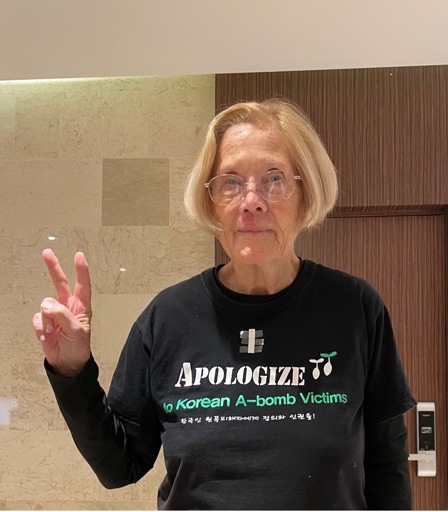

By U.S. Army Colonel (Retired) Ann Wright, World BEYOND War, November 14, 2026
First, an Apology from a United States Citizen
My name is Ann Wright. I served 29 years in the U.S. Army and retired as a Colonel. I was also a U.S. diplomat for 16 years. I resigned in 2003, 23 years ago in opposition to the Bush war on Iraq.
I was invited to share my reflections on the testimonies of the Korean victims of the U.S. Atomic Bombs for the International People’s Tribunal for the Korean Victims of the 1945 U.S. Atomic Bombings
First, as a U.S. Army Colonel (Ret) and a former U.S. diplomat and as a citizen of the United States, I want to give my deepest apology to the Korean victims of the U.S. atomic bombing of Hiroshima and Nagasaki on August 6 and 9, 1945. I am wearing a shirt that says “I apologize to the Korean victims of the Atomic Bombs.”
I have previously given in other conferences my apology to Japanese victims of the atomic bombs, but this is the first time I have been able to give my apologies to Korean victims and survivors and the victims as well as to the survivors of many other countries who were in both cities when the U.S. dropped the two atomic bombs on them in August 1945.
Today we were honored at the Tribunal with the remarkable presentation at the opening session with a reenactment of the difficult life of Kim Hyung-ryul, a second-generation Korean victim of the 1945 atomic bombings, who brought the issue of genetic transfer of radiation effects to the international arena.
 photo by Ann Wright
** **poster held by Father of Kim Hyeong Yul at the United Nations
Testimonies of Korean atomic bomb survivors

photo of Korean Survivors of Atomic Bombs. Photo by Ann Wright
Then later today, what we heard today from First-Generation Korean victims Jeong-sun Park, So-sa Jeon, Yun-gyu Park, Jin-tae Shim and Kee-youl Lee and from Second Generation victims Hyeong-yul Kim, represented by his family, and Jeong-sun Han underscored the horrific physical and emotional injuries of first and second generations that for decades went undiagnosed and untreated by the medical profession and largely ignored by the United States, Japanese and Korean governments.
The oral and written testimonies of Korean survivors of the atomic bombs and second-generation survivors are heartbreaking and demonstrate that the harm caused by the atomic bombings in 1945 is by no means an event confined to the past but has continued for 81 years.
The continuing reality of nuclear harm across generations also reveals the long-term and intergenerational consequences left by the use of nuclear weapons and the question of responsibility and accountability.
The Korean hibakusha, the Korean survivors of Hiroshima and Nagasaki, have campaigned for recognition, compensation and medical support for decades and to this day the response of the authorities has been inadequate.
The U.S. is Responsible for War Crimes: Atomic Bombs and Fire-Bombing of Japanese Cities
81 years after the dropping of the atomic bombs on Hiroshima and Nagasaki in August 1945, there is still a debate in the United States and other nuclear weapons countries concerning the ethical and legal justification for the bombings.
Supporters of the use of the atomic bombs, mainly in the government of the United States even 8 decades later, argue that the atomic bombings were necessary to bring an end to the war with Japan that would prevent a greater loss of life on both sides than an invasion of the Japanese mainland would have caused…
Critics of the use of the atomic bombs argue that the bombings were unnecessary for the war’s end and were a war crime, raising moral and ethical implications of specifically testing the bombs to determine their effects on the human body.
I firmly believe that the use of atomic weapons on those in Hiroshima and Nagasaki was a war crime.
The callous attitude of the government of the United States in dropping the atomic bombs to test their effects on humans was a war crime, as were the fire-bombings of Tokyo and 64 other cities in Japan. Over 100,000 persons were killed in one night in the U.S. firebombing of Tokyo.
The World War 2 Target Committee of the U.S. identified five cities that could be the targets of the atomic bombs, cities that were largely untouched during the nightly U.S. bombing raids on the major cities of Japan.
The Army Air Forces agreed to leave Hiroshima and Nagasaki off the fire-bombing target list so accurate assessment of the damage caused by the only by the atomic bombs could be made.
Top Secret Target Committee Minutes-Human Experiment with the Atomic Bombs Dropped in Japan
As recorded in the Top Secret “Minutes of the Second Meeting of the Target Committee
Los Alamos, May 10-11, 1945,” Hiroshima was described as “an important army depot and port of embarkation in the middle of an urban industrial area. It is a good radar target and it is such a size that a large part of the city could be extensively damaged. There are adjacent hills which are likely to produce a focusing effect which would considerably increase the blast damage. Due to rivers, it is not a good incendiary (fire-bombing) target.”
The U.S. military Target Committee stated that “It was agreed that psychological factors in the target selection were of great importance. Two aspects of this are (1) obtaining the greatest psychological effect against Japan and (2) making the initial use sufficiently spectacular for the importance of the weapon to be internationally recognized when publicity on it is released. … Hiroshima has the advantage of being such a size and with possible focusing of the explosion from nearby mountains that a large fraction of the city may be destroyed.”
Apology to All Victims of the U.S. Atomic Bombs
Again, as a U.S. citizen, I want to apologize to all the victims and the future generations of the U.S. atomic bomb victims who lived in Hiroshima and Nagasaki, Japan…the Japanese, Korean citizens and persons from many other countries who were in the two cities on August 6, 1945, as Japanese citizens, Korean laborers and prisoners of war.
I also want to apologize to all the Marshallese who endured the relentless U.S. testing of atomic and nuclear bombs in their island home.
Between 1946 and 1958, the United States conducted 67 nuclear tests in the Marshall Islands—23 at Bikini Atoll and 44 at Enewetak—releasing a combined explosive yield equivalent to more than 7,000 Hiroshima bombs and causing long‑lasting health, environmental, and cultural damage.
 poster in exhibit at Hanshin University for the People’s International Tribunal
And I make an apology to all those in the continental U.S. who were “downwind” of the nuclear testing in Nevada and New Mexico.
On July 16, 1945, the United States military conducted the world’s first test of an atom bomb in Alamogordo, New Mexico, code-named Trinity, this explosion created the world’s first victims of an atom bomb: residents of New Mexico.

poster in exhibit at Hanshin University for the People’s International Tribunal
From 1951 – 1962, the Nevada Test Site (NTS) was a primary site used for both surface and above-ground nuclear testing, with 100 tests at or above ground level, all of which involved releases of significant amounts of radioactive material into the atmosphere with “downwinder” communities exposed to radioactive contamination or nuclear fallout from atmospheric or underground nuclear weapons testing and nuclear accidents in Arizona, Nevada, New Mexico, Utah, Oregon, Washington and Idaho.
Atmospheric testing was halted in 1958 after a testing moratorium was agreed upon with the Soviet Union. 828 underground nuclear tests, including 24 joint U.S.-United Kingdom tests, were conducted at the Nevada Test Site between 1951 and 1992.
 poster in exhibit at Hanshin University for the People’s International Tribunal
And finally, I want to make an apology to all the people of the world who were affected by atomic and nuclear testing that the U.S. brought on… the nuclear weapons race that the Soviet Union, Great Britain, France joined with the U.S. in testing their nuclear weapons on primarily indigenous peoples of their empires and to the people of Russia, Kazakhstan, China, Pakistan, India and South Africa whose governments were caught up in the frenzy of nuclear bomb acquisition and testing, as well as Israel that has never admitted that it has tested nuclear weapons.

graphic by Redbubble.com
In these dangerous times with the U.S.-Israeli attacks on Iran, with the Russia-Ukraine war, with the Middle East confrontations and the U.S. drums of war with China, we as citizens of the world must continue to stand firm in our work to prevent our nations from ever using atomic/nuclear weapons again.
World BEYOND War’s David Swanson’s excellent description of the first day of the Tribunal.
About the Author: Ann Wright was in the U.S. Army/Army Reserves for 29 years and retired as a Colonel. She was also a U.S. diplomat and served in U.S. Embassies in Nicaragua, Grenada, Somalia, Uzbekistan, Kyrgyzstan, Sierra Leone, Micronesia, Afghanistan and Mongolia. She resigned from the U.S. government in March 2003 in opposition to the U.S. war on Iraq. She is a member of Veterans For Peace, Hawai’i Peace and Justice, CODEPINK: Women for Peace, International Peace Bureau, World Beyond War, and the Pacific Peace Network among many other organizations.
The post Reflections on Testimonies of Korean Victims of the U.S. Atomic Bombs for the International People’s Tribunal for the Victims of the 1945 U.S. Atomic Bombings appeared first on World BEYOND War.
From World BEYOND War via This RSS Feed.