

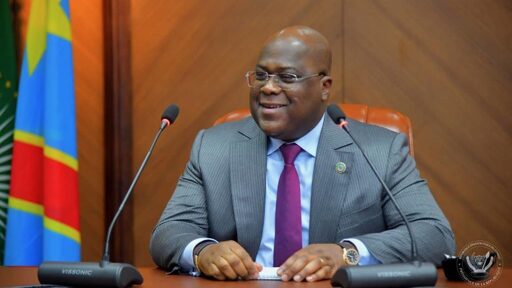

Democratic Republic of Congo (DRC) President Félix Tshisekedi has promulgated a controversial law establishing the conditions for holding referendums. Opposition parties, civil society groups and grassroots movements have previously said it could allow him to seek a third term. The signing follows more than five months of protests, court challenges, and street mobilization against the law.
The promulgation was announced on national television late on Tuesday, November 10. “The President of the Republic, Félix-Antoine Tshisekedi Tshilombo, promulgated, on November 10, 2026, through an ordinance, the law setting the conditions for the organization of the referendum in the Democratic Republic of Congo,” state broadcaster RTNC reported.
Roger Kalenga, Deputy Spokesperson for the Head of State, read excerpts of the new legislation on air: “Law No. 26/045 of November 9, 2026, establishing the conditions for organizing referendums in the DRC. … The National Assembly and the Senate have adopted, and the President of the Republic promulgates, the following law: Chapter One, Purpose and Scope. Article One: This law establishes the rules relating to the purpose, procedure, initiation, and convening of referendums, as well as related offenses.”
The bill went through parliament, where Tshisekedi’s coalition holds a large majority, first passed it in June while opposition members stayed away. The Senate vote was 89 in favor, none against, with 20 senators not taking part.
In July the Constitutional Court ruled the law constitutional, subject to interpretive reservations on thirteen provisions. On August 10, Tshisekedi sent the text back to parliament for a new deliberation, which re-adopted it in October.
Read more: Push for referendum in DR Congo sparks protests over possible Tshisekedi third term
The opposition opposes the referendum
The law has met resistance at every stage. In May, the main opposition parties, formed Coalition Article 64 (C64) named after Article 64 of the constitution, which obliges every Congolese to oppose anyone who seizes power by force or exercises it in violation of the constitution.
In mid-June, days before the Senate vote, opposition parties and civil society groups marched in Kinshasa against the bill. Police and security forces dispersed protesters with tear gas. Several people were injured. With opposition figures accusing the authorities of suppressing peaceful protest and violating citizens’ constitutional rights.
Read more: Several arrested in protests against constitutional changes in DRC
Protests rocked the country again on September 15, when C64 called a nationwide day of action. In Kinshasa, hundreds gathered before the march was disrupted by clashes with members of the Force du Progrès, a group affiliated with Tshisekedi’s UDPS party. Police fired tear gas and warning shots, and at least 10 people were arrested in Kinshasa.
Constitutional limits and Tshisekedi’s third-term ambitions
Tshisekedi, who first assumed office in January 2019 following the December 2018 elections, was re-elected in December 2023 for a second five-year term. Under the current constitution, his mandate is due to end in 2028.
The current constitution limits the president to two five-year terms; However, the proposed constitutional changes have raised questions about whether a new constitution could be used to circumvent these protections.
Tshisekedi has previously defended the possibility of constitutional reform and indicated his willingness to remain in office beyond 2028. In May 2026, he said he had not sought a third term but would accept one if the Congolese people wanted him to continue governing.
The new referendum law therefore represents an important development in the dispute. Although it does not automatically remove presidential term limits or guarantee a third-term bid, it provides a legal framework for holding referendums on constitutional matters, including the adoption of a new Constitution.
With the legislation now in force, opposition parties and civil society organisations face a renewed challenge in their campaign to defend the existing constitutional order.
From BT News via This RSS Feed.