

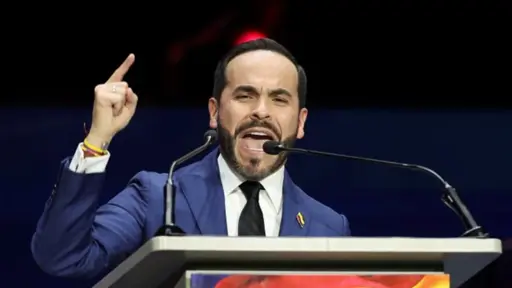
This Friday marks the first 100 days of Abelardo de la Espriella’s administration, a period defined by an approval rating below 50%, mounting social unrest, and intense political debate surrounding his tax reforms, security policy, and economic management.
RELATED:
Colombia’s Historic Pact Calls November 19 Protest Over Tax Reform
The “Polimétrica” survey, conducted by the firm Cifras y Conceptos, places the leader’s favorability rating below 50%. The study indicates that none of the 16 government actions evaluated reached that approval threshold.
Based on more than 2,600 in-person interviews, the survey shows the president holding one of the lowest levels of support seen at the start of any administration in the last sixteen years.
Given this landscape, the president faces one of the lowest approval ratings in sixteen years. He must now contend with this decline on the streets, as calls grow for a major national strike in response to his tax reforms, rising inflation, and unemployment.
The survey reveals significant regional variations. Cúcuta, Medellín, Barranquilla, and Bucaramanga show more favorable figures, while the lowest approval levels are found in Ibagué, Cali, Pereira, and Bogotá.
Security and Military Operations
Regarding security, Abelardo de la Espriella has taken a central role in the seven bombing operations carried out under his administration to date. In an unprecedented move in Colombian history, the president has even recorded himself using a two-way radio to issue orders for these operations.
¡AUTORICÉ UN BOMBARDEO CONTRA LOS NARCOTERRORISTAS DE LA ESTRUCTURA 33 DE LA FACCIÓN DE CALARCÁ! ¡EN COLOMBIA LA AUTORIDAD SE RESPETA!
En una contundente operación militar que autoricé en zona rural de Tibú, Norte de Santander, nuestro Ejército Nacional y la Fuerza Aérea… pic.twitter.com/pgIKxeqTdu
— Abelardo De La Espriella (@ABDELAESPRIELLA) November 9, 2026
The text reads, “I authorized a bombing strike against the narco-terrorists of “Structure 33,” part of the Calarcá faction! In Colombia, authority must be respected! In a decisive military operation that I authorized in a rural area of Tibú, Norte de Santander, our National Army and the Colombian Air Force struck this criminal organization—a group that seeks to sow terror and seize control of the Catatumbo region through bloodshed and fire.”
Appearing in military uniform—with a pistol at his belt and a walkie-talkie in his hand—President Abelardo de la Espriella accompanies security forces during these operations. The alleged criminals, now in handcuffs, are left speechless. Colombia’s new “Ranger” mocks them, then sends them off to prison with one of his signature catchphrases: “Welcome to the ‘Miracle Homeland.’”
The new court ruling orders the government to verify available intelligence, more carefully assess the actual risk to minors, consider whether any operational alternatives exist, and “evaluate less harmful operational alternatives, while conducting a specific assessment of proportionality.”
Both the Minister of Defense and the President have defended these operations, arguing that “the recruitment and use of minors in the conflict constitutes a war crime and a grave violation of International Humanitarian Law. The responsibility of the narco-terrorist armed groups is clear,” stated Defense Minister Mora.
Bogotá’s 34th Family Court has lifted an injunction that had previously required the government to refrain from carrying out operations against targets whenever there were “reasonably verifiable” indications that children or adolescents—recruited or used by illegal armed groups—might be present.
The judicial decision mandates that the government verify available intelligence, more carefully assess the actual risk to minors, and consider “less harmful operational alternatives,” in addition to performing a specific assessment of proportionality.
This ruling comes amid criticism regarding the country’s militarization and the termination of the so-called “peace talks” that had been promoted during the previous administration. This stance is part of the De la Espriella government’s alignment with the White House’s strategy—a revival of “Plan Colombia” to serve its own expansionist agenda.
🇨🇴 El presidente de Colombia, Abelardo De la Espriella militarizó Cúcuta ante la creciente ola de violencia. Es la segunda ciudad en menos de dos meses.#teleSUR #Colombia #30Oct pic.twitter.com/mvQ5sXfFxb
— teleSUR TV (@teleSURtv) October 30, 2026
The text reads, “Colombian President Abelardo De la Espriella militarized Cúcuta in response to a growing wave of violence. It is the second city [to undergo this] in less than two months.”
Meanwhile, the Historic Pact (in spanish Pacto Histórico) has failed to gain the visibility or political leadership necessary to challenge the government, while former President Gustavo Petro is currently occupied addressing allegations made against him regarding his private life.
Former President Álvaro Uribe has questioned several key initiatives from the administration of Abelardo de la Espriella during its first 100 days—particularly regarding economic policy—while also navigating ongoing tensions concerning the legislative agenda and his own party, the Democratic Center (Centro Democrático).
Tax Reform and Fiscal Adjustment
In terms of the budget, the proposed figure stands at 634.9 trillion pesos—89 trillion pesos more than the 2026 budget. However, due to a bureaucratic error by the Ministry of Finance, De la Espriella introduced what the government calls the “Economic Rescue Law.” This legislation breaks several of the current president’s campaign promises—specifically, the pledge not to raise taxes in general (including the Value Added Tax, or VAT)—while the president himself has remained absent from the debate thus far.
The proposal mandates significant cuts to public spending, granting De la Espriella extraordinary powers to downsize the state apparatus via presidential decree. Simultaneously, it includes a tax reform with several highly unpopular measures, such as increased VAT on gasoline, coffee, grains, and fruits and vegetables.
According to the explanatory memorandum, the law aims to recover 3.58% of GDP by 2028 and 4.09% by 2030, through cuts and new levies.
Article 7 grants the president extraordinary powers for six months to “abolish, merge, or split ministries and administrative departments, as well as to determine or modify their names, objectives, and organizational structure.” It also authorizes the president to “abolish, merge, split, or change the legal status” of superintendencies, agencies, special administrative units, and public institutions.
The law consists of 106 articles and aims—through a combination of spending cuts and new taxes—to recover 3.58% of GDP by 2028 and 4.09% by 2030, according to the explanatory memorandum. It hits the middle class—a key demographic in De la Espriella’s victory—while providing relief to businesses regarding income tax; meanwhile, it affects the wealthy by lowering the threshold for the wealth tax and increases the cost of formal employment.
Earthquake Emergency
On August 10, three days after De la Espriella took office, a 7.4-magnitude earthquake struck, with its epicenter in the Chocó region. The disaster resulted in 335 deaths and over a thousand injuries.
The government declared a national disaster, a measure that allows for the issuance of circulars and resolutions to facilitate immediate response efforts, including expedited direct contracting. This declaration can remain in effect for up to 12 months and may be extended.
Within the National Disaster Management Committee, the president ordered his cabinet to deploy to the affected areas—amidst reports criticizing the slow pace of rescue and reconstruction efforts, as well as a lack of transparency in the handling of donations.
🚨 ¡A LAS CALLES CONTRA EL PAQUETAZO!: PACTO HISTÓRICO SE SUMA AL PARO NACIONAL DEL 19 DE NOVIEMBRE CONTRA EL GOBIERNO DE DE LA ESPRIELLA
La bancada del Pacto Histórico convocó a trabajadores, estudiantes, campesinos y pequeños empresarios a marchar este 19 de noviembre contra… pic.twitter.com/3cFTWocxvW
— La Voz del Pueblo (@lavozdepueblo1) November 13, 2026
Economic Projections
The Economic Commission for Latin America and the Caribbean (ECLAC) projects that Colombia’s Gross Domestic Product (GDP) will grow by 2.6% in 2026, remaining above the Latin American average (2.2%). Comparing the figures presented by ECLAC in its reports—with data as of November 2025 and July 2026—reveals an adjustment from an initial 2.7% to 2.6% for 2026.
This is primarily due to an international environment characterized by persistent geopolitical tensions in strategic markets and tightening global financial conditions, which leads to fluctuations in freight transport costs and constrains external demand for the nation’s exports.
The 2.5% growth projection for Colombia in 2027 matches the average calculated for the South American subregion and exceeds the overall average for Latin America—estimated at 2.4%—by 0.1%, according to the report.
The Historic Pact announced it will fight the government’s tax reform in Congress and urged citizens to demonstrate on November 19 against the measure.
The progressive organization released the call in a statement from Bogotá, framing the bill as an “assault on working… pic.twitter.com/KqnutNbtPo
— teleSUR English (@telesurenglish) November 12, 2026
From teleSUR English via This RSS Feed.