

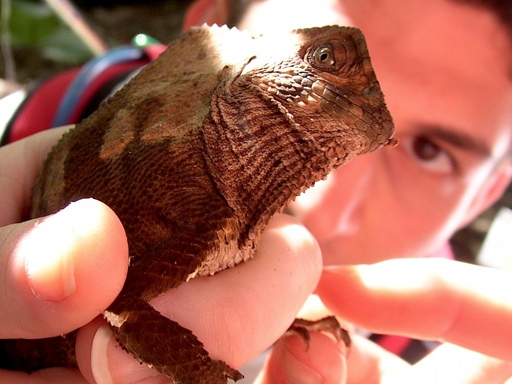
Leading a group of ecology students down a trail through the forest behind Merrimack College, in North Andover, Massachusetts, U.S., where I teach biology part-time as an adjunct professor, I spot a garter snake. As it rapidly starts crawling away, I grab the snake by its tail. Excited students gather round to check out the foot-long striped serpent, while taking photos with their cell phones. I tell them a bit about garter snakes and ask if anyone wants to hold it. “I do!” one of the students says. I gently hand her the snake. “That’s really cool. I’ve never held a snake before,” she says, before handing it to another eager student. Then we turn the snake loose and continue on our way. Merrimack College biology students with a garter snake found during an ecology lab on campus, North Andover, MA, September 2025. Image courtesy of Don Lyman. Since I began at Merrimack in 1997, I’ve taught mainly ecology labs. Most of the ecology lab sessions are outdoors, so they’re like weekly field trips. They give students the opportunity to step outside of laboratories and classrooms and interact with nature. Field courses provide the same opportunity for teachers. When I head off into the woods with students in tow, I’m in my element. Whether I’m diving into the bushes and scrambling on my hands and knees to catch a snake or a frog to show the class, pointing out a hawk circling overhead, or teaching students how to identify various…This article was originally published on Mongabay
From Conservation news via This RSS Feed.