

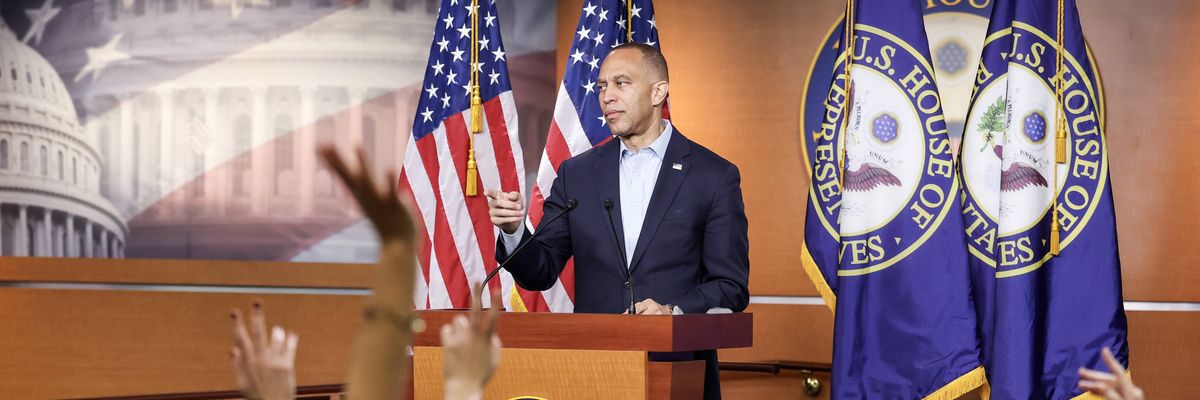
Democratic Rep. Hakeem Jeffries sidestepped a reporter’s questions about a controversial proposal to more closely integrate the US and Israeli militaries on Thursday, underscoring some critics’ argument that he’s unfit to serve as House speaker when Democrats retake the chamber in January.
Democrats in the US Congress are facing growing calls to strip out provisions in the 2027 National Defense Authorization Act (NDAA) that would significantly expand cooperation between the US and Israeli defense industries, making it easier for the two countries to jointly develop weapons, share military technology, and incorporate Israeli tech into US military systems.
One poll from August by Data for Progress showed that 61% of likely voters opposed the measure, known as the “United States-Israel Defense Technology Cooperation Initiative,” including 78% of Democrats—a reflection of the public’s growing desire for the US to cut ties with Israel following over three years of genocidal attacks on Gaza, expansionist conquest in the West Bank and Lebanon, and military aggression against Iran.
Sen. Chris Van Hollen (D-Md.), who is challenging Senate Minority Leader Chuck Schumer (D-NY) to lead the Democrats’ Senate majority, said earlier this week that Democrats should oppose the military integration provisions. He and his colleagues warned that these provisions would give Israel even greater leverage over US policy and threaten national security by granting Israel access to sensitive information about US military technology beyond what is shared even with NATO allies.
The NDAA is expected to come up for a vote next month. But it will need Democratic support to pass the Senate, where 60 votes are required to break the filibuster. It may also face obstacles in the House, where Republicans hold a narrow 218-214 majority. Some in the GOP, like Reps. Thomas Massie (Ky.), Lauren Boebert (Colo.), and Anna Paulina Luna (Fla.), have already signaled opposition to the measure, meaning that a united Democratic caucus could kill it.
Asked by The Hill’s Laura Kelly at a news conference on Thursday whether he agreed with Van Hollen’s call to remove the provisions from the NDAA, Jeffries never answered her question directly:
I haven’t had a conversation with Sen. Van Hollen, but what I have said is that things have to dramatically change over in the Middle East.
We need dramatic change in the West Bank, which is why I strongly support the West Bank Violence Protection Act. We need dramatic change in Gaza, and we need dramatic change with respect to the memorandum of understanding as it winds down, all of which I’ve previously said publicly.
And we’ll work as a caucus to make sure that we can bring about the just and lasting peace that Israelis and Palestinians deserve over in the Middle East.
The status quo is unacceptable, and we need dramatic change. And that looks like, as far as I’m concerned, making sure you have a safe and secure Israel, living side by side as a Jewish and democratic state with an independent Palestinian state that provides dignity and self-determination for the Palestinian people.
Jeffries, who has received more than $1 million in campaign donations facilitated by the American Israel Public Affairs Committee (AIPAC) since 2022, is already facing criticism over his refusal earlier this week to commit to using next month’s government funding bill to force President Donald Trump to end his war in Iran and for failing to ensure the whole Democratic caucus was present for a key vote to advance the impeachment of Defense Secretary Pete Hegseth.
Trita Parsi, the executive vice president of the Quincy Institute for Responsible Statecraft, said that with his noncommittal answer on US-Israeli military integration, Jeffries had “in less than 90 seconds” made it “crystal clear why he should not become the next speaker of the House.”
“Asked whether he supports removing provisions that deepen US defense cooperation and intelligence sharing with Israel from the National Defense Authorization Act—an obvious yes!—he refuses to address the question and instead gives a 1990s answer about a mythological two-state solution,” Parsi wrote on social media.
In the Senate, momentum is building behind Van Hollen’s effort to oust Schumer as leader. On Wednesday, Sen. Bernie Sanders (I-Vt.) said that Schumer, another staunch ally of Israel, was “way out of touch with where the American people are at.”
Several incoming Democratic senators, including Abdul El-Sayed (Mich.), Peggy Flanagan (Minn.), Troy Jackson (Maine), Adam Hamilton (Kan.), and Juliana Stratton (Ill.), have said they support Van Hollen or won’t back Schumer, while others, including Democratic Sens.-elect Annie Andrews (SC) and Chris Pappas (NH), as well as the centrist Sen. Elissa Slotkin (D-Mich.), have suggested they wanted new leadership.
However, despite growing calls from the Democratic base for new leadership in the House as well, no Democrat has formally stepped up yet to challenge Jeffries’ claim to the speaker’s gavel.
Some newly elected Democrats—like Reps.-elect Melat Kiros (Colo.), Don Leonard (Ohio), and Claire Valdez (NY)—have suggested they would prefer a different leader, but House progressive leaders have so far put the kibosh on an insurgency, with Reps. Alexandria Ocasio-Cortez (NY), Pramila Jayapal (Wash.), and Greg Casar (Texas) standing by Jeffries, at least as long as he’s the only choice.
Time is running out for progressives to rally behind an alternative to Jeffries. The Democratic caucus will begin its internal leadership elections on November 18 and choose its nominee for speaker. The entire House will vote to elect a speaker when the new Congress convenes on January 3, 2027.
Some grassroots organizers have pushed for progressive Rep. Ayanna Pressley (D-Mass.) to challenge Jeffries, with one petition to draft her garnering over 90,000 signatures.
She has circulated her own petition pushing for a bolder agenda for Democrats to pursue in the next Congress, including passage of Medicare for All, national abortion protections, restrictions on data centers, and the abolition of US Immigration and Customs Enforcement.
In a speech on the House floor Thursday, she declared that “incrementalism is a recipe for failure” and that Democrats “cannot let money and the special interests dictate our fight.”
No one in the House Democratic caucus has publicly declared support for Pressley. But there is reportedly some movement behind the scenes ahead of Wednesday’s caucus meeting, where a nominee for party leader will be chosen.
One lawmaker, granted anonymity by Drop Site News congressional reporter Julian Andreone, said, "I am hearing that many progressives will be writing Ayanna’s name in.”
From Common Dreams via This RSS Feed.