

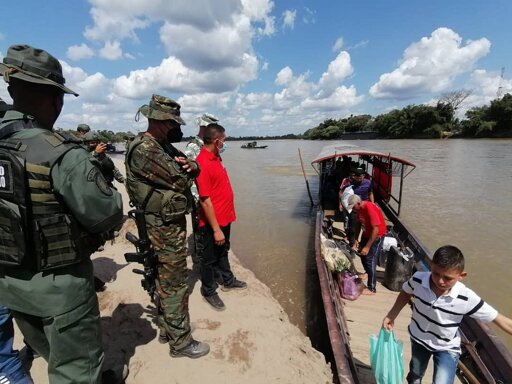
Caracas (OrinocoTribune.com)—On Thursday, November 12, Venezuela informed that it was ready to coordinate security measures with Colombia through existing bilateral channels, while the Bolivarian National Armed Force (FANB) announced a deployment in the border state of Apure.
In a communiqué published by the Foreign Ministry, Venezuela offered to exchange information and coordinate any necessary actions with Colombian authorities under existing bilateral protocols. The statement reaffirmed Venezuela’s commitment to border and regional security, the fight against transnational organized crime, and cooperation based on mutual respect, national sovereignty, and shared responsibility for peace and stability.
The communiqué did not refer to a recently reported strike on an alleged ELN camp in Apure and did not confirm any operation involving Colombia or the United States.
FANB announces Apure operationAlso on Thursday, ZODI No. 31 Apure announced the deployment of forces and equipment under the operation “Sovereignty and Peace.” According to the FANB announcement reported by Radio Nacional de Venezuela, the operation targets logistics camps, clandestine airstrips, and laboratories used by paramilitary and other irregular groups, many of Colombian origin, as well as drug-trafficking and illegal mining networks.
The deployment is being carried out under the Strategic Operational Command of the FANB (Ceofanb) coordination and in accordance with government directives. The force said its patrols would cover Apure’s river, forest, and land terrain along the border with the Colombian departments of Arauca and Vichada.
The stated objectives include disrupting illegal trafficking corridors and confronting drug trafficking, smuggling, illicit fuel trafficking, extortion, kidnapping, and cattle rustling. Venezuelan authorities have repeatedly reported operations against Colombian paramilitary and other armed groups along the border.
Colombia’s militarized escalationThe deployment comes amid escalating violence in Colombia and the border region. Orinoco Tribune has reported that President Abelardo de la Espriella ordered more military and police operations, continued bombings of armed groups, and a resumption of aerial fumigation of illicit crops. His announcement followed attacks that killed at least five people and wounded several others in three departments.
De la Espriella’s return to bombing and aerial spraying revives the militarized logic of Plan Colombia, a US-backed strategy that, according to experts, did not resolve Colombia’s conflict and left rural and border communities exposed to further violence.
Analysts claim that this turn is a direct driver of the current spiral of violence: the Colombian far-right administration is expanding the same militarized methods that have repeatedly failed to bring peace. The US military, with its long record of intervention and counterinsurgency in Latin America, is not an impartial actor in this history, they note.
Apure bombing claims remain unverifiedOn October 31, far-right-aligned NGO Fundaredes and activist Rocío San Miguel reported an alleged Venezuelan military bombing in Apure, claiming that the target was an ELN camp. As Orinoco Tribune reported at the time, the material they circulated did not independently establish the identities of those killed or confirm that the site belonged to the ELN. Venezuelan and Colombian authorities had not publicly confirmed the alleged operation.
The accounts of who, where and how the reported strike was carried have since shifted. The New York Times, citing four unnamed US officials, reported that the United States supplied intelligence and drones for a Venezuelan military attack. Other reporting suggested Colombian participation, although Colombian defense officials denied any role, according to Latin America Daily Briefing’s review of the reports.
More recently, Fundaredes Apure coordinator Juan Francisco García Escalona claimed that US forces carried out the strike alone, according to CounterVortex’s account of the competing claims. These accounts rely on anonymous officials or statements by people connected to the far-right organization that first publicized the allegation; they are not independent confirmation of the target, the victims’ identities, or the forces responsible.
The sources of the claims also warrant scrutiny. In a recent Union Radio 15-minute interview with Rocío San Miguel, host Román Lozinski described the alleged action as a joint operation by the FANB and the United States. San Miguel replied that US participation had not been confirmed, while adding that she thought it would be involved. She offered no coordinates, names of victims, or evidence in the interview to substantiate the allegation. Orinoco Tribune highlighted this gap after San Miguel had spent days promoting the story, as a source of skepticism.
The communiquéThe unofficial English translation of the communiqué follows.
Communiqué**The Bolivarian Republic of Venezuela expresses its full willingness to carry out all necessary coordination with the authorities of the Republic of Colombia on security matters.
To this end, the existing cooperation mechanisms, institutional channels, and bilateral contacts are available to facilitate the exchange of information and the coordination of any actions that may be necessary, in accordance with the existing protocols between the two nations.
Venezuela reaffirms its commitment to border and regional security, the fight against transnational organized crime, and the strengthening of bilateral cooperation, on the basis of mutual respect, national sovereignty, and shared responsibility for preserving peace and stability in the region.
Caracas, November 12, 2026.
This is an unofficial English translation of the communiqué.
Special for Orinoco Tribune by staff
OT/JRE/JRE
From Orinoco Tribune via This RSS Feed.