

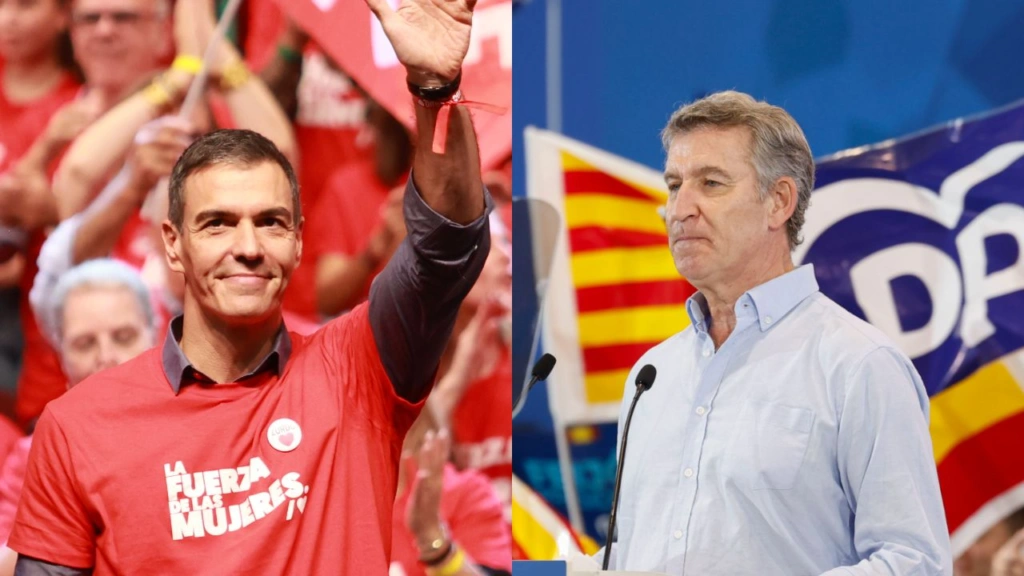
The final stretch of the election campaign for Spain’s general election—leading up to the vote on November 29—officially began this Friday, November 13. Spanish voters will determine the 350 seats in the Congress of Deputies; an absolute majority requires 176 seats.
RELATED:
Lula to Meet Sánchez in Madrid Ahead of Spain Election
The election, originally scheduled for next year, was called early by Prime Minister Pedro Sánchez following a parliamentary deadlock over two housing-related decrees, as well as public outcry surrounding the “Maricarmen case”—an elderly woman who passed away days after being evicted.
Social unrest regarding the right to housing led to encampments across the country, culminating in a general strike on Wednesday, November 11—a day marked by massive demonstrations and police interventions.
Prime Minister and Socialist candidate for reelection, Pedro Sánchez, chose Seville to launch the PSOE’s campaign before a crowd of approximately 4,000 people. For the first time at a rally, he was accompanied by his wife, Begoña Gómez, who wore a red T-shirt bearing the slogan “the strength of women.”
Sánchez urged progressive voters to turn out in record numbers to achieve an epic comeback that would allow him to govern for another four years. He highlighted housing and the defense of public services as the pillars of his platform, contrasting his administration’s approach with that of the regional governments led by the People’s Party (PP).
🚨🇪🇸 THE ELECTION CAMPAIGN BEGINS IN SPAIN, with polls pointing to a major defeat for PM Sánchez
This is how the governing party has kicked off its campaign in Seville: pic.twitter.com/qx68WyOYu8
— The European Horizon (@europeanhorizon) November 13, 2026
The Socialist leader took aim at the PP and Vox, describing them not as a viable alternative, but as a regression—likening them to figures such as Trump, Bolsonaro, or Milei. He asserted that on November 29, a progressive Spain would once again defeat this regression at the ballot box.
Alberto Núñez Feijóo, leader of the People’s Party (PP), symbolically launched his campaign in Barcelona, supported by the city’s mayor. He presented himself as an administrator capable of resolving the problems that had accumulated over eight years of Socialist rule, focusing his discourse on public safety, immigration, and housing.
Feijóo warned that, should he reach La Moncloa (the seat of the Spanish government), he would initiate an audit of the “plunder” to clarify “where every euro has gone and who took it.”
Meanwhile, Vox leader Santiago Abascal launched his campaign in Huesca, emphasizing the concept of national priority as it applies to access to housing, healthcare, and education. His primary objective is to oust Sánchez from the executive branch.
Abascal expressed his wish for the Civil Guard’s Central Operational Unit (UCO) to bring the Prime Minister before the courts. The Vox platform includes the deportation of migrants in an irregular situation, a ban on renting housing to them, the eviction of illegal squatters within 24 hours, a prohibition on the burqa or niqab in public spaces, and the repeal of gender-related laws.
Regarding his immigration policy, Abascal maintained that it is “not hatred toward foreigners, but rather “love for one’s own people” and “common sense.”
Following the dissolution of Sumar, 15 political groups joined the new coalition, “Broad Front” (in spanish Frente Amplio), led by former Barcelona mayor and anti-eviction activist Ada Colau. Podemos, for its part, is running separately, with Irene Montero as its lead candidate.
La campaña arranca con la derecha en el horizonte de los 190 escaños. El primero de los ‘trackings’ diarios de 40dB. para EL PAÍS y la SER confirma la fortaleza de Vox, cuyo líder compite en popularidad con el del PP https://t.co/wNvHf0DLqH
— EL PAÍS (@el_pais) November 13, 2026
The text reads, “The campaign kicks off with the right-wing within reach of 190 seats. The first of the daily tracking polls by 40dB. for EL PAÍS and SER confirms the strength of Vox, whose leader rivals the leader of the PP in popularity.”
Both candidates held their campaign launch events in Madrid, with the housing crisis as a central priority. “Frente Amplio” used the slogan “A vote as solid as a home,” while Podemos chose “Peace, a home, and work.”
Colau expressed her willingness to form a coalition government with the PSOE, though she warned Sánchez that “simply holding on” is not enough; she demanded a “change to the rules of the game” to combat inequality. Montero appealed for a “useful vote” to curb the far right and proposed intervening in the market to lower rents, banning real estate speculation, and reforming the judicial system to require judges to disclose their assets.
The campaign will run for 15 days, until midnight on Friday, November 27, followed by a “day of reflection” on Saturday, November 28, and the vote on Sunday, November 29.
Spain’s general election campaign has begun, but rallies and traditional poster-posting are being overshadowed by a November 11 general strike, the first in 14 years and the first to coincide with a campaign.
UGT, CCOO and housing groups say the walkout defends housing and… pic.twitter.com/CrMf9342RN
— teleSUR English (@telesurenglish) November 13, 2026
From teleSUR English via This RSS Feed.