
This article was originally published by Truthout on Nov. 12, 2026. It is shared here under a Creative Commons (CC BY-NC-ND 4.0) license.
On Thursday, House Minority Leader Hakeem Jeffries (D-New York) refused to say whether or not he supports efforts to strip the Pentagon budget bill of a highly controversial provision to integrate the U.S. and Israeli militaries, even as other Democrats unite on the issue.
This week, a group of 12 members of the Senate led by Chris Van Hollen (D-Maryland) urged congressional leaders to remove the measure mandating the creation of a “U.S.-Israel Defense Technology Cooperation Initiative” from the National Defense Authorization Act (NDAA) for 2027. Rep. Ro Khanna (D-California) also said this week that it is one of his top priorities for Congress before the new year.
The issue is time sensitive. The measure is slated for inclusion in the Pentagon budget, which is regarded by many in Congress as a bill that must pass before year’s end.
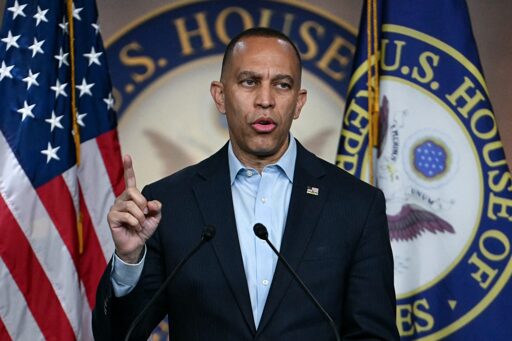
When asked about the measure and the Van Hollen letter at a press conference on Thursday morning, however, Jeffries dodged the question.
“I haven’t had a conversation with Senator Van Hollen,” Jeffries said. “But what I have said is that things have to dramatically change over in the Middle East.”
“That looks like, as far as I’m concerned, making sure you have a safe and secure Israel, living side by side, as a Jewish and democratic state, with an independent Palestinian state,” he went on. The only legislation that he called out specifically was the West Bank Violence Prevention Act, which has been criticized as insufficient by pro-Palestine advocates, and which Jeffries said he supports.
The military integration measure — Section 219 in the House version and Section 1217 in the Senate — would mandate the creation of an initiative to deeply integrate the U.S. and Israeli military and technology sectors, including in areas like weapons production and autonomous warfare. It is backed by Israeli Prime Minister Benjamin Netanyahu, and has faced vehement opposition by critics who say that it inextricably links the U.S. and Israeli military at a time when Israel is committing genocide in Gaza, backing horrific violence in the occupied West Bank, and razing huge swaths of Lebanon.
“As an American, I am outraged by Section 219,” said Khanna. Khanna and Rep. Thomas Massie’s (R-Kentucky) amendment to remove Section 219 was blocked in committee twice this summer. “Who do they think they are? This needs to be the top priority in the lame duck session.”
Jeffries also called for “dramatic change” with the memorandum of understanding (MOU) between the U.S. and Israel, which is set to expire in 2028. However, he did not address President Donald Trump’s announcement last week that the U.S. would stop sending the roughly $4 billion in annual funding called for by the MOU next year. This announcement was already met with skepticism by advocates for Palestinian rights, who pointed out that Section 219 and other measures are slated to deepen the U.S.-Israel relationship in more secretive ways.
The remarks are likely to fuel yet more criticism of Jeffries, who has been under scrutiny in the past week along with Senate Minority Leader Chuck Schumer amid calls for new Democratic leadership. Both Democratic leaders are staunch supporters of Israel, and have broken with large swaths of their caucuses this year in votes on blocking assistance to Israel.
Their continued support of the apartheid state comes as support for Israel among the public has fallen to all-time lows amid its genocide in Gaza, as Americans grow increasingly incensed over the U.S.’s aid to Israel, polls have found. The military integration measure is also extremely unpopular: An August poll found that 61 percent of Americans oppose the proposal, including 78 percent of Democrats.
This week, Sen. Bernie Sanders (I-Vermont) announced that he is not backing Schumer for Senate leadership when the Democratic caucus votes next month, calling for drastic change. In an interview with The Nation, he cited Schumer’s backing of Israel as a reason to oust him from leadership.
“[I]n this moment in American history, Chuck’s views are way out of touch with where the American people are at — and especially with where [the base of] the Democratic Party is. On issue after issue, I think he is just not in tune with where his constituents are at,” Sanders said.
When asked about the issues in which Schumer differs from the base, Sanders said: “You can start off with U.S. military aid to Israel.”
From The Real News Network via This RSS Feed.
If Jeffries or Schumer (or worse, both) aren’t replaced, the dems will lose 2028. Mark my words.
Agreed.
When they arrest old ladies in wheel chairs for supporting Palestine, how does any amerikkkan wonder why people don’t want to talk about Palestine?
So many red flags, but no, he’s certainly fine to keep as leadership for the new Democrat wave next year. See no problems at all. /s
Fuck the DNC and party establishment, the Democrat party needs to be burned to the ground and replaced with an actually progressive party.