

Bullets:
The housing market in the United States is frozen, with young generations unable to buy, and older generations unable to sell.
There is too much damage, in too many sectors and industries, for the current system to be reformed.
A new real estate market must be developed, in new areas, by new builders, and led by a new generation of business and political leaders.
Inside China / Business is a reader-supported publication. To receive new posts and support my work, consider becoming a free or paid subscriber.
Report:
Good morning.
I’m 59 years old, and went to university in Atlanta, from 1985 to 1988. The summer of 1986 was after my freshman year, and I decided to work hard and save up enough money to buy a used car, and take it back to school with me, so that from then on I could have transportation that allowed me to get an off-campus job. I also signed up for two courses at a junior college during the summer, so I could graduate early.
And I did those things. I worked for 60 hours a week for about 9 weeks, and finished two courses. I bought a 1979 Ford LTD, which cost $1,900 and which we drove until it fell apart.
I really did grow up a lot, during that summer—setting goals, then working hard to achieve them. Here on YouTube, our channel audience skews heavily male, business owner, and around my age. And I’m sure that most of us could share great stories about what it was like to come of age during that time, and how a strong work ethic laid a good foundation to where we are now.
But our experiences have no relevance to younger people, in younger generations. Consider a kid in the same position I was, exactly forty years later. He’s back after a year of college, and wants to save up. Here are the price tags he’s looking at, for a 7-year-old car, and sort by price.

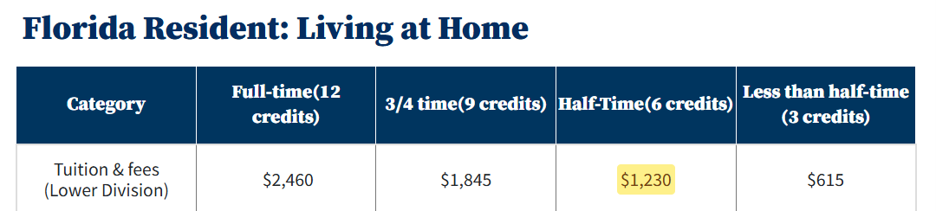
The cheapest one on offer is $10,998. For some reason there is a big cluster at that price point. Eleven thousand dollars divided by 9 weeks is over $1200 a week, which is what he needs to clear—after taxes and gas back and forth—to do the same thing I did. Forty years ago I paid $120 for those two courses, now they’re 10 times as much:
This is all to point out that my experiences and most of yours were real, and our stories are true, but have zero validity today. And when we give advice to young people, we’re lying to ourselves if we pretend the world isn’t a completely different place today. And we’re lying to them too, and they know we’re lying to them. They use Google too.
These are some of our most popular videos. We explain how Chinese factories build houses and apartment buildings and schools, and ship them to construction companies across the world. These videos generate about 60 emails per month, to our team here. Half the emails and inquiries come from the United States and Canada, unfortunately, and we cannot do a thing with them. The regulations and the rules for North America are deliberately written, to keep affordable options out of their markets.
Our group runs a company called Direct Equipment Corporation. We work with factories in China, sourcing capital equipment for buyers outside China. We’re paid out of the marketing and commission budgets at the factories themselves, so buyers really are paying the same factory prices as if they just called the company, or flew over to meet them.
And it’s the same for us whether the calls come in from Indonesia, or India, or Indiana. We get paid exactly the same, wherever those houses go. And it’s here, in Asia, where the demand actually is.
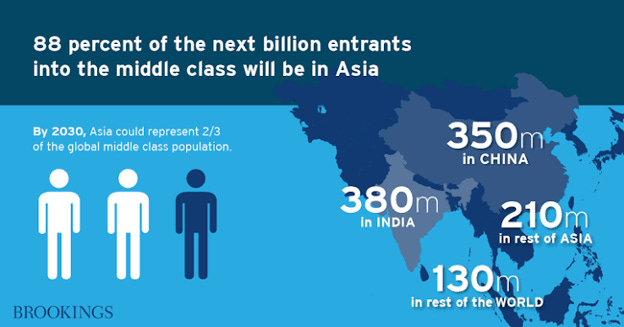
Of the next billion people joining the middle class and needing new homes and schools and hospitals and shops, 880 million of those people are already here. Latin America and Africa up next, and are just getting started on a boom that will last decades, our factories will build for another two billion people there.
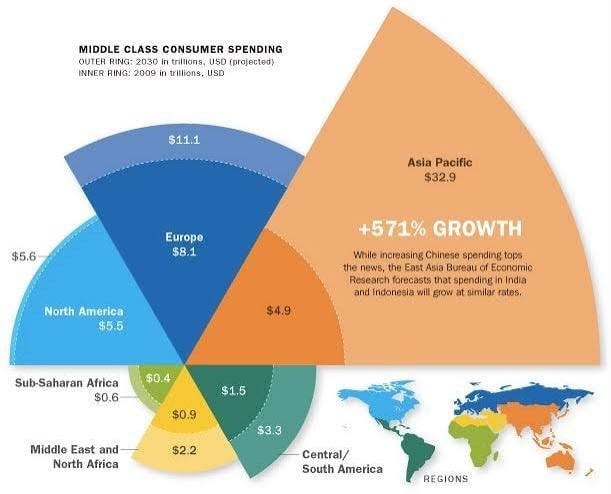
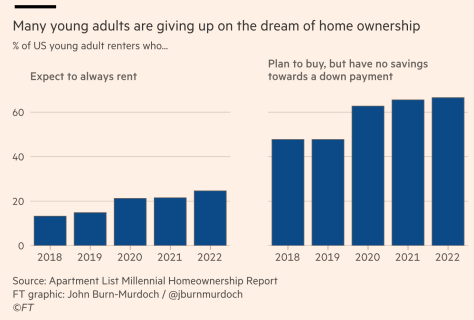
But real estate markets in the so-called developed world are frozen, by the affordability crisis. Young people in Asia and South America are more optimistic than in the United States, when asked about the future. A fourth of young adults believe they will never buy their own home. Two thirds plan to, but have no money for a down payment.
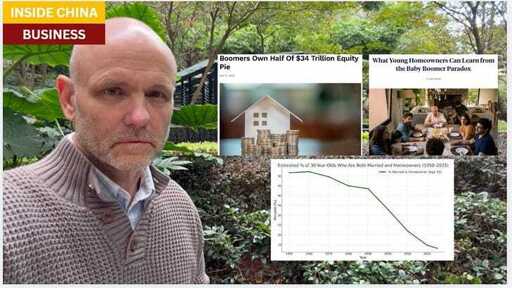
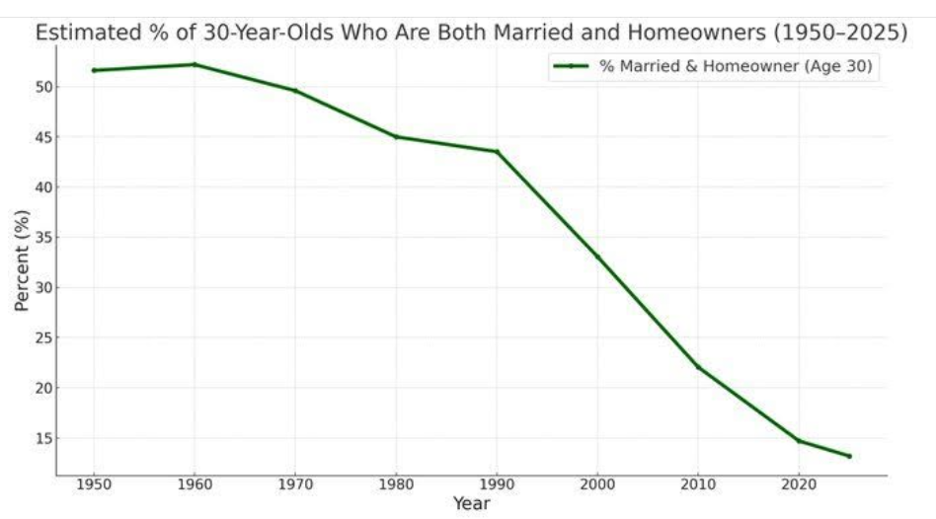
For demographers this chart looks almost like the end-of-civilization—the percentage of 30-year olds who are married and living in their own home has crashed to almost zero:
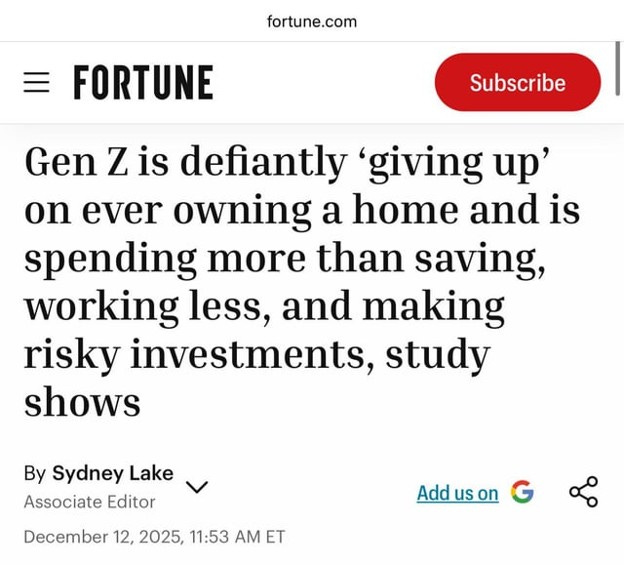
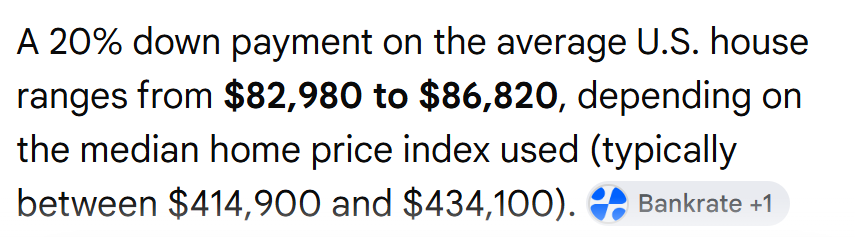
GenZ is 14 to 30 years old right now; they’re the ones who need to earn that $1200 a week to save up money for a used car, and will need to net and bank $1200 a week for 17 months just to have enough for a down payment on a median-priced house:
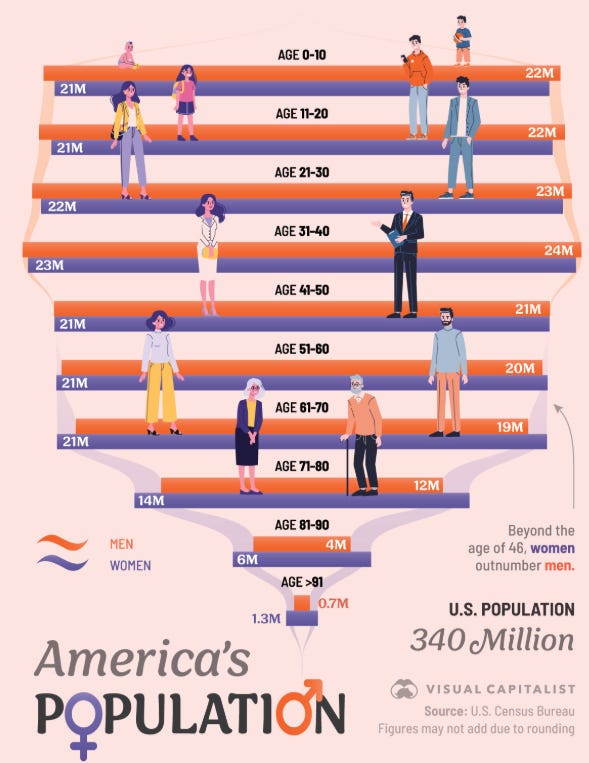
This is the population chart for the United States. Every single age cohort, by decade, under the age of 40 today, is bigger than every single one over 40, and something did happen, a radical change, in the system that has today priced starter homes and used cars out of their reach:
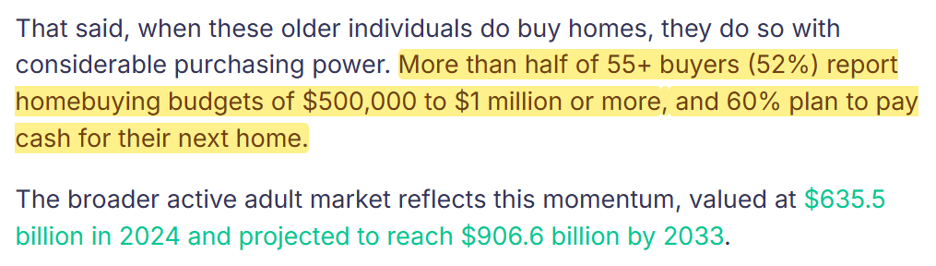
And on the surface, it seems that the older populations of homeowners have it made, by comparison. But just on the surface. This is from the National Association of Homebuilders, who see that the 55+ population is a better market, than the far larger population of under 40’s. Builders can’t seem to build those communities fast enough, and it’s because they have a lot of money to spend. Over half the buyers are looking for homes over $500,000, and most of them will pay cash:
Federal law created massive incentives for the builders of these communities, who can legally discriminate based on age. Strangely it’s against the law to restrict Boomers from buying or leasing a house, but it is legal to lock out younger buyers.
And kudos to Wall Street and the NAHB for identifying this particular investment niche, made up of old people who only want to live around other old people. That would never have occurred to me, but they expect the market to grow to almost a trillion dollars a year by 2033.
But from those same figures, we see that 48% of older buyers do NOT have a half-million-dollar budget. And the statistic there skews to those with an intention of buying homes. Boomers in general cannot afford that, and Wall Street investors are going after them too. At the low end of the housing market is manufactured housing, and private equity groups are buying up these parks across the country:
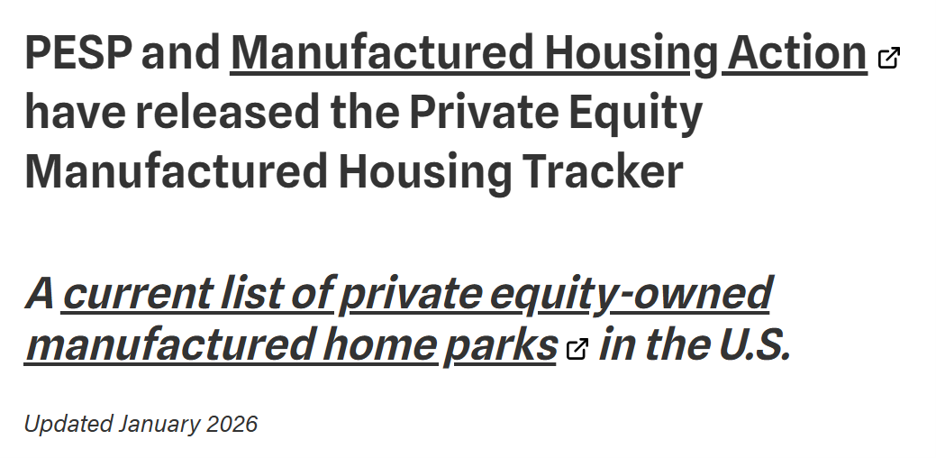
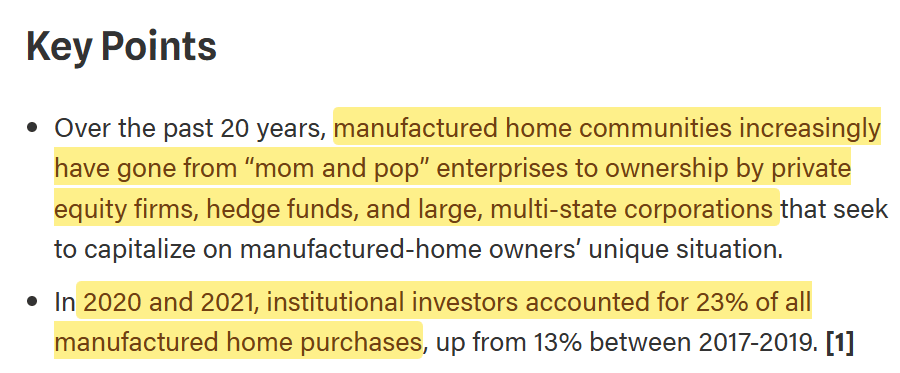
It’s not young people driving the sales of factory-built homes and parks, it’s investment banks. Twenty-three PE firms own 400,000 lots in almost 2,000 parks across the country. And we see right away why they are such a juicy target for Wall Street: Many of the homes themselves are owned outright by the family living in them, but they’re in a community where the land underneath them is leased from park managers.
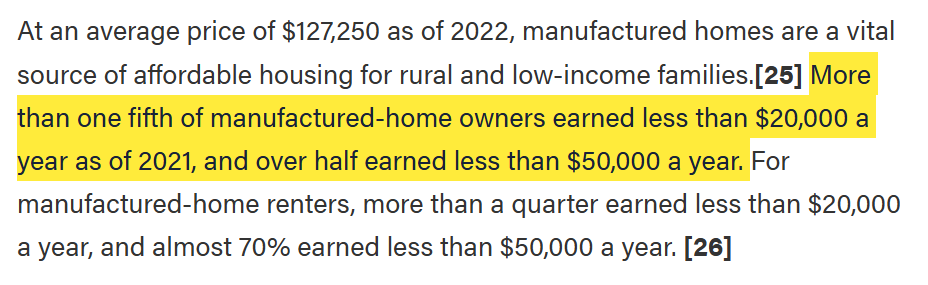
Over half of the owners earn under $50,000 per year, and for the renters, 70% earn under $50k. Average moving costs are high, so Wall Street investors have zeroed in on this population as being stuck, in place, with no choice but to pay higher rents if they can just get their hands on the land sitting under the houses.
Green Street Advisors sees these communities as the most attractive investment in all of commercial real estate—better than apartments, office buildings, shopping malls, hotels, and warehouses.
Jack up the rent on a guy renting a shop or an office and he might move. But these homeowners are stuck, and it’s that situation that makes private equity investors drop whatever they’re doing and fan out across the country to buy mobile home parks.
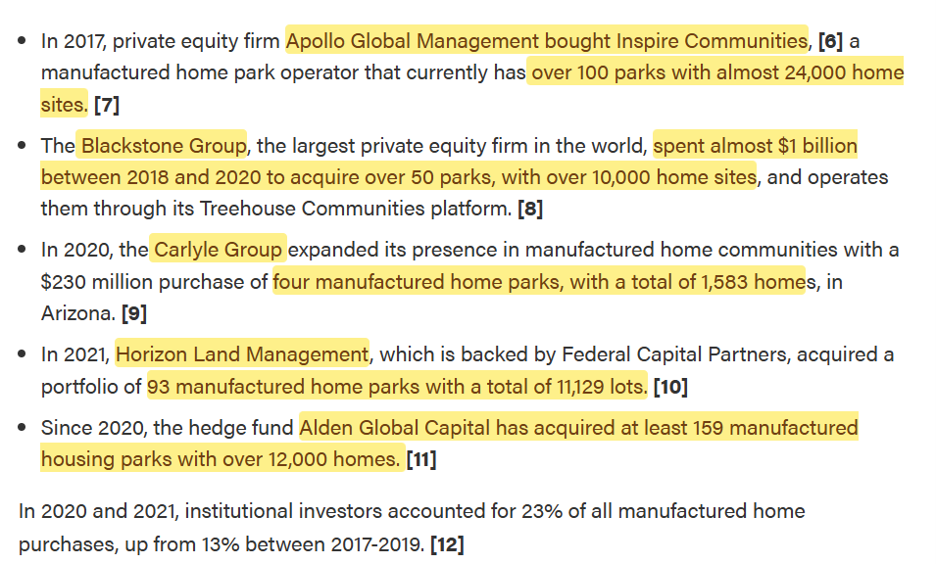
Apollo bought a hundred, in a single year. Blackstone spent a billion dollars over three years. Carlyle, Horizon.
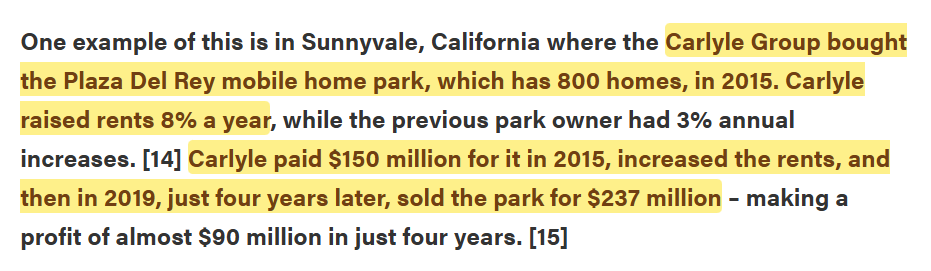
And that is their business model: Carlyle paid $150 million for a park with 800 homes, raised rents 8% a year compared to previously when it was capped at 3%, and four years later sold it off for $237 million. Here’s a map of the parks that were taken over by Wall Street and private equity firms:
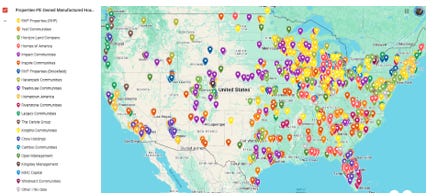
And somehow the investment industry even qualifies for federally guaranteed money to borrow, to finance their acquisitions of these properties. Fannie Mae and Freddie Mac loans were used in almost half of those takeovers.
There are a handful—a small handful—of cases where the homeowners in these parks are fighting back against Wall Street, who is buying up the land their homes sit on and raising their rents. On paper, the residents don’t have much power at all. And the laws are written to make it that way. Usually it involves raising lots of money to make a higher bid.
22 million people in the United States live in trailer parks, and Congress is finally asking if it’s good policy for Wall Street to own that industry too. Nonprofit groups are also fighting back, as they did here in Colorado.
But it’s a case, again, of raising millions of dollars to place a higher bid than the Private Equity group. And Wall Street makes it hard, by bidding far higher prices than the sellers even are marketing the properties for.
For institutional money, buying the land under the manufactured homes is simply a move up the value chain. Wall Street already owns giant chunks of the factories that build them. Berkshire Hathaway bought Clayton Homes over 20 years ago, and Clayton today a huge profit center for Berkshire, and is probably worth 10 times what Warren Buffet paid for it.
Factory-built housing in the United States is an oligopoly, which is something that most of us assumed that regulators and representatives in Washington are supposed to do something about.
Wall Street sees the manufactured housing market as a better business than homebuilding—“It’s simpler, doesn’t have a lot of competition, and doesn’t involve risky land purchases. It’s the only housing alternative available for Americans earning under $60,000 a year, and once they’re bought, it’s hard to for the homebuyer to move them. This isn’t my conclusion or slant; this is from Clayton Homes’ website—this is their own marketing to Berkshire investors.
Berkshire is under new management, they have a cash pile of over $365 billion, and now they’re snapping up traditional homebuilders also. The country has a housing shortage of 4 million homes, the only solution is to build more of them, so Berkshire is buying more shares in companies that build houses in the $400,000+ range.
Institutional investors already control the factories for affordable housing, and now are buying up the parks they’re in. And they’re probably right to expect good returns on their investments in homebuilders for far larger and more expensive homes. And that’s because the incentive structure in the real estate market argues against the construction of smaller, less expensive houses.
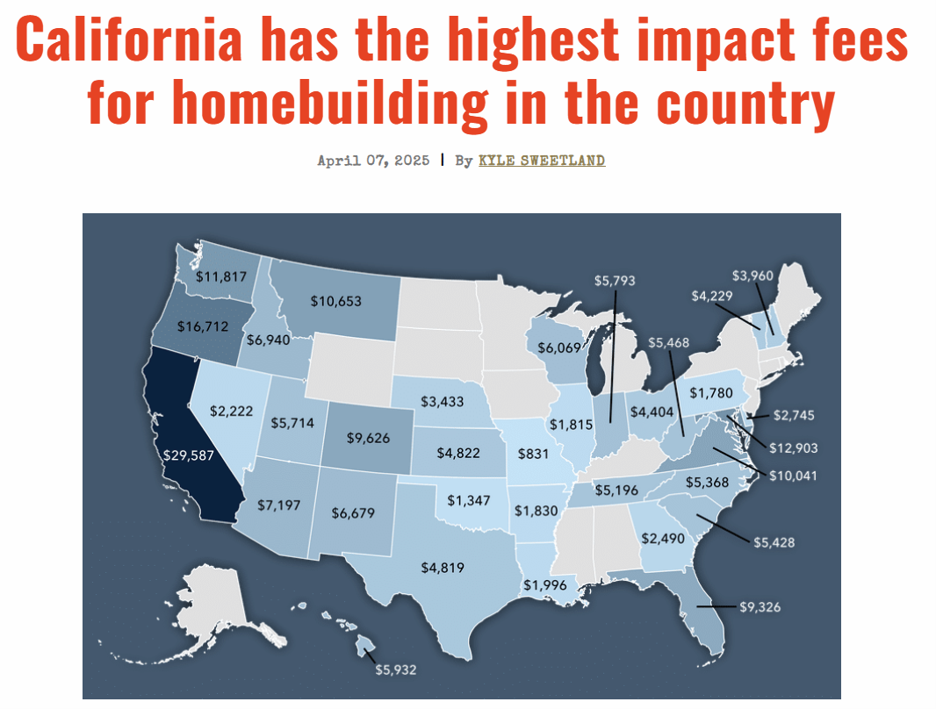
Impact fees are assessed for anyone building a new home, and they’re intended to cover the new demands put on existing infrastructure. In Florida, the impact fees total over $9,000. In California they’re $30,000 on average, and these fees force construction costs up. There are other locations where impact fees are very negligible, and this is a point we’ll return to later. But for any new build, it costs money and resources to comply with the laws in the first place. So these impact fees mean high fixed costs for the homebuilder, which need to be recouped from the buyer later.
Then comes the cost of permitting; what it costs homebuilders to apply for and get approval from local building inspectors. These are also fixed costs, which are passed along to the homebuyers. And they are another big reason why developers build houses that are bigger than people actually want. The impact fees and permits for a large home are just slightly higher than for a smaller house, and so builders just do what’s rational, and build bigger.
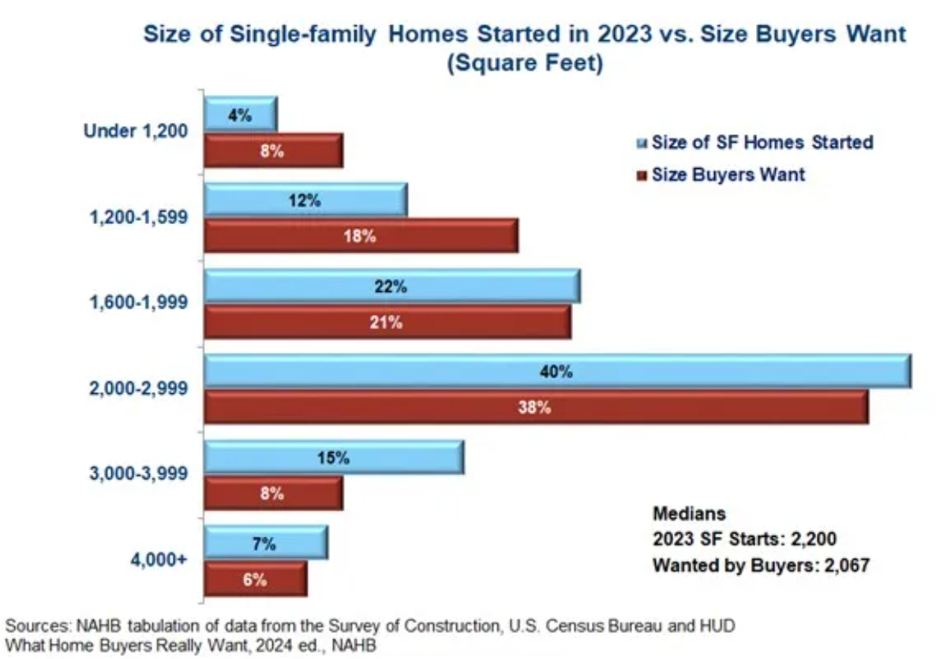
Over a quarter of homebuyers want houses under 1600 square feet, which is about 150 square meters. But only 16% of the houses under construction are that size. Homebuilders are building bigger houses than the market wants, but homebuilders are stuck too. Cities and towns collect a lot more in property taxes for bigger houses, and so they write their zoning requirements accordingly, to discourage or outright ban the construction of smaller homes.
It’s easier for homebuilders to get large homes approved, and they spend thousands of dollars on permits and fees just to ask for permission to build.
Their cost of construction on a square-foot basis falls, the bigger the house gets, and that is true across all market segments.
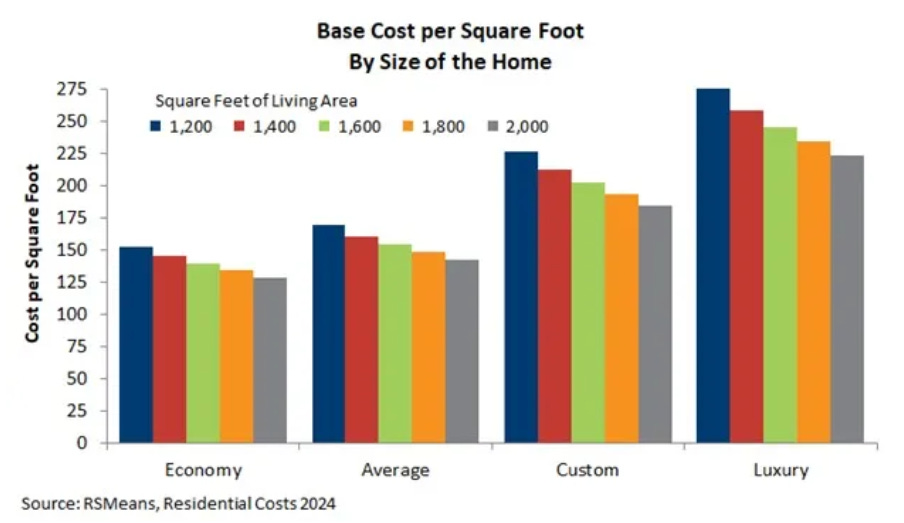
And there is no good news on that chart, anyway. A home in the “economy” segment at 1,200 square feet, costs $180,000 to build, and that is exclusive of land. And you see there why municipal governments push for bigger houses that are not classed “economy”. A larger home carries a higher price tag, and higher property tax payments. Move up into the custom and luxury segments, and it makes a lot of sense for cities and towns to close their market to working class families.
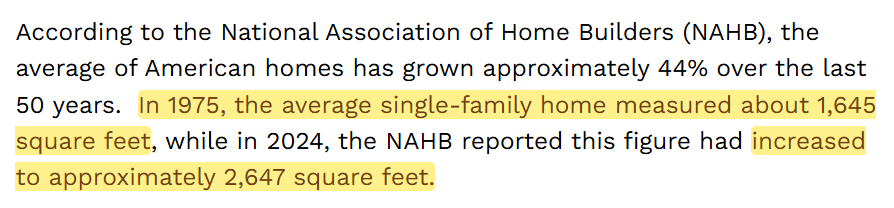
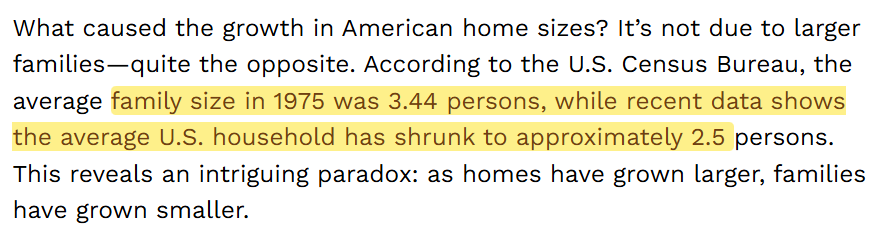
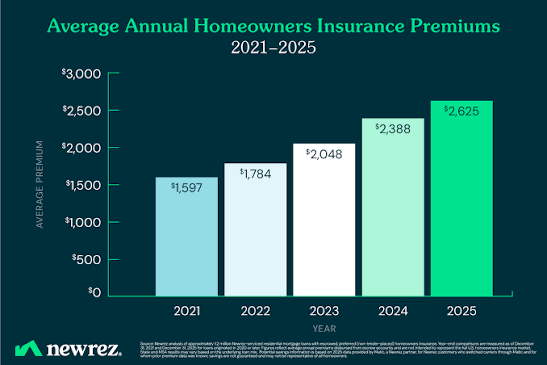
So houses are bigger today—over a thousand square feet bigger than the houses most of us grew up in—and less affordable. Meanwhile, families are getting smaller. Bigger houses mean higher insurance costs, which have increased by about a thousand dollars a year, just in the last five years:
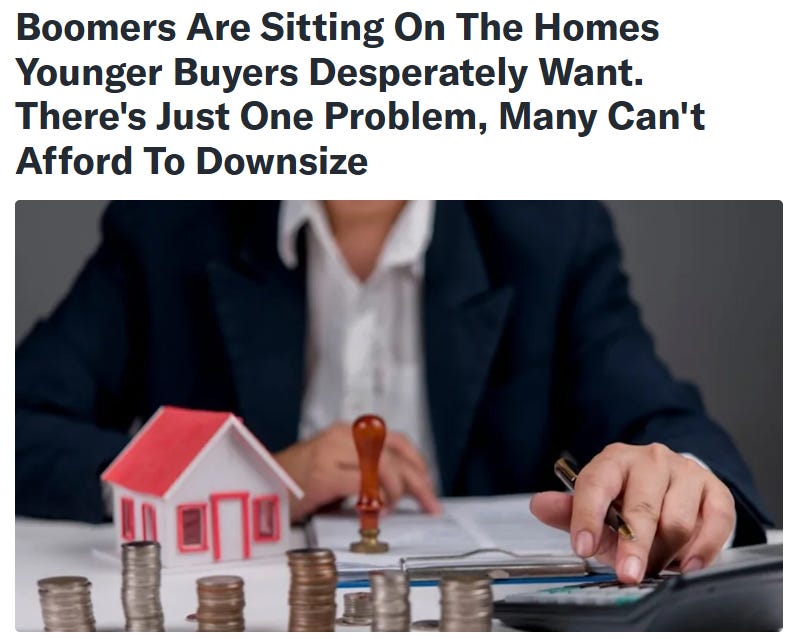
Buyers are desperate for affordable housing that homebuilders are not building, and cities and towns aren’t allowing them to. Meanwhile Wall Street is buying up land under the most vulnerable homeowners, jacking up their rents, and selling them off in chunks to other investors. What results is a frozen market in the middle, and for Boomers, who cannot afford to sell their homes, and cannot afford to stay in them:
Condos and apartments in their neighborhoods are just as expensive as older houses, and those aren’t available anyway—they were never built.
What economists expected for decades was the “Silver Tsunami”—millions of homes coming onto the market as the Boomers downsized. But there is nowhere for them to go. Empty-nesters own 50% more three-bedroom homes, than younger families with children.
A lot of that resulted from the zero interest rate policy, that artificially suppressed rates and pushed a lot of people to buy more house than they need, and which now they cannot afford. And millions of other buyers are locked in houses they could never afford, because they believed rates would come down and never did.
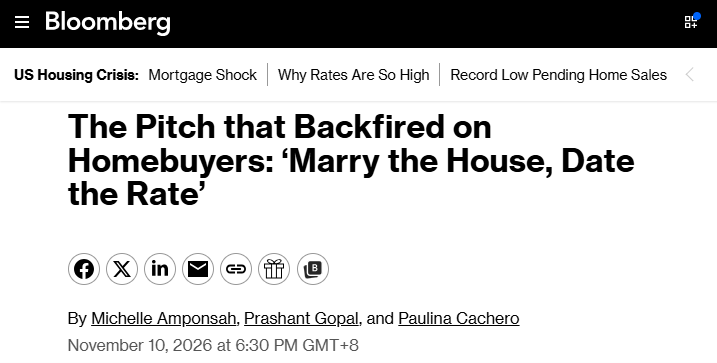
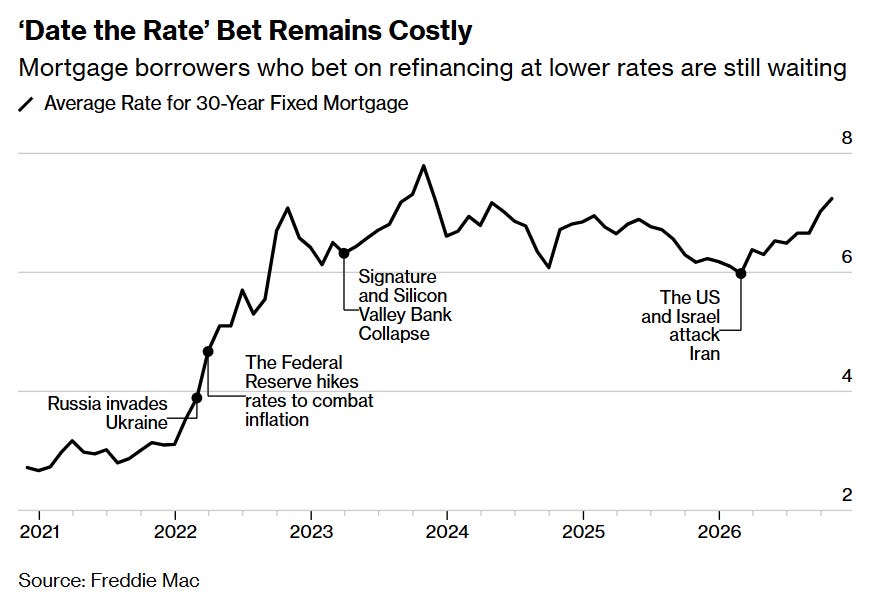
Real estate agents and brokers told buyers to “Marry the House, Date the Rate”. Don’t worry about what the loans cost. Get the house you want today, then when rates come down, just refinance. 11 million borrowers locked in long-term rates over 6%, and they were conditioned to believed that the rates would fall, and they could just refinance out of the problem, which is that they couldn’t afford the house they bought if rates stayed where they were.
But instead of falling, as those borrowers expected, rates went higher. Now those buyers are stuck with houses they cannot afford to keep, and a handful – a small handful, no doubt – of the real estate brokers who gave buyers bad advice now feel responsible. Many buyers in that position are “squeezed for the foreseeable future”.
And mortgage defaults are shooting higher for the buyers in that cohort. Foreclosures are the highest level in years, and half of them are on mortgages originated in 2022 or after, which is where that line goes straight up on the historical rate chart. Today a third of mortgages guaranteed by the FHA are for borrowers with debt-to-income ratios over 50%, which is the highest level since they started tracking the data.
Many Boomers are fortunate, in comparison. They got lucky when they refinanced their mortgage, or bought a new home, when interest rates were at record lows. But they’re squeezed too. Now those rates are a lot higher. And even IF smaller and less expensive homes were available—and there aren’t—the higher mortgage rates mean they would be paying more for less space. Financially, they’re far better off staying in a big house they don’t want. The houses aren’t even suitable, and so they’ve no choice but to renovate them to be easier for elderly residents to live in.
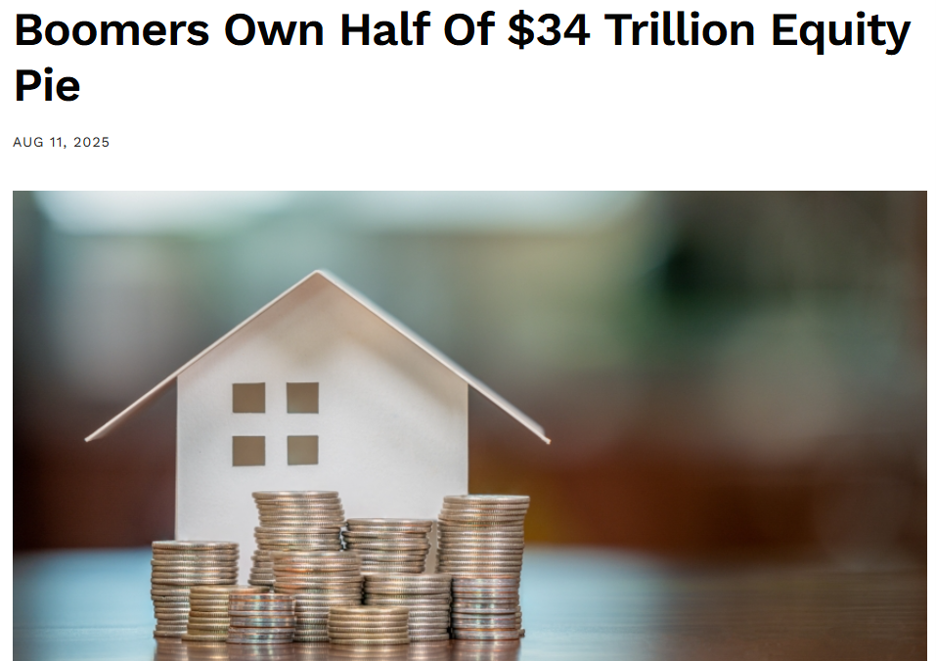
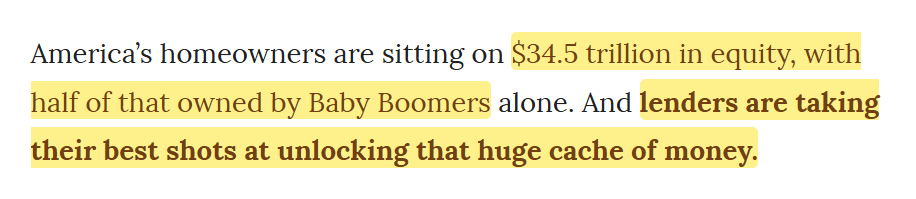
That’s why that headline is so misleading. Boomers own half of the housing equity in the United States. But that’s not even what the article is about. Banks are moving in to convert all that equity into loans. In a single year, the average home equity line offer jumped from $104,100 to $145,000. HELOC borrowing rates are higher than conventional mortgages.
These Boomers are house-rich, but cash poor, and have no choice but to take out large loans to make improvements and repairs to big houses they don’t even want. That’s explains what the “Baby Boomer Paradox” is. Once again, on the surface, we assume that a generation sitting on $17 trillion in home equity has won the game. “If any generation should feel like homeownership delivered on its promises”, it’s those guys.
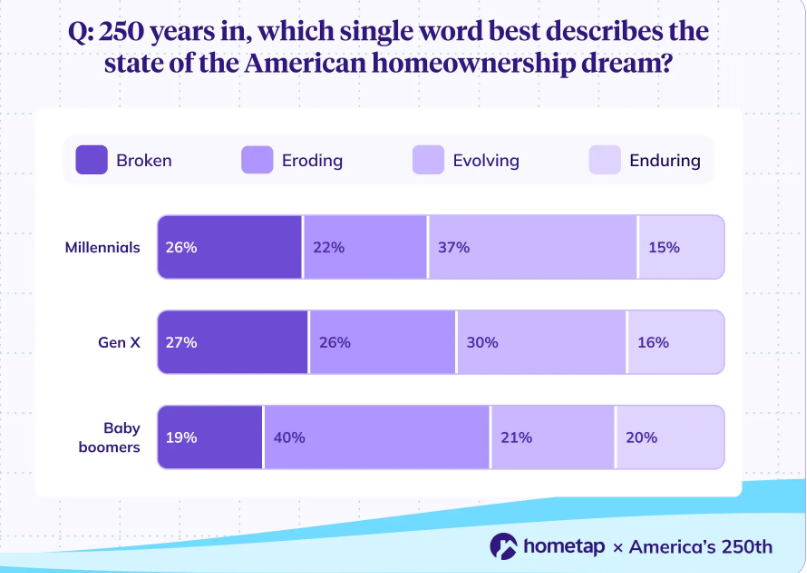
But they are the most skeptical generation. 59% of Baby Boomers say that the “state of the American homeownership dream” is either “Broken” or “Eroding”. We GenXers are the next up, and we’re at 53%. Millennials are more optimistic than we are, and are far more likely to say that the American dream is “evolving”. And we’ll come back to that later, too.
Older Americans know that home equity doesn’t even mean security, let alone wealth. Outside their homes—which they cannot downsize and get away from, and which gobble up more and more of their savings with property taxes and insurance premiums every year—they don’t have much saved. For Boomers, their net worth is concentrated in the value of those homes, at levels that are unhealthy compared to Millennials.
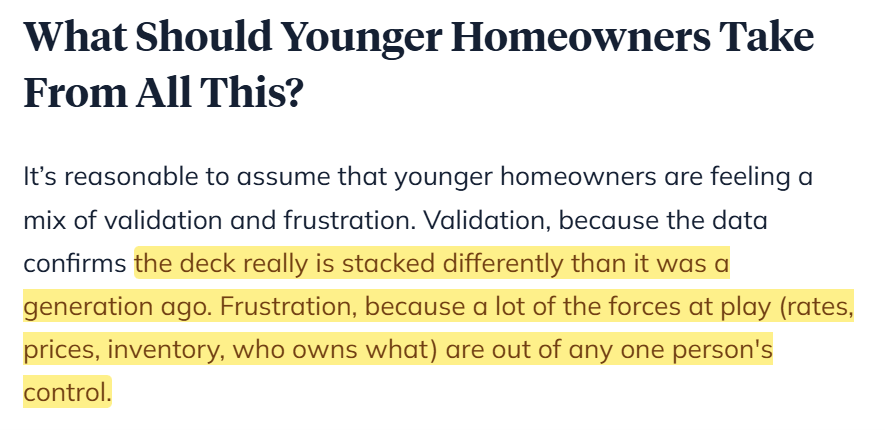
And we’re back to where we started at the beginning of this report: it’s a completely different world today, than the one most of us grew up in, and there are too many problems in too many places to be fixed easily.
The reason we’re here, in this situation where the entire market is locked up and frozen, is because for years, everybody everywhere was doing the most rational thing, at the time. Cities need more tax revenue, so they tell developers they need to build bigger and more expensive houses. Real estate brokers earn commissions based on the sale of the house, so they recommend the biggest and most expensive houses. Loan processors earn commissions by loaning money, and make more money more often when they convince buyers to borrow a lot of money, and in a couple of years borrow it again at lower rates. Completely rational.
Truly rich Baby Boomers with $600,000 cash in their pocket decide to live out the rest of their lives on a property that will be well maintained by private equity investors, and has a hospice facility just down the street. It’s expensive, and those communities are designed to drain their residents of their savings, but there aren’t a lot of good options, even for them.
Other Wall Street firms found it’s a lot more profitable to invest in mobile home parks than in hospitals or new industrial parks, and by the way they would tell you that they are only acting as fiduciaries, investing money given to them by pension funds and 401k contributions.
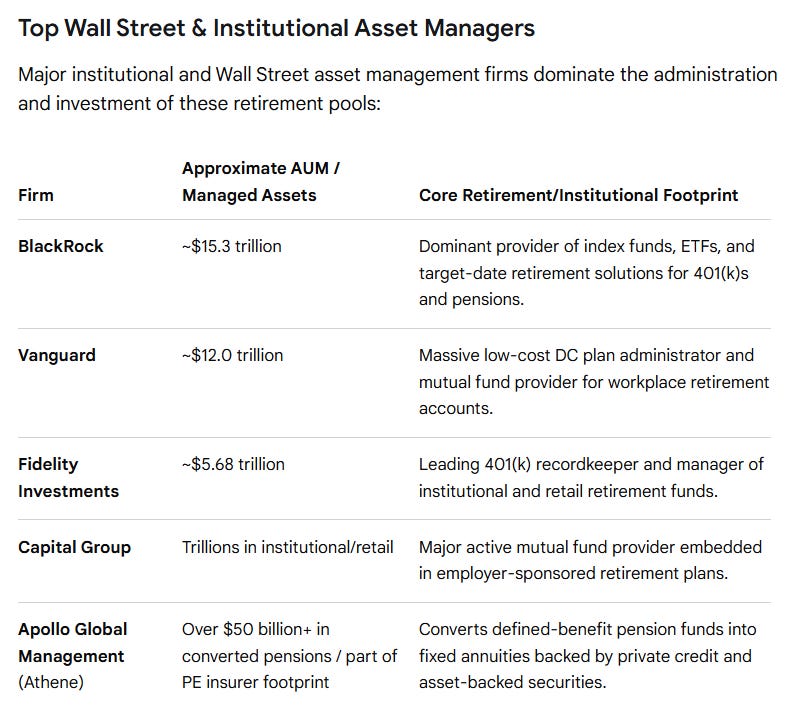
In other words, they’re only putting money to work that we give them first. Everyone is being rational, and so are the young people who decided that they can never own a home, while the system is the way it is.
And that’s the good news, ultimately. The system is broken and cannot be reformed; nothing can be done at the margins to make any difference. What’s needed instead is a new housing market. We need millions of new homes, but they need to be built by thousands of new property developers, in thousands of new areas across the country.
There are communities who are eager for young families to move in; what we need is new builders setting up there, and getting to work. The idea of homeownership isn’t completely dead for young people, it’s “evolving”—it means something different to them than it means to us. They’re waiting for that new generation of homebuilders. Homebuilders who will work for fair profit margins building smaller homes, but will building many more of them. They need to identify new areas, where young families will be welcome by young mayors who will build new schools.
This is a fight that involves all of us. Old and young, and everyone from upper-middle class to poor, have woken up in a system that doesn’t work for almost anyone. The deck is stacked differently. And I’m an optimist because I already know my own generation, and I also have a good perspective and a lot of admiration for the ones coming up behind us, and of the strengths they have, and the talents that they will bring to make these changes happen. YouTube and social media are far more powerful than traditional media, and it’s younger people who own almost all the space, and have all the influence.
Here’s a strong example. Barry’s Economics. It’s powerful. It’s one of the only channels where I watch every video end-to-end, and I think about them for days after. He’s unpretentious—just a guy sitting in his kitchen in England, and talking about economics and getting half a million people tuning in. It’s some of the most thought-provoking content on the internet. Hundreds of thousands of views, each.
Now compare Barry’s Economics to Fox News, for viewership in the 25-54 age group. Fox averages 98,000 viewers a night. An advertiser hoping to be in front of the most sought-after demographic in media is better off putting his commercial on Barry’s Economics on YouTube, instead of Fox News.
ReVenture is another young guy, who’s an expert in the real estate business. Just a guy walking around neighborhoods talking about the market, who picks up over 7 million views a month. More young people watch Nick Gerli than watch CNBC. A lot more. It’s not even close.
So it’s not just the housing market that’s broken; network television is also done. Hundreds of creators across dozens of niches who dominate, and reach tens of millions more people, at a lower cost.
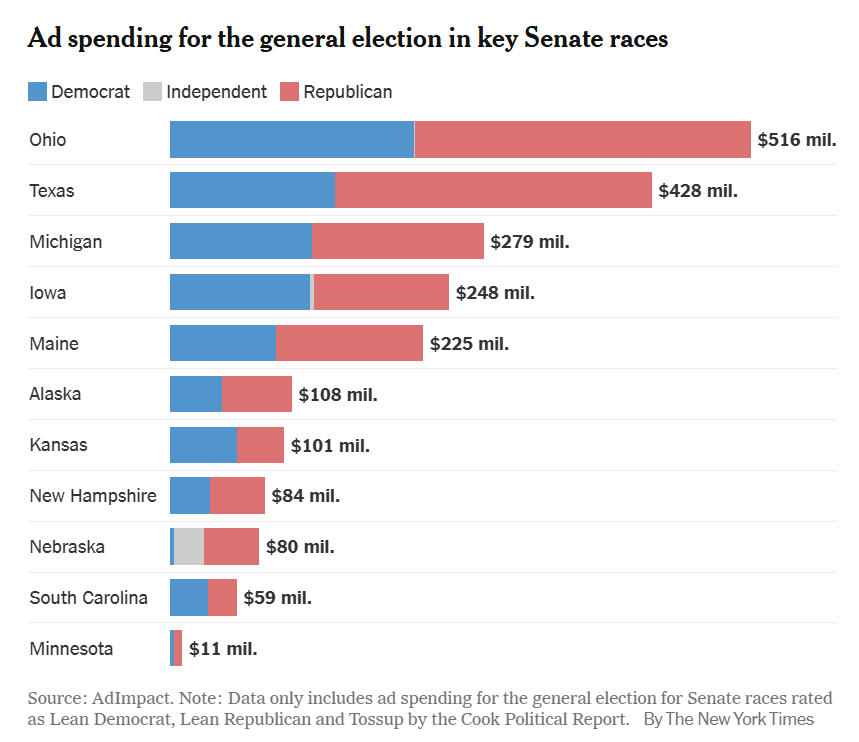
Experts are trying to make sense of recent elections, given the ridiculous amounts of money spent by the ones who went on to lose by large margins. The Republicans spent $250 million more than the Democrats, just on the Senate races, and lost – every single race on that list, except for Nebraska:
Nobody has more money or more power than the literal trillionaires and the multi-trillion dollar companies in Silicon Valley who want to build data centers everywhere. And on every ballot in the country, except for one, voters rejected them. The political machines are breaking down, too: Wall Street money, Elon Musk money, AIPAC money, Silicon Valley money—billions of dollars that just recently would have won elections, easily, and stock the Congress and state houses with legislators and reps who would write the laws they wanted and cut the checks their way—it all went POOF.
It’s very healthy to realize that the system isn’t working. And it’s healthy to understand that the tools we need to start over, are already in our hands. Boomers hope young people understand that things haven’t worked out nearly as well for them as the younger generation probably believes.
And young people can also be inspired, hopefully, by what happens when old people decide to fight back, even when they’ve few resources of their own except for close friendships, working together, and righteous rage.
And there is much more to celebrate in younger people, who are enraged and moved by the wealth inequality that keeps growing, and by the genocides in Gaza, and by wars that they are not themselves being forced to serve in. They have a profound sense of justice, of right and wrong and fairness, and they also understand better than so-called Mass Media how to make their voices understood, and heard. And they can make your voices heard.
That’s to say that the first step for a mobile home community who just got an eviction notice from a Private Equity company, should be to reach down a generation or two—or three-- and find one of the guys who already owns the niche on YouTube for real estate investment. Invite him out to Colorado ski country, let him walk around and point out all the vacant tracts of land that investors could be buying, and building affordable housing on, and thereby be part of the solution instead of the problem.
More people will watch him tell that story, than will watch CNBC or Fox News tonight, and just maybe the situation will “evolve” and result in a better outcome for everybody. The audience that you need to get to work on your problem, is already there: hundreds of thousands of viewers who have capital and are looking for alternatives, and to make a difference.
Back to our audience. GenX and Baby Boomers, male. We didn’t break the system, but it did break, and it did happen on our watch. We cannot point to a single generation behind us and say, you guys broke the economy. It was us. We have a responsibility, that when we pass on, to pass on a world that’s better than the one we were born into. Our grandparents did do that. But we’re going the wrong way. And our grandchildren will not be born, unless we get busy.
Be Good.
Resources and links:
https://www.carmax.com/cars?search=2019&Year=2019-2019
The future of the middle class in emerging markets – 2026 update
https://www.oxfordeconomics.com/resource/the-future-of-the-middle-class-in-emerging-markets-2026-update/
Visualizing the U.S. Population by Age Group
https://www.visualcapitalist.com/u-s-population-by-age-group/
55+ Housing: Trends and Benefits
https://www.nahb.org/other/consumer-resources/types-of-home-construction/55-plus-housing
S. Rept. 104-172 - HOUSING FOR OLDER PERSONS ACT OF 1995
https://www.congress.gov/committee-report/104th-congress/senate-report/172/1
PESP and Manufactured Housing Action have released the Private Equity Manufactured Housing Tracker
https://pestakeholder.org/pesp-private-equity-manufactured-housing-tracker/
These Residents Stood Up for Their Mobile Homes
https://www.aarp.org/home-living/residents-fight-for-their-mobile-homes/
Senator launches probe of investment groups buying up trailer parks
https://www.nbcnews.com/business/real-estate/investment-groups-trailer-parks-rcna248031
With $2.4 million purchase, nonprofit is testing ‘intervention model’ to keep trailer parks out of private equity’s hands
https://aspenjournalism.org/with-2-4-million-purchase-nonprofit-is-testing-intervention-model-to-keep-trailer-parks-out-of-private-equitys-hands/
Berkshire Hathaway to buy Taylor Morrison for $6.8 billion in cash to expand in housing
https://www.reuters.com/legal/transactional/berkshire-hathaway-buy-us-homebuilder-taylor-morrison-85-billion-2026-05-31/
California has the highest impact fees for homebuilding in the country
https://pacificlegal.org/california-has-the-highest-impact-fees-for-homebuilding-in-the-country/
The hidden reason small homes aren’t more common: economies of scale
https://www.resiclubanalytics.com/p/hidden-reason-small-homes-arent-common-economies-scale
Economies of Scale in Single-family Home Construction
https://eyeonhousing.org/2024/09/economies-of-scale-in-single-family-home-construction
Boomers Are Sitting On The Homes Younger Buyers Desperately Want. There’s Just One Problem, Many Can’t Afford To Downsize
https://finance.yahoo.com/real-estate/articles/boomers-sitting-homes-younger-buyers-173007636.html
Many boomers are desperate to move but can’t afford to
https://www.marketwatch.com/story/many-boomers-are-desperate-to-move-but-cant-afford-to-6c9907ea
Boomers Own Half Of $34 Trillion Equity Pie
https://nationalmortgageprofessional.com/news/boomers-own-half-34-trillion-equity-pie
What Young Homeowners Can Learn from the Baby Boomer Paradox
https://www.hometap.com/blog/baby-boomer-homeownership-paradox
Bloomberg, The Pitch that Backfired on Homebuyers: ‘Marry the House, Date the Rate’
https://www.bloomberg.com/news/features/2026-11-10/-marry-the-house-date-the-rate-advice-has-homeowners-stuck-in-pricey-mortgages
Fox News Suffers Stunning Wipeout in Election Ratings
https://www.thedailybeast.com/obsessed/fox-news-suffers-stunning-wipeout-in-election-ratings
Your Brain Won’t Let You See What Epstein Really Was - Barry’s Economics
The Game Is Rigged. That’s the Best News You’ll Hear All Year - Barry’s Economics
Voters rebuff data centers in every ballot measure except one during the 2026 midterms
https://www.cnbc.com/2026/11/04/data-center-ballot-measures-2026-midterm.html
The Pitch that Backfired on Homebuyers: ‘Marry the House, Date the Rate’
https://www.bloomberg.com/news/features/2026-11-10/-marry-the-house-date-the-rate-advice-has-homeowners-stuck-in-pricey-mortgages
Borrower data, Historical debt-to-income ratios
https://www.hud.gov/sites/dfiles/Housing/documents/2025FHAAnnualReportMMIFund.pdf#page=115
WATCH HOW: Homebuilders use Chinese factories to build houses, for 1/4 the cost
China’s factories are in another world
WATCH HOW Space Capsule Houses are built and shipped to AirBnb’s, ADU dealers, and resort properties
Senior Living Costs Explained: Comparing Types of Communities
https://stellarliving.com/senior-living-costs-explained/
Release: Quarterly Retirement Market Data, Second Quarter 2026
https://www.ici.org/statistical-report/ret/_26/_q2
Inside China / Business is a reader-supported publication. To receive new posts and support my work, consider becoming a free or paid subscriber.
From Inside China / Business via This RSS Feed.
Great aticle right up to the point where they suggest that the solution is to just advertise the right way to the right investors.
Very seriously lacking in imagination for what can be done. We need far more radical change than working within the bounds of the status quo.
