

Anpo Jensen Oglala Lakota
I landed in Ulaanbaatar, Mongolia, around 9 o’clock at night, exchanged my currency for tugrik and found a taxi. It was dark, but there was still a bright white light on the horizon, like the sun had just gone down. While sitting in the back of the taxi, it hit me. I can’t believe I’m here. I was so far north and away from home that I got nervous just thinking about it. But deep down, I knew I had to come. There was a reason, and it was up to me to uncover it.
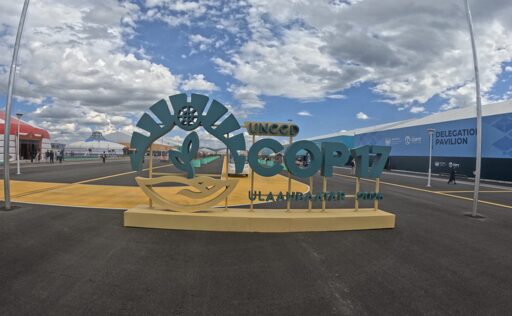
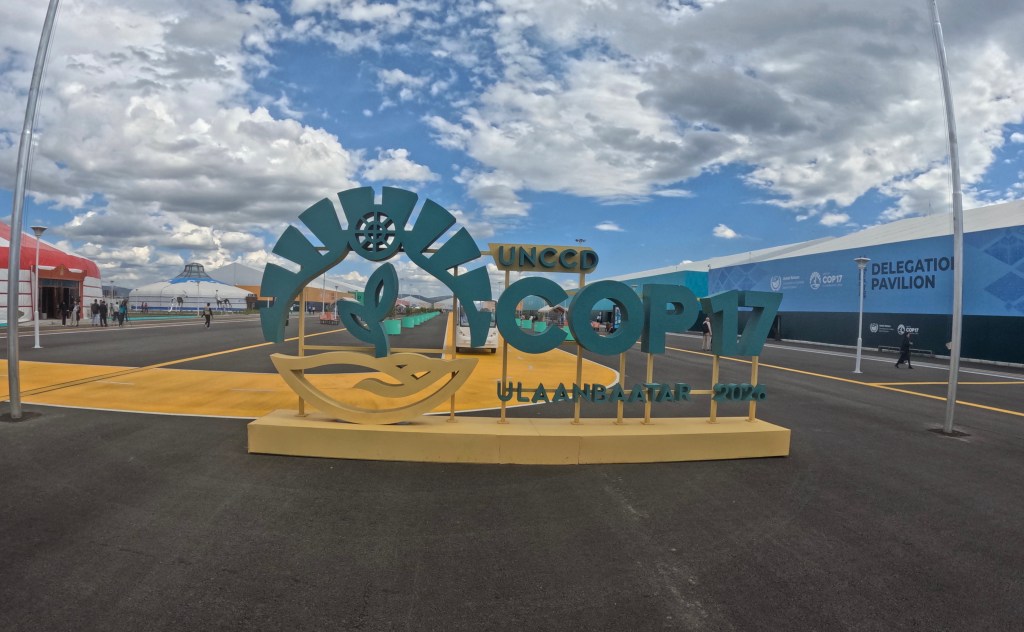
I was there for UNCCD COP17, the United Nations conference on land degradation and drought, as part of the international youth delegation. Rangelands, which cover 54 percent of the Earth’s land, were at the center, and the focus was on implementation and community-led restoration. I am an Oglala Lakota environmental engineer, and I study international frameworks and legally binding instruments intended to protect land and water. I also came to witness Mongolia’s nomadic way of life. As someone who comes from a nomadic history, I wanted to see what it looked like before our nomadic lifestyle was brought to a forced halt by reservations.
I had never seen a place that mirrored the Great Plains – the vast grasslands, the horse culture, the sustainable homes, even a clan system like our tiospaye systems. There I hiked Turtle Rock, where offerings were left and it reminded me of hiking Black Elk Peak at home.
But this is what shocked me the most. Nearly 30 percent of Mongolians are still nomadic, according to the Asia Foundation. This isn’t ancient history. Most live with their families and move four times a year with the seasons and the stars, the way we used to. Before traveling outside of Ulaanbaatar, I couldn’t even imagine this reality. Could there be a timeline or a future where we, as Oceti Sakowin, also still moved four times a year? Is it still possible for us?

Anpo Jensen, Oglala Lakota. (Photo by Sage Studios)
The land itself makes that possible. Mongolia has a free land policy where every citizen is entitled to a plot of land of their own, at no cost. The pastureland stays public and shared, so herding families can keep moving across it. About 72 percent of the country is open, shared rangeland, and that openness gives families access to a sustainable food system.
I was so impressed that I wished we still lived in our thiíkčeya. I wished it was normal again, the way living in a ger is normal in Mongolia. Still, what I saw was beautiful and peaceful, and I wanted it for us.
Mongolia has its own struggles. Like us, Mongolians have experienced mining and extractivism on their lands. Yet their nomadic way of life continues. When I asked our tour guide if young people who live nomadic still go to college, he said of course. And like ours, their young people face pressure from mainstream society to choose between living in the city and returning home to their communities.
Over dinner with Mongolian friends, we found that we carried the same pressure to retain our culture through graduate school. At one point, every friend at the table knew their clan and its origin story, and I shared mine too. This reminded me that the Lakota way connects me with the rest of the world.
I also saw the numbers. About 77 percent of the land is degraded, and 21 percent of lakes and 12 percent of rivers have dried up. Overgrazing is part of it too, responsible for about 49 percent of the desertification.
But the research is clear that moving herds is not the problem. In Mongolia, degradation has been driven by larger herds and less movement, as families settled closer to markets and many cut back their seasonal migrations. Among the Maasai in Kenya, land that stayed shared and moved with the seasons held more grass and more wildlife than land divided into private plots, according to the Journals of Arid Environments and Biological Conservation Overgrazing comes from being fenced in and pushed to produce more, not from moving with the land. That is what our ancestors understood when we followed the buffalo.
Home is facing the same problem. Between 2000 and 2007, wells in the Madison aquifer dropped anywhere from a few feet to more than 100 feet. An earlier South Dakota Mines study found the region could not meet current demand in a drought. The answer on the table is a $2 billion, 161-mile pipeline from the Missouri River that could take decades to build.
We have seen this answer before. The Mni Wiconi pipeline already brings Missouri River water to the reservation. And yet families on Pine Ridge still wait years to be connected to a water line that runs right past their homes. There is no reliable count of who on the reservation lives without running water. That gap in the data is part of the problem, and it is why Anpoetry, the initiative I started, exists.
There’s another way forward, one our ancestors already practiced. We can restore our connection to the land and water as one system, beyond the borders of the reservation. That is why the treaty territory of the Oceti Sakowin matters.
The research backs this up. A study across Australia, Brazil and Canada found that Indigenous-managed lands have equal or higher biodiversity than protected areas. A 2026 review led by the University of British Columbia found they protect forests, biodiversity and carbon as well as or better than government protected areas. Indigenous-led solutions are proven solutions, and that is why we are the ones to lead this work.
Today, the world is still building legally binding instruments to protect land, water and biodiversity. The UN Convention to Combat Desertification, which brought me to Mongolia, and the Convention on Biological Diversity both bind the countries that join them, and nations are still negotiating a legally binding treaty to end plastic pollution. The 1851 and 1868 Fort Laramie Treaties are legally binding instruments too, and they protected a land base large enough for our people to remain nomadic. In that sense, our treaties were ahead of their time.
The treaty council taught me why we protected that land. Protecting the land meant protecting the water systems within that territory too. What if our treaties were honored as intended?
I figured out what the reason was. Mongolia showed me that a nomadic life isn’t something lost to history. It is happening right now. With the land, it could happen for us too. I was there to be reminded to dream bigger. Dream bigger than what is.
Anpo Jensen is a Lakota environmental engineer and co-founder of Anpoetry Climate, an Indigenous-led initiative advancing environmental stewardship and sovereignty through science, storytelling, and community-led solutions. She is also the founder of Anpoetry.
This opinion-editorial essay does not reflect the views of ICT; voices in our opinion section represent a variety of reader points of view. If you would like to contribute an essay to ICT, submit your op-ed here.
The post What if we had the land to be nomadic again? appeared first on ICT.
From ICT via This RSS Feed.