

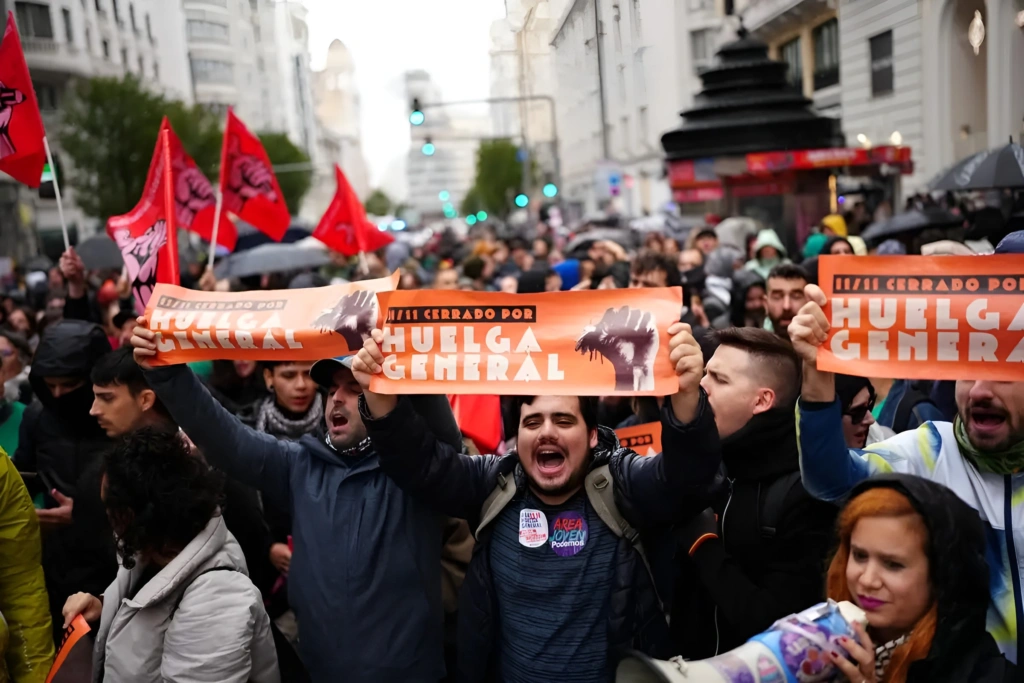
Spain’s unions and teant groups unite across more than 50 cities in a general strike to demand rent caps, higher wages, and price controls ahead of snap elections.
On November 11, 2026, workers across Spain participated in the first nationwide general strike in 14 years. Called by Spain’s two largest labor confederations, Workers’ Commissions (CCOO) and the General Union of Workers (UGT), along with tenant organizations and smaller trade unions, the work stoppage lasted 24 hours.
Unlike the November 14, 2012, state-level general strike, which focused primarily on labor market reforms and austerity measures, the November 11 mobilization focused on the cost of living and access to affordable housing.
RELATED: Spain’s Unions Call Nationwide Strike on Housing Crisis
Under the official slogan “Wages. Housing. Prices.“, the strike is connecting traditional workplace demands with broader economic pressures affecting households outside working hours.
the General Union of Workers’ Secretary General Pepe Álvarez said that this was “not a classic strike” directed solely at employers over collective bargaining agreements. Instead, union leaders and civil society groups framed the walkout as a response to a structural decline in purchasing power, where stagnant wages failed to keep pace with rising rents and basic consumer goods.
In Madrid, government delegation estimates reported that 120,000 people joined the main evening demonstration, while marches took place in more than 50 cities nationwide.
Speaking at a rally on November 11, Workers’ Commissions Secretary General Unai Sordo stated that the strike had “exceeded the expectations of the trade union organizations,” emphasizing that housing affordability had become the primary factor eroding the living standards of Spain’s 22 million registered workers.
Millions struck across Spain over soaring rents—and lawmakers just responded.
Spain’s interim parliament ratified new measures on Thursday to limit evictions and real estate speculation after massive street protests filled Madrid and Barcelona.Whether those rules stick around… pic.twitter.com/7Qc0wW8F2o
— teleSUR English (@telesurenglish) November 12, 2026
Mass Tourism, Gentrification and Inflation
The conditions that led to the November 11 general strike developed over several years, driven by rapid increases in rental prices, the expansion of short-term tourist accommodations, and cumulative inflation.
Between 2024 and 2025, public discontent over housing first gained national visibility through large-scale demonstrations against mass tourism and urban gentrification.
Protests took place in more than 40 Spanish cities, particularly in high-tourism regions such as Barcelona, Madrid, Málaga, and the Balearic and Canary Islands. In Catalonia, which received a record 20.1 million international tourists in 2025, resident associations and tenant unions organized marches demanding limits on short-term holiday rentals.
Demonstrators argued that the conversion of residential apartments into tourist flats reduced the long-term housing supply and pushed residents out of central neighborhoods.
By 2026, public opinion polling reflected this shift in priorities. According to the Torres y Carrera Social Barometer published in September 2026, housing access accounted for 63.3% of public debate regarding urban quality of life, surpassing general complaints about tourist crowding.
Economic data from national institutions confirmed households’ financial strain. According to the Bank of Spain’s 2025 Annual Report, published in June 2026, the percentage of Spanish households living in rented housing rose to 20.2%, increasing 6.3 percentage points since 2007. Among adults under 30 years, 54.7% lived in rental housing.
At the same time, market rental prices rose. Data from the National Statistics Institute (INE) and real estate portal Idealista showed that average asking rents increased by 37.3% between September 2022 and September 2026, reaching 15.1 euros per square meter. In major urban centers such as Madrid and Barcelona, which accounted for 55% of national rental price growth, monthly rents reached 1,535 euros by October 2026.
Furthermore, the Bank of Spain reported that purchasing a home required an average of 7.8 years of gross household income, effectively locking many salaried workers out of homeownership.
By March 2026, the housing crisis merged with broader protests over the rising cost of living. Cumulative increases in food, utility, and transport prices prompted demonstrations in major cities, alongside parliamentary debates over emergency tenant protections.
In March 2026, the Ministry of Consumer Affairs introduced an initial proposal to automatically extend expiring rental contracts to shield tenants from sudden price hikes. However, when Congress failed to ratify the measure in April 2026, millions of tenants remained exposed to market-rate renewals, deepening social unrest across the country and setting the stage for the political confrontations of late 2026.
Millions in Spain on Wednesday brought the country to a standstill as part of a nationwide general strike, demanding solutions to the housing crisis, fair wages, and protection of labor rights. The action was the first nationwide work stoppage since 2012.
The nationwide… pic.twitter.com/MilToPlXRf
— BreakThrough News (@BTnewsroom) November 12, 2026
The Human Catalyst: Maricarmen’s Case
The immediate catalyst that transformed long-standing housing discontent into a nationwide general strike was the eviction and subsequent death of 87-year-old Madrid resident Maricarmen Abascal.
Abascal had lived in her apartment for 71 years under an inherited, long-term rental contract in Madrid. Although she had never missed a rent payment, the property management firm Urbagestión initiated eviction proceedings following the legal expiration of her lease, demanding a rent increase from her previous rate to 1,650 euros per month, exceeding her entire monthly pension of 1,350 euros.
On September 23, 2026, after three postponed attempts and rejected mediation offers from the Ministry of Housing, judicial officers and police units executed the eviction order.
Officers forced entry into the apartment and removed Abascal on a medical stretcher, transferring her to the Gregorio Marañón General University Hospital in Madrid. Two weeks later, on October 7, Abascal died while still hospitalized.
Her removal and passing triggered immediate protests across the country. Within hours of the eviction, the Tenants’ Union organized rallies in at least 12 Spanish cities.
On September 26, thousands of demonstrators marched through central Madrid under the banner “Not One More Maricarmen“. After the march, protesters stayed in a permanent encampment in Madrid’s Puerta del Sol, occupying the square for five weeks.
In an interview, the Workers’ Commissions (CCOO) Secretary General Unai Sordo acknowledged the direct link between the Abascal case and the labor mobilization, stating, “The spark is Maricarmen”.
On October 7, the Tenants’ Union and major trade unions formally agreed to call a 24-hour general strike for November 11, merging grassroots housing activism with organized labor.
Ver esta publicación en Instagram
Una publicación compartida de teleSUR English (@telesurenglish)
Housing Decrees and the Road to Elections
The street mobilizations unfolded alongside a severe institutional crisis in the Spanish Parliament. The legislative package proposed by Pedro Sanchez’s administration, strict caps on rental price increases in stressed housing markets, mandatory automatic extensions for expiring lease contracts, expanded protections against evictions for vulnerable households, and tax penalties on institutional landlords and investment funds holding vacant properties.
On October 2, 2026, both measures were declined with votes from the conservative People’s Party (PP), the far-right Vox party, and the Catalan pro-independence party Junts per Catalunya.
Opposition lawmakers argued that price controls and mandatory lease extensions violated private property rights, distorted market supply, and discouraged real estate investment.
Three days later, on October 5, Sanchez appeared before the press to announce the dissolution of Parliament and calling general elections for November 29, roughly nine months ahead of the scheduled 2027 end of the legislative term.
Formalized through Royal Decree 806/2026 published in the Official State Gazette (BOE) on October 6, the election call placed housing regulation at the center of the national campaign.
#Spain | Several union organizations launched a general strike (11N) to demand improvements in living conditions, access to housing, and the strengthening of public services.https://t.co/O0p7WCMUzb
— teleSUR English (@telesurenglish) November 12, 2026
Unions, Sectors, and Class Demands
Eight trade union organizations registered the November 11 general strike in the Ministry of Labor, under Spanish Labor law.
Alongside the two largest labor confederations, Workers’ Commissions (CCOO) and the General Union of Workers (UGT), also joined the alternative and sectoral unions, including the General Confederation of Labor (CGT), the National Confederation of Labor (CNT), the Union of Actors and Actresses, Co.bas, Intersindical, and Workers’ Solidarity.
Calling on approximately 19 million salaried employees across Spain, the walkout produced sharp disagreements between labor and business over participation rates. The Spanish Confederation of Business Organizations (CEOE), led by Antonio Garamendi, described the strike as a failure with an average participation below 5%.
Conversely, the General Union of Workers reported sector-by-sector participation ranging from 25.4% to 95%, with the highest stoppages recorded in heavy industry and logistics. According to union figures, participation reached 95% in the food and meatpacking industry, 90% in automotive manufacturing, including complete work stoppages at SEAT Barcelona and Volkswagen Navarra, and 90% at major ports such as Valencia and Algeciras.
Transport was visibly disrupted nationwide, with airport operator Aena reporting more than 300 canceled flights (7.33% of scheduled operations) and rail operator Renfe canceling 15.7% of high-speed and long-distance trains.
Evening demonstrations drew large crowds across urban centers, including 120,000 protesters in Madrid, according to the government delegation, and between 55,000 (police estimate) and 400,000 (organizers’ estimate) in Barcelona.
The strike’s platform combined housing, wage, and price demands directed simultaneously at public administrations, at the municipal, regional, and national levels, and at private capital, specifically employer associations and large corporate landlords.
On housing, unions and tenant groups demanded statutory caps on rental prices, mandatory automatic extensions of lease contracts, a ban on evictions of vulnerable households without alternative housing, and the expansion of public social housing stock by up to two million units.
On labor and purchasing power, organizers demanded across-the-board wage increases tied to inflation in collective bargaining agreements and price controls on essential food and energy supplies.
Addressing questions over whether the strike targeted the caretaker government or opposition parties, Workers’ Commissions (CCOO) leader Unai Sordo stated that union demands were autonomous and directed at all political institutions and business organizations responsible for both working conditions and living standards.
Around 4 million workers joined Spain’s first general strike in 14 years, protesting soaring housing costs and rents ahead of the November 29 election.
Unions reported 90% participation at ports and car factories, while clashes with police left 20 protesters injured and 40… pic.twitter.com/vCEWnb5Ngg
— Clash Report (@clashreport) November 11, 2026
Class Power Vs. Speculative Capital
The November 11 general strike linked workplace labor rights and the cost of housing in Spain. For the first time since 2012, major trade unions and grassroots tenant assemblies coordinated a nationwide stoppage, showing that high housing costs and cumulative inflation had eroded workers’ salaries, triggering broad industrial action.
Despite conflicting assessments of participation rates between the Spanish Confederation of Business Organizations (CEOE) and labor confederations, the disruptions in manufacturing, port logistics, and public transit, alongside mass evening rallies in more than 50 cities, placed the housing emergency at the forefront of national politics.
Occurring just 18 days before the November 29 snap general elections and two days before the official start of the electoral campaign, the 11-N mobilization framed the central political choice facing Spanish voters.
After the defeat of the emergency housing decrees by the People’s Party, Vox, and Junts per Catalunya, the incoming legislature will determine whether Spain adopts state-enforced rent controls, automatic lease renewals, and public housing expansion, or maintains a market-led approach to real estate and rental pricing.
As tenant organizations and trade unions concluded their demonstrations on November 11, their joint platform underscored that any future parliamentary majority will face sustained organized pressure if housing affordability and real wage recovery remain unresolved.
Sources: RTVE – El País – Diario Red – Agencia EFE – TV3 – Canal Sur – El Salto – La Marea – elDiario.es – CNN – BBC – TeleSUR – DW – France 24 – RT – Xinhua.
From teleSUR English via This RSS Feed.