

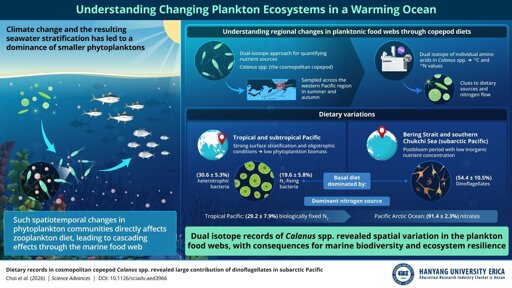
Climate change is causing warming in the oceans, which can have significant effects on marine food webs. Rising ocean temperatures can intensify seawater stratification, a process in which ocean water forms layers of different densities that mix less readily. This can reduce the supply of nutrients to surface waters and favor smaller phytoplankton species that are better adapted to low-nutrient conditions. Phytoplankton support zooplankton, which in turn transfer energy to fish and other animals. Changes in phytoplankton communities can therefore lead to cascading effects on marine food webs.
From Biology News - Evolution, Cell theory, Gene theory, Microbiology, Biotechnology via This RSS Feed.
You must log in or register to comment.