

Caracas (OrinocoTribune.com)—Acting President Delcy Rodríguez arrived in Antalya, Türkiye, on Wednesday, November 11, to lead Venezuela’s delegation at COP31. The annual UN climate conference, which runs from November 9 to 20, brings together nearly every country to negotiate collective responses to climate change under the 1992 UN Framework Convention on Climate Change. Its work includes limiting global warming, helping vulnerable communities adapt, and advancing emissions reductions.
Venezuela’s delegation is expected to take part in plenary sessions on November 11 and 12 and hold bilateral meetings. Its agenda includes presenting Venezuela’s positions on climate financing and a just energy transition, according to the Presidency’s press office.
The delegation includes Foreign Minister Oliver Blanco, Presidency Office Minister Juan Escalona, and Hydrocarbons Minister Paula Henao.
At her arrival, Rodríguez said the summit’s priority should be “a road map, a concrete agenda” to confront the climate emergency. She warned that Venezuela could be affected by a “Super El Niño” this year and called for respect for the rights of nature. She also urged greater attention to teaching children and young people about nature and environmental care, particularly in an energy-producing country such as Venezuela.
The COP31 program is organized around three stated pillars: rebuilding trust through dialogue, shared responsibility through consensus, and turning commitments into action. Its proposed initiatives include a goal to raise global electrification to 35% by 2035, reduce methane emissions, advance zero-waste programs, and build resilient, energy-efficient cities. The host country’s vision also proposes a “Climate Implementation Bridge” to speed the distribution of climate finance.
Rodríguez was received at the summit by Turkish President Recep Tayyip Erdoğan and UN Secretary-General António Guterres. She said Venezuela would participate “with its voice and commitment” in the forum and described protection of the planet as a shared responsibility.
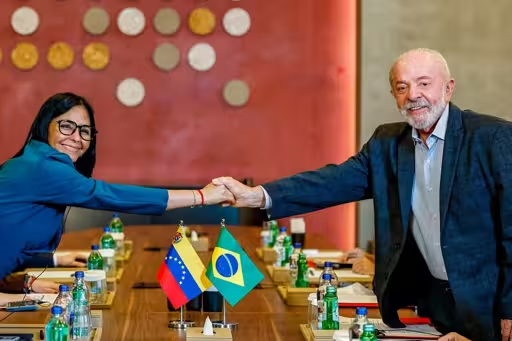
On the sidelines of COP31, Rodríguez met with Brazilian President Luiz Inácio Lula da Silva. The leaders discussed restoring bilateral relations at the highest level and expanding cooperation in areas including trade and energy. Lula said they would continue negotiations on revising Economic Complementarity Agreement No. 69 and on Brazilian tariffs on automobiles.
Rodríguez proposed sending a Brazilian negotiating delegation to Caracas. They also discussed expanding Brazilian investment in Venezuela’s oil sector and agreed that Brazil’s Minister of Mines and Energy, Alexandre Silveira, would visit Venezuela before the end of the year.
The meeting follows Venezuela’s condemnation of Brazil’s decision at the October 2024 BRICS summit in Kazan, Russia. Venezuela’s diplomacy said Brazil’s maintained a veto blocking Venezuela’s admission despite support by the other participating countries. After the US bombing of Venezuela on January 3 to kidnap President Nicolas Maduro the bilateral relationship began to show signs of improvement.
The climate summit’s stated goals also face scrutiny over whether negotiations deliver action at the scale required. Ahead of COP31, negotiations in Bonn failed to reach agreement on scaling up emissions cuts and financing climate adaptation; policy advisers described progress on adaptation talks as “stuck, stalled or deferred.”
Reuters, after interviewing more than 30 experts and participants in the COP process, reported that many called for reforms to turn years of pledges into real-world implementation, while global emissions continued to rise. At COP31’s opening, UN climate chief Simon Stiell said progress was “nowhere near fast enough.”
Wealthy countries continue to resist their responsibility to fund climate action in developing nations. At the UN climate negotiations in Bonn, Germany, in June 2026, countries failed to agree on adaptation finance.
President Maduro Calls For Summit in Defense of the Amazon (+ COP27)
The record also exposes the failure of the original market-centered promise that carbon credits could deliver real reductions in place of direct action: a Nature Communications study found that 87% of the credits retired by the 20 largest buyers from 2020 to 2023 carried a high risk of failing to represent real, additional emissions cuts.
Special for Orinoco Tribune by staff
OT/JRE/JRE
From Orinoco Tribune via This RSS Feed.