

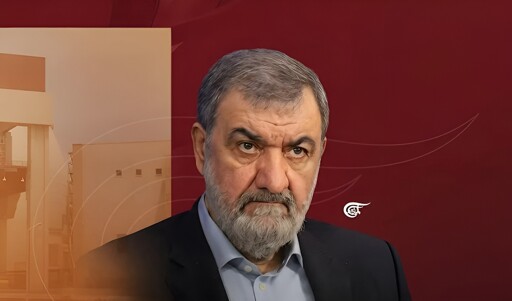
Iran’s Mohsen Rezaei tells Al Mayadeen that Tehran will hit distant US bases if attacked, denies any talks with Washington, and ties reopening Hormuz to seven conditions.
Iran is not negotiating with the United States and will not reopen the Strait of Hormuz until Washington meets seven Iranian conditions, General Mohsen Rezaei, secretary of Iran’s Supreme National Security Council, told Al Mayadeen in an interview, dismissing reports of recent talks as an effort to ease economic pressure on Washington.
Rezaei also warned that any new US aggression would bring strikes on distant American bases, including some in Europe, and accused Washington of tearing up an agreement signed in Islamabad.
Rezaei: No negotiations under wayAsked about a flurry of conflicting reports of a near-final deal covering the nuclear file, the blockade and Hormuz, Rezaei flatly denied that any talks are taking place.
“I affirm that we are not conducting any talks with the Americans at the present time; there are no negotiations between the United States and us at present,” Rezaei stressed.
He described reports of a meeting in Qatar, or of Iranian officials traveling there to meet US counterparts, as fabrications with an economic motive.
“All of this is a lie and slander, and its aim is to ease economic pressures and lower oil prices,” he said.
Tehran, he maintained, has submitted its terms and is waiting for Washington’s answer.
“We have informed the Americans of our conditions, and we are awaiting from them a frank and clear response,” he said.
Asked whether he plans to meet Vice President Vance, Rezaei ruled it out. “Absolutely, they have no basis in truth,” he replied.
**‘Trump signed the agreement then tore it up’**Rezaei recounted three rounds of diplomacy with Washington, which he said showed that Iran does not seek war and that the United States does. In the first round, he argued, the Americans sabotaged the talks and then entered the war. In the second, in Geneva, they abandoned talks and launched an aggression.
In the third round, in Islamabad, he made his most pointed accusation: that the United States signed an agreement and then reneged on it.
“In Islamabad, despite our reaching an agreement and both sides signing it, the Americans reneged on their signature. It is rare in history for a head of state to sign an agreement, then tear it up and abandon it after less than a month,” Rezaei declared.
Even so, he said, Tehran continues to pursue the diplomatic track seriously.
Hormuz tied to seven conditionsElsewhere in his remarks, Rezaei insisted that the strait will stay closed until Washington meets the terms of the Iranian people’s rights.
“We have set seven conditions, and if the Americans implement these conditions, we will open the Strait of Hormuz,” he said. “We announced our seven conditions, and they are the very rights of the Iranian people. The Strait of Hormuz will not be opened unless these conditions are implemented.”
He characterized the American response so far as evasive, while leaving the door open to a future reply.
“The response we received from the Americans was a deceptive response and was marred by much ambiguity and confusion. We asked them to give a frank and clear response to our conditions, and to this day they have not provided it, and they may provide this response in the future,” he emphasized.
Mediators, notably Pakistan and Qatar, have been the most active, according to Rezaei, while messages have also reached Tehran from Iraq, the United Arab Emirates and others close to Trump. None matched Iran’s announced conditions, he said.
Ending the war on all fronts: Iran’s first demandThe first of Iran’s demands, he explained, is an end to the war on all fronts, particularly in Lebanon.
“From here, the first item in our diplomacy with the United States is ending the war on all fronts, particularly in Lebanon,” he said.
“West Asian states are like communicating vessels; if insecurity arises in any country, its consequences extend to the other countries,” Rezaei added.
Nuclear red linesThe nuclear file is not the subject of current talks, Rezaei explained, but he laid out Iran’s position. Iran would keep all of its enriched material, especially as it is currently working on designing nuclear-powered ships and submarines. including nuclear-powered ships and submarines, as well as small modular reactors.
“We are even working on designing nuclear-powered ships, as well as nuclear-powered submarines, and for that reason we need our enriched materials. At some stage we may also want to produce small modular reactors (SMRs), and for this too we need these materials.”
“Not a single atom, even a tiny one, of the enriched materials will leave Iran; all of these materials will remain at our disposal,” he asserted.
Iran remains a party to the Non-Proliferation Treaty and is entitled to its full rights under it, which he put at 22. Having met its obligations, he insisted, Iran was still attacked and denied those rights, which is why Tehran changed its diplomatic approach.
The top Iranian figure tied that approach to deterrence.
“We want to impose on the Americans a cost that makes aggression against Iran costly and turns into a deterrent factor,” Rezaei said.
“This war has proven that reliance on the United States brings nothing but insecurity,” he added.
Warning of wider strikesRezaei argued that Trump and Netanyahu have lost the political ability to continue the war, both internationally and domestically. By their own calculations, he maintained, a new offensive could not last more than three to five days, and they have yet to identify an objective achievable in that time.
“I see that the political ability of Trump and Netanyahu to continue the war has ended,” he said.
A new aggression would bring a broader response than before, he warned. Iran lifted self-imposed restraints during the 40-day war after the US and “Israel” escalated their aggression through the assassination of the Iranian leader, martyr Sayyed Ali Khamenei, and would lift them further if attacked again.
“If the Americans make a mistake and attack us, we will not content ourselves with targeting nearby bases, but will strike all nearby bases, and we will also target distant American bases,” Rezaei disclosed.
That could include bases in Europe if aircraft take off from them to attack Iran, he added, urging countries hosting US bases not to cooperate with any American assault.
“Any place from which American planes take off, we will regard as a threat to us,” he said.
Over the course of the conversation, Rezaei disclosed that Iran’s capabilities have grown since the war began.
“Therefore, our defensive and offensive capabilities have now become much greater than they were on the first day of the war,” Rezaei said.
**‘Who can say America is not a source of insecurity?’**Rezaei argued that the war has overturned the assumption that Washington guarantees regional security.
“Before the war, everyone believed that the United States provides security,” he said. “Now, who in the region can say that America is not a source of insecurity?”
Rezaei stated that Trump and Netanyahu had wanted a showy operation before the elections that would help them win, but were prevented from launching one by Iran’s handling of the battlefield.
“Before the elections, they wanted to carry out a showy operation that would let them win in it, but we managed the field well and tightly managed the fronts, so they were unable to launch an attack before the elections and exploit its military effect in the electoral process,” he pointed out.
Rezaei further argued that the US and “Israel” are now unable to sustain even a medium-length war, and that the most they have planned is an operation of three to five days.
“Now, after the elections, they do not have the ability to wage a medium-length war, even if it lasted ten days or twelve days,” Rezaei said.
He also dismissed talk of a strike on Pickaxe Mountain, calling it a gesture with no real value.
“They say they want to bomb a mountain, on the pretext that there is a nuclear facility in it, that its height is about five hundred meters, and that they may drop a bomb on it. Such a showy step would be meaningless for them,” he contended.
‘Severe defeat’: Iran’s battlefield gainsIn his comments to Al Mayadeen, Rezaei presented the war as a defeat for Washington and “Israel” across every field.
“I can say that we inflicted a severe defeat on the enemy that attacked Iran in this war, on the military, diplomatic, political and economic levels,” he acknowledged.
He credited conviction over hardware. Before the war, he argued, many believed that spending billions on F-35 jets and AWACS systems would guarantee security.
“On the other hand, the confrontation proved that faith takes precedence over technology,” Rezaei said.
He shared that Iranian forces targeted F-35, AWACS, F-15, F-16, and F-18 aircraft, downed roughly 200 cutting-edge drones, took control of US drones in the air, and seized two advanced submarines.
**“We now have seven drones that we captured intact,” Rezaei unmasked.**He also contended that Iranian commanders outperformed their American counterparts, singling out US War Secretary Pete Hegseth for criticism.
“The truly inexperienced Hegseth was unable to keep pace with Iranian generals, and we showed superiority in defensive management over the United States and Israel, especially in managing the defensive confrontation arena,” he reflected.
US-Israeli aggression on Iran has touched every household: RezaeiRezaei noted that the impact of the war has reached ordinary families and businesses in the United States and Europe, and that European leaders themselves acknowledge this.
“Today, there is no family in the United States or Europe that has not been harmed by the American attack on Iran,” he said.
He argued that the Iranian people’s resistance exposed grave errors by Washington and “Israel”.
“The Iranian people proved that the United States and Israel committed grave historic mistakes that will remain recorded in American history for centuries,” Rezaei stressed.
The Axis of ResistanceWhen asked about the Axis of Resistance, Rezaei argued that it has been unfairly treated in the Islamic world, and that without it the United States would have achieved its aims in the region.
“I see that the Axis of Resistance is a wronged hero in the Islamic world. Were it not for the resistance, and were it not for Iran defending, and were it not for it preventing the establishment of the so-called ‘Greater Israel,’ the United States would have achieved all of its goals in the region,” Rezaei pointed out.
Without the Axis of Resistance, he argued, every state in West Asia would today be living under US and Israeli military occupation.
“Even now, the Resistance Front continues to bear the costs and sacrifices. Look at what is happening in Gaza; what is this situation? And what is the scale of the genocide and crimes against humanity that have been committed there? The same applies to Lebanon.”
Ayatollah Khamenei: ‘Ever Stronger’ Iran Is the Only Path to Absolute Deterrence
Rezaei: Israeli forces keep their distance from Hezbollah linesThe Islamic Resistance in Lebanon – Hezbollah was discussed in Rezaei’s argument that faith matters more than technology. He also described Iranian fighters who stay at their missile positions while drones fly overhead and fire on them, and he asked whether the American or Israeli armies have anything comparable.
“Where do we find such faith in the American army? And where do we find it in the Israeli army?” he asked.
He then added that Israeli occupation forces currently keep well away from Hezbollah’s positions, and said the same is true of their confrontation with Hamas.
“The soldiers of the Israeli army do not currently approach Hezbollah’s lines at a distance of less than twenty kilometers; indeed, they do not approach even within ten kilometers. The same applies to their confrontation with Hamas,” Rezaei said.
On Lebanon more broadly, he accused “Israel” of destroying homes in the south of the country and questioned its aims there.
“And what does Israel want in southern Lebanon, where it demolishes residents’ homes with bulldozers?” he asked.
Resistance fighters sacrifice their lives in defense of all Islamic states: Rezaei
Rezaei argued that the Axis of Resistance has been decisive in protecting Lebanon and other states. Without it, he stressed, “Israel” would have taken control of these countries.
“The resistance front is what contributed to preserving Syria, Lebanon, Saudi Arabia, and Iraq. Were it not for the existence of this front, Israel would have taken control of all these states,” Rezaei said.
He added that its Resistance fighters are paying a personal price for others.
“The fighters of the resistance front sacrifice their lives in defense of all Islamic states,” he declared.
Gulf union proposedDespite his warnings, Rezaei stressed regional cooperation. He noted that Iranian strikes targeted only US military bases and caused no harm to citizens of Arab states.
“Yes, we are indeed determined to establish a Gulf union that includes the states surrounding the Persian Gulf, namely Oman, the UAE, Saudi Arabia, Qatar, Bahrain, Kuwait, Iraq and Iran; that is, the eight states overlooking the Persian Gulf,” he said.
“Our hands are still extended, and we are open to cooperation with the brotherly and friendly Arab states,” he affirmed.
Moscow visit and Beijing supportRezaei described his recent trip to Moscow as an important one, saying he delivered a message from Iran’s Leader Sayyed Mojtaba Khamenei to Russian President Vladimir Putin, who received it warmly.
According to Rezaei, Putin rose from his seat to take the letter from the table himself and twice asked him to pass on his greetings to the Iranian leader. Rezaei said the message was largely a commitment to continue the cooperation that existed under martyr Sayyed Ali Khamenei, with Iran’s current leader confirming that it will carry on.
The talks covered communications and trade corridors, notably the North-South corridor, which Rezaei called strategically important. They also touched on energy. Rezaei noted that Russian gas is no longer exported to Europe and said the two sides discussed shipping it to Iran, both to meet Iranian demand and to resell to neighboring countries.
‘The Islamic Republic does not depend on individuals’: RezaeiPutin backed the idea of regional states taking responsibility for their own security, Rezaei said, adding that a trip to China by his deputy drew similar support. He relayed Putin’s assessment of Iran’s standing.
“President Putin greatly praised the courage of the Iranian people, and said that the view of Iran has changed in the region, and that everyone now realizes that achieving security in the region is not possible without Iran’s participation,” Rezaei said.
Rezaei disclosed that Putin told him he had conveyed to the Americans that the Islamic Republic is not a regime that can be toppled. Rezaei added that he told Putin that Iran’s system does not depend on individuals.
“The Islamic Republic does not depend on individuals. It has turned into a firmly rooted tree,” he said.
Leadership and the uniformAsked about the health and capacity of Iranian leader Sayyed Mojtaba Khamenei, Rezaei contended that he found him fully informed after a recent meeting, pointing to more than 30 years spent beside his predecessor, Sayyed Ali Khamenei.
“But I found that he possesses extensive information, more than I possess, and that he is fully up-to-date on the country’s situation,” he said.
He credited Sayyed Mojtaba’s grasp of military and diplomatic matters and said he knows many foreign leaders well.
“He understands military issues well, and enjoys good leadership ability, and constantly gives instructions to the commanders of the armed forces,” Rezaei said.
“I see that what happened represents a divine miracle for Iran, as there was no vacuum in leadership, even for a single moment,” Rezaei added.
Rezaei, who joined the Islamic Revolution Guard Corps (IRGC) in 1980 and served as its commander-in-chief from 1981 to 1997, closed the interview by explaining why he is back in uniform.
The top Iranian figure traced the decision to his youth, saying he has considered himself a soldier in the service of the Iranian people since he was 17. He recalled helping found a group called Mansouroun (“The Victorious Ones”) to resist the Shah’s government, and wearing the green Guards uniform after the revolution while staying out of politics for some 17 or 18 years.
Rezaei declares he wants to be martyred in his IRGC uniformThat, the top Iranian figure declared, was a vow.
“I pledged to Abu Abdullah al-Hussein [Imam Hussein] that I would remain wearing this green uniform of the Revolution Guards, and offer myself to defend the Iranian people until the end,” Rezaei bared.
Imam Hussein is the grandson of Prophet Muhammad, whose martyrdom at the Battle of Karbala in 61 AH (680 CE) is a central pillar of Islamic remembrance, resistance, and justice.
He said he turned to politics and economics because he believed the economy would be Iran’s next battlefield, but put the uniform back on the moment war broke out, after more than three decades.
Then, he turned to the viewers with a final request.
“I ask you to pray for me, that God Almighty grant me martyrdom while I am wearing this uniform, God willing,” he proclaimed.
From Orinoco Tribune via This RSS Feed.