

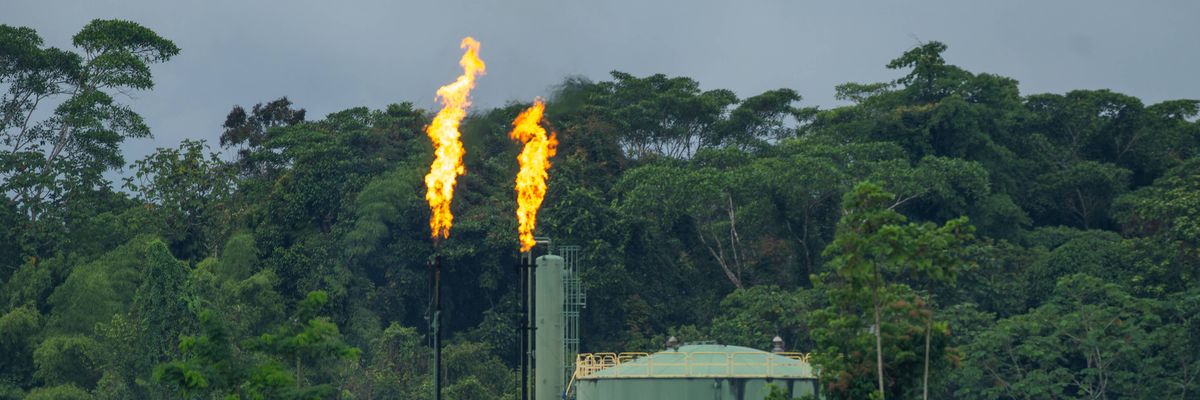
More than 40 advocacy groups on Thursday issued a declaration calling on the world’s governments to establish permanent "Fossil Free Zones” to protect the climate, critical ecosystems, and Indigenous peoples and their lands from oil, gas, and coal exploration and extraction.
Unveiled at the United Nations Climate Change Conference—also known as COP31—in Antalya, Türkiye, the Fossil Free Zones Declaration urges governments to make the zones a central component of each nation’s plans to transition away from oil, coal, and gas.
What is a Fossil Free Zone? As Cecilia Requena, a Bolivian senator and environmentalist, and Juan Pablo Osornio, the engagement and policy director at the nonprofit green group Earth Insight, explained:
A Fossil Free Zone is a defined area demarcated by its ecological, biodiversity, or cultural significance, where exploration, extraction, and development of fossil fuels are permanently prohibited. Think tropical rainforests, key biodiversity areas, Indigenous peoples’ territories, and critical marine ecosystems. They translate the abstract global commitment to transitioning away from fossil fuels into something tangible: a map, a boundary, a legal safeguard.
“Amid deep geopolitical fragmentation and weakening international cooperation, continued dependence on fossil fuels is further exacerbating existing vulnerabilities,” the Fossil Free Zones Declarations states.
“Beyond its climate impacts, this dependence exposes countries and communities to volatile energy markets, supply disruptions, and economic instability, while undermining energy security and national sovereignty,” the document continues. “Continued coal, oil, and gas extraction also causes unnecessary and avoidable harm to people and nature, including driving deforestation and biodiversity loss.”
“Fossil fuel expansion continues to threaten ecosystems essential for biodiversity, climate stability, and the cultures and livelihoods of the peoples who protect them,” the declaration adds. “Halting this expansion in critical territories such as forests or coral reefs is therefore an immediate, concrete step toward a just, orderly, and equitable transition, alongside plans to phase out existing fossil fuel production within key ecosystems.”
The declaration—whose signatories include WWF International, Amazon Watch, the Science Panel for the Amazon, and Parliamentarians for a Fossil Free Future—calls for halting new fossil fuel exploration and expansion while prioritizing the responsible closure of existing projects in areas of climatic, ecological, and cultural importance.
“Fossil Free Zones are where the transition away from fossil fuels stops being a promise and starts happening on the ground," said Earth Insight senior associate for diplomacy Ignacio Arróniz Velasco. “When governments permanently close critical ecosystems and Indigenous territories to oil, gas, and coal extraction, they protect ecosystems, uphold the rights of the peoples who steward nature, and take a concrete first step towards a full, fair phaseout.”
“This can be done with existing tools like nature protection laws or land tenure recognition,” he stressed. "This is what implementation looks like. COP31 gives governments a real chance to work together on Fossil Free Zones and build them into their national roadmaps, so the just transition starts in the places that matter most for climate, nature, and people.”
Noting that “the Arctic is warming more than twice as fast as the rest of the globe, and should be the most obvious place to draw the line against new fossil fuel development,” Susanne Waage, WWF Norway’s fossil fuel transition lead, lamented that “Norway continues to explore aggressively for new oil and gas in one of the world’s most vulnerable regions.”
Waage added that the European Union, “Norway’s largest oil and gas customer, has already said no to new Arctic oil and gas. Norway should listen, stop exploring for new oil and gas resources, and help make the Arctic a Fossil Free Zone.”
Pascal Mirindi, Democratic Republic of Congo national coordinator of the group Our Land Without Oil, asserted: “We cannot claim to protect forests, peatlands, and vital ecosystems while opening the door to oil and gas within them. In the DRC, these projects threaten territories and the communities who depend on them for their livelihoods.”
“Fossil Free Zones offer a concrete and immediate solution,” Mirindi added. “Here at COP31, we are calling on governments to end all new exploration in critical ecosystems, to recognize these zones in their national roadmaps, and to guarantee a just transition centered on the rights of communities.”
From Common Dreams via This RSS Feed.