

By Maria Paez Victor – Nov 10, 2026
I have just returned from my homeland, Venezuela—after the January 3rd bombing and kidnapping of the democratically elected president and his wife, and after the June 24th rare and devastating double earthquake. The country is still reeling. “What else is going to happen to us?” I heard so many say.
After our plane landed at midnight in a darkened international airport of Maiquetía, a little bus took us, from a remote temporary runway, across the entire airport—in utter silence. No one said anything, just looked astounded at the full length of what had been a thriving, modern airport, now all darkened and shut down. Tears came unbidden at the sight of how such a fine emblematic building had been laid low. We were taken to a temporary terminal, and it was a marvel to see what the Venezuelans authorities had managed to set up, and at how efficient the personnel were. I needed physical assistance and was overwhelmed at how cheerfully I was helped to get around. There were no US flags nor any of their military at the airport. It was completely in the hands of the Venezuelan National Guard and the airport staff. And all the staff I talked with were inordinately proud of what they had accomplished there. The airport was run with smooth administrative efficiency.
However, all around outside the airport one could see the ruins of what had once been thriving vacation beach areas and communities. The losses of the earthquake, being so widespread, have been uppermost in the conversations. It seemed everyone I met knew someone, or of someone, who was killed or whose home was destroyed. I heard moving stories of how the population rushed to the shores of La Guaira to help, just as soon as the news of the devastation was understood.
Those volunteers who first arrived told me of their incapacitating shock at the destruction, the bodies, the screams, for which they were not prepared. They fully approved of the Venezuelan armed forces declaring the area a military zone and the subsequent, and almost immediate, organization of communes, communal councils, neighbourhoods, lining up with food, water, and all sorts of aid for the rescuers as well as the rescued. One woman told me that she and her working-class community baked arepas (Venezuelan corn bread) all night until her arms and hands ached. 26 years of emergency planning, and neighbourhood organizations gave valuable help to the Armed Forces and rescue teams.
When the US arrived with 2,000 unbidden and unwelcomed troops, they found they were not able to ‘take over,” and in a matter of days the Southern Command left, admitting there was nothing for the soldiers to do.
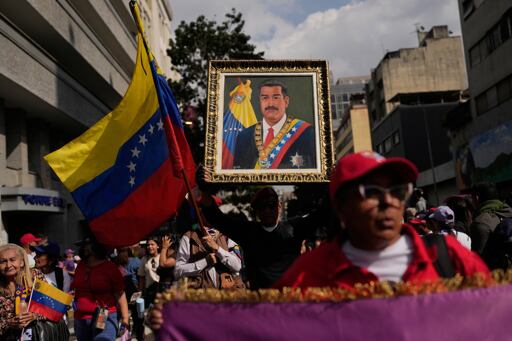
Along highways, there are large billboards with the photos of President Nicolas Maduro and First Lady Cilia Flores demanding their return, but most people I talked with seem unable to trust any US justice to bring them back. There is also a sense that Venezuela is alone. Apart from the international rescue teams that came after the earthquake, and towards whom everyone felt enormous gratitude- politically Venezuelans feel they have been left alone, shunned and no one is really coming to their aid. The empire took over and the world shrugged. Interest is centered only on what countries and companies can grab of its resources. Talk of “international law” is mostly considered a joke, as the blatant trampling of the country’s laws, constitution, human rights, slaughter of 120 people with unknown and banned hypersonic missiles, murder of fishermen in the Caribbean, kidnapping of the legitimate president and his wife, are proof of the hypocrisy and evil intents of the international “rules-based” order.
It is not despair, because astonishingly, Venezuelans are optimistic, believing in their own resiliency. Many said to me: “We have withstood so many blows already; we will prevail because we know how to resist. “Venezuelans feel it is only themselves who will overcome these misfortunes because no one is coming to their rescue. Indeed, the latest polls show that 70% of Venezuelans trust in the country’s economic recovery and 82% believe peace is fundamental.
Everyone in Venezuela wants peace. No one wants to see the extremist opposition’s brand of street violence and mayhem, which is the only thing people like Maria Corina Machado can offer. In fact, she has been invisible since her return, showing her face only in elite strongholds like the private Catholic university. She is irrelevant to Venezuelan daily life or politics, with only the Miami social media to back her and that ridiculous tiny elite that has never stopped longing for the past.
I was at a theatre and happened to sit next to the daughter of one of Venezuela’s former decrepit presidents—before Chávez. It was not surprising to hear her utter superficialities and expressed longing for “how things were.” It is a pathetic elite that lost power but craves its return without having to deal with all those shoeless, ungrateful, ignorant people who do not know whom they vote for. It is as if they live in a frozen time. I almost felt sorry for her, but not quite. Wilful blindness is no excuse.
The United States has been acting outwardly with prudence. There are no US flags or emblems flying around. One does not see any of their guards or soldiers in the cities. One does see boorish “americanos” offending the citizens by strolling around the city areas (not the popular ones) as if they were on a beach, with flip flops and gaudy t-shirts, as if they owned the place. Nobody speaks to them. They are there however, like an evil wizard behind the curtain.
And there are the carpetbaggers, mostly a Rubio gang of Cuban-Americans, and billionaires like Richard Branson, that are out to get as much as they can out of the defeated country. They are eager to further seduce and make deals with the neo-fascist Venezuelan elite that acts like the cat that swallowed the bird, and in fact does not need much seduction. This elite has lived in a self-created bubble since 2000, and now is salivating, hoping to make a lot of money out of these “businessmen”—official gangsters—that now seek them to sack the country.
I spoke with some of this despicable elite—one even denied the country had been bombed and who repeated, like parrots, the accusation against Maduro. They are quite happy the US kidnapped him. Their lack of understanding, even a mild view, beyond their immediate interests is astounding. They seem to have no sense of the wide and deep changes that are happening in world politics. No wonder they are a minority, will remain a minority and will never gain power again with any kind of popular backing.
For the majority of Venezuelans, however, things are not too different from before since the illegal sanctions are still exerting their malign pressure on daily life. The shops are stocked, they do have products to sell, it is just that people do not have the money to buy.
Foreign Minister Oliver Blanco Says Venezuela Is Undergoing ‘Democratic Transformation’
The big difference is, however, the secrecy. There is a great deal of it, and I suspect not in the form of censorship, but self-imposed, a form of passive defense. The news are centred on secondary, sometimes banal announcements but no full information of what the government plans, budget, or income is about, only drips of data flow. It is known via US media that Caracas still does not have access to all the money from oil sales, in fact, there is no clear information as to where the money is. Some assume the US takes it all. Trump himself has bragged on camera that they have taken billions from Venezuela.
Even US Democratic representatives are suspicious as to where the Venezuelan money is held and by whom. Now with a majority in Congress, Democrats have a proposal to curb US public funded investments which will certainly include the murky deal with American Blue Energy Partners to exploit 17 Venezuelan oil fields with 35% shares going directly to the Pentagon, and plans to curb any further US military intervention in Venezuela. In other words, Trump’ s pumped-up Monroe Doctrine will be under serious scrutiny. This may mean that any further bombing of Venezuela will not be probable, lowering the risk to Caracas and help them resist further domination.
Caracas does not have the funds to properly keep up the social services which is one of the main goals of the US empire: to destroy the social network and security that the 26 years of Chavismo built up—to destroy any vestige of socialist well-being. It is being done like administering a slow, gradual poison, or death by starvation.
The economic statistics are good—for what these economic indicators are worth. The UN ECLAC (CEPAL, Economic Commission for Latina America and the Caribbean) in its October report states they foresee a 6.5% growth in Venezuelan GDP, highest in the region. However, this crude indicator states nothing about the real economy of every day, about overall well-being or quality of life, inequality, environmental needs, about, in fact, any measure of people’s happiness. Again, the great incognita is: How much of this “prosperity” actually goes into the Venezuelan government’s coffers?
Despite the circumstances, Venezuelans have not given up hope in their own country, their own resourcefulness, and their own future. If one fifth of what has happened there had occurred in any other democracy that I know, there would have been full revulsion of government. Not so in Venezuela. The people know perfectly well whom to blame and it is not themselves or their government. They were defeated and the victor is in plain sight. There will be no coup, no protests against themselves and their government. “Wait, have patience and resist” is the password I heard, a silent, perhaps savage, defence strategy is at hand.
“But we are not fools. We know all this. We do not fall into provocations. Loving submissiveness and the fierce rebellion, both, in failing us, have taught us better. Let them organize us, incorporate us into their organizations, make us serve in their world, but since all this machinery with all its values, is alien to us we will cook their food adding our fecal and menstrual matter, saliva and sweat to witness, in secret, our rejection…
We will work in their plantations and ranches making alliances with the parrot, the worm, the locust, the pest, with the ambiguous violence of the waters and with fire…We apparently accept the relation of the dominator and will collaborate with him because it is not possible to defeat him for now, but we abolish in secret the alienation that accompanies domination and we undermine from below, from inside like a parasite, we undermine all the occidental enterprise in America (pp.93-97)
(Discurso Salvaje , J.M. Briceño Guerrero, 1980)
MPV/OT
From Orinoco Tribune via This RSS Feed.