

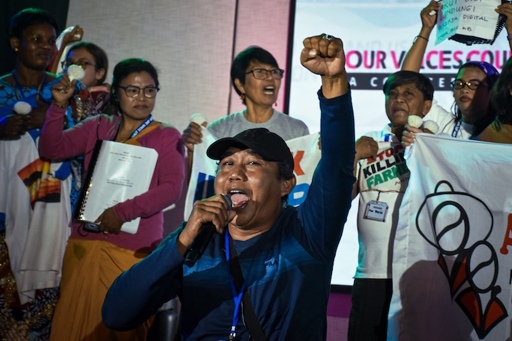
The Counterdocket exposed the harms caused by the IMF-WB.
BANGKOK – For 80 years, the International Monetary Fund (IMF) and World Bank (WB) brought suffering to many communities in the Global South.
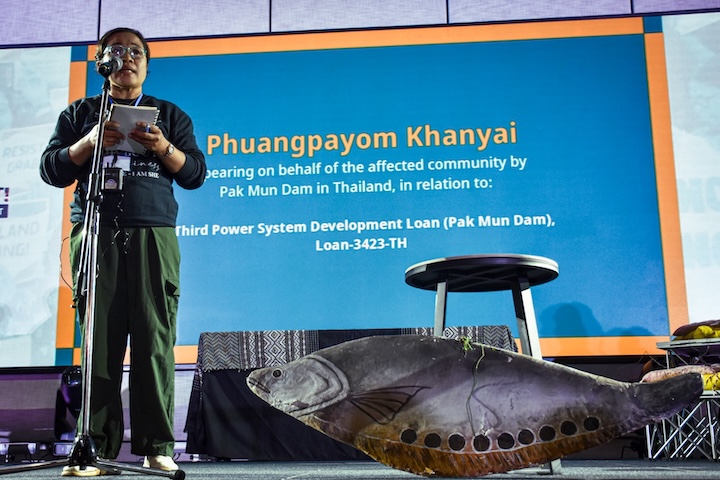
On October 15, their stories were heard at the Counterdocket in Bangkok, Thailand where the two Breton Woods institutions also held their annual meeting from October 12 to 18.
Dubbed as Our Voices Count! A Counterdocket, it brought together movements to challenge extractive systems and demand greater accountability from the IMF-WB. The Counterdocket exposed the harms caused by the IMF-WB. From the Support to Parcelization of Lands for Individual Titling (SPLIT) project of the WB Group in the Philippines to Lithium mining in Argentina, these testimonies became public records of the IMF-WB’s effects on communities.
“This counterdocket is an act of historical and political reassertion,” said Joms Salvador, regional coordinator of the Asia Pacific Forum on Women Law and Development (APWLD) during the opening on October 15. “The communities sitting in this room are not beneficiaries of course waiting for charity, nor are they subjects to be studied. You are the plaintiffs. You are the witnesses. And you are the judges of a system that has failed humanly. And through the voices of community leaders, feminist economists, legal scholars, and human rights defenders across all these sessions throughout the day, we are building an irrefutable record of systemic accountability.”
“Its jurisdiction is not grounded in formal legal authority, but in the right of communities to document, testify, question and demand accountability for decisions that shape their lives,” said Zeph Repollo, Southeast Asia regional director at Just Associates (JASS), a feminist movement-building organization.
(Photo courtesy of Asia Pacific Forum on Women Law and Development)
She added, “It is an expression of communities’ self determination and their right to be heard, particularly in a context where existing accountability mechanisms have proven largely ineffective in addressing the consequences of IFI (international financing institutions) actions for economic, social, cultural, and environmental rights.”
The Counterdocket focused on five connected themes examining how economic policies, development projects, and global power structures affected the communities in the Global South. The testimonies presented covered a range of projects and issues spanned across South Asia, South East Asia, Africa and Latin America.
Some of the cases heard at the Counterdocket included the Sentani Airport and Transformation of Buyaka Ancestral Land case in West Papua
IMF-WB effects on Filipinos lives
At the Counterdocket, Ana Marie Mijares, 54, a farmer from Kabankalan, Negros Occidental narrated the militarization they experienced in the government’s implementation of SPLIT, a project of the Department of Agrarian Reform and the World Bank Group.
According to the project proponent, the main objective of SPLIT is to improve the land tenure or the rights of the farmers to the land they cultivate and to provide individual titles to farmers under collective certificate of land ownership award (CLOA).
Their community is composed mainly of farmer-beneficiaries and former sugar farmworkers organized through Kauswagan sang Bino para sa Buhi kag Hilway nga Palangabuhian (Kabuhi-an) and Kauswagan sang Mamumugon, Mangunguma sa Bino (KASMMABI) in Barangay Orong, Kabankalan City, Negros Occidental.
The community manages around 198 hectares of land awarded through the Comprehensive Agrarian Reform Program in 1998 under a collective Certificate of Land Ownership Award (CLOA). The original beneficiaries were former hacienda sugarcane workers, with additional Agrarian Reform Beneficiaries (ARBs) later included through a petition for the inclusion of qualified ARBs in the landholding. The community now involves around 168 farming families.
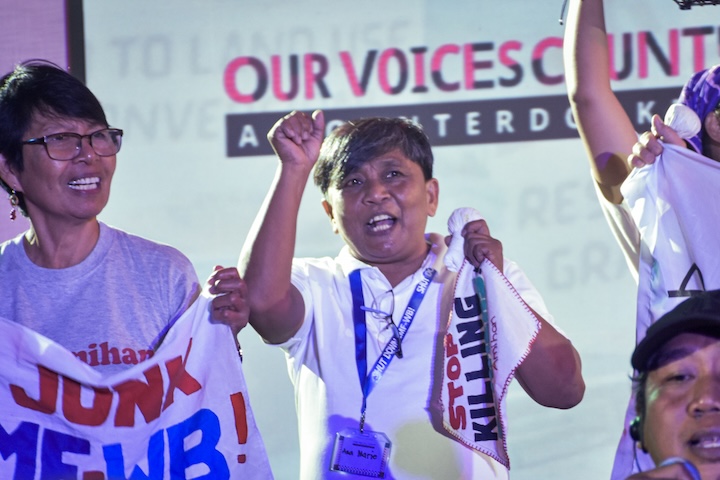
Ana Marie Mijares (middle) with other delegates at the Counterdocket. (Photo courtesy of Asia Pacific Forum on Women Law and Development)
After years of struggle for land, the farmers developed their own way of managing the property. Each family cultivates an individual portion of around 1.5 hectares, while at least 15 hectares are maintained as common or collective land for collective production.
This is why, Mijares said, they do not need individual titles because at present, the land that they collectively cultivate can support their needs. “We have three hectares of land that we cultivate. This is where we get our food for consumption. We encourage the bayanihan culture where we help one another in the community,” Mijares told Bulatlat in an interview.
She said that in their collective production, their harvest would be divided among all those who worked on the land for their own consumption. Aside from sugar cane and crops, they also plant Masipag lines or rice varieties developed by farmer-breeders through crossbreeding two or three rice varieties or what they call as farmer-bred lines.
Mijares said that they were against SPLIT and have organized women in their community to strengthen their opposition to the project. She said that SPLIT only led to the division of farmers because DAR promised that those who will obtain individual title can easily sell their land if the need arises.
Read: World Bank-funded project in Negros spells division, violence for farming communities
To convince those who are under collective CLOA, Mijares said that military forces were also deployed in areas where lands are under collective CLOA. The military would red-tag them or associate them to the revolutionary group New People’s Army.
“Some were being offered trucks just to give up their land,” Mijares said.
SPLIT aims to parcel around 139,000 collective CLOAs. The DAR proposed a $473 million total budget for the SPLIT project, with 78 percent coming from a World Bank loan and remaining 22 percent from the Philippine government. In June 2020, the WB approved the loan, amounting to $370 million, payable in 29 to 39.5 years.
Community-led alternative
Also presented at the Counterdocket is the Green Revolution, a project funded by the WB implemented in the Philippines. According to Ibon Foundation, the program was introduced by WB across Asia to facilitate the sale of input-dependent, high-yielding rice varieties and the chemical inputs peddled by transnational agricultural corporations.
The think-tank group said that in the Philippines, the program was paired with a credit facility so farmers could afford the higher production costs driven by their growing dependence on chemicals. They described the project as “a fiasco” as Filipino farmers fell deeper into debt while soil and land quality declined.
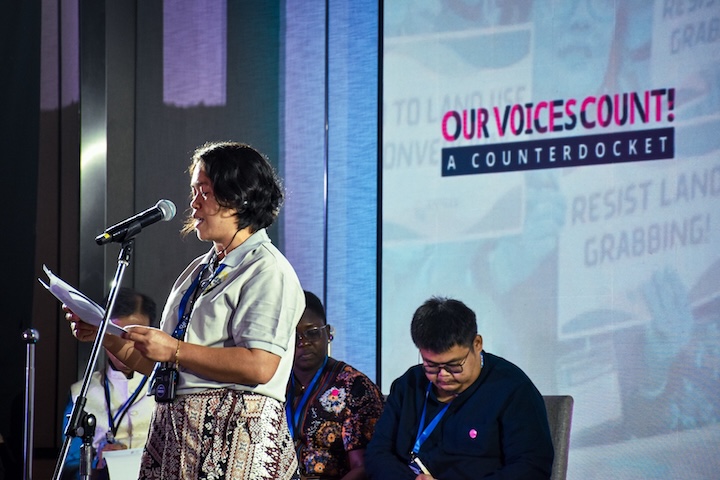
Emelyn Garay Chato, farmer member of Masipag speaking at the Counterdocket in Bangkok, Thailand. (Photo courtesy of Asia Pacific Forum on Women Law and Development)
Emelyn Garay Chato, who spoke on behalf of farmer members of Magsasaka at Siyentipiko para sa Pagunlad ng Agrikultura (Masipag) at the Counterdocket shared her father’s experience with the implementation of the Green Revolution in the Philippines. “When the government started distributing miracle rice, we were encouraged to adapt supposedly to these high yielding varieties. At first the harvest was promising but over time we became dependent on buying seeds and agricultural inputs.”
Her father acquired loans to buy seeds for the rice production. This also took a toll on her father’s health. “My dad got sick because of the excessive chemicals, and also from being so, so tired from trying to pay off the debt. My parents literally died still in debt,” she said, adding that when her father died, her mother had to find ways to pay off their debt.
This was not only her family’s experience but also other community members.
She said, “The promise of productivity did not necessarily translate to either income or freedom from poverty and debt. And women carry the heaviest burden, and we must find loans, manage our farms, care for our families, and attend microfinance meetings. Some members struggle to participate in our organization activities and training because of this conflict with the repayment schedule.”
Until they worked with Masipag, Chato said that they were able to rediscover the importance of native seeds and build a different vision of development. “One is on agroecology and diversified integrated farming systems.”
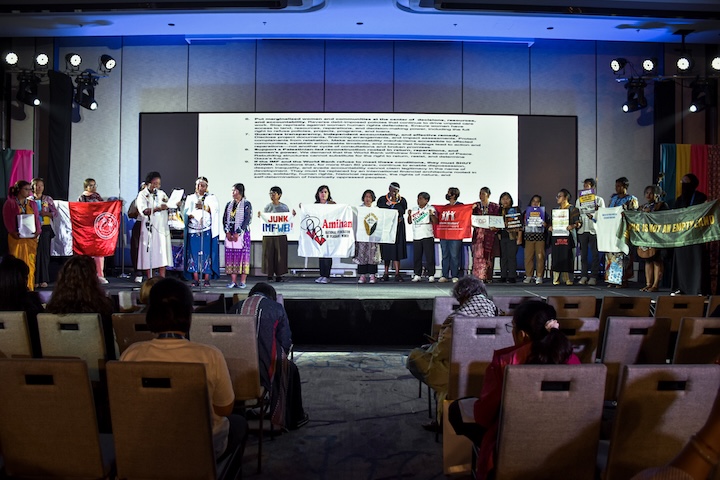
Photo courtesy of Asia Pacific Forum on Women Law and Development
They were able to establish trial farms where they tested and identified rice varieties that are resilient and suited for our actual farming condition. “We can produce through farming, rice breeding, and conserve our own seeds instead of depending on purchased varieties and chemical inputs,” Chato shared. They are also working to establish a community seed bank.
They also shared their products and experiences in community events like the Patikim Festival.
“This achievement was made possible not by debt, but by collective action by Bayanihan. For us, the face of Bayanihan is farmers exchanging seeds, sharing knowledge, and helping one another. It is the recognition that our development must be built on cooperation, not dependence on loans,” Chato said.
Development for whom?
Yokbeth Felle, an activist and a third-generation Papuan from the Sentani/Bayuka clan also spoke at the Counterdocket. According to her, the Sentani people, also known as Buyaka (with “Bu” meaning water, “yaka” meaning visible), are an Indigenous community living along the shores of Lake Sentani, Jayapura, West Papua. Their ancestral lands have been affected by the Sentani Airport and the transformation of the Bayuka ancestral land.
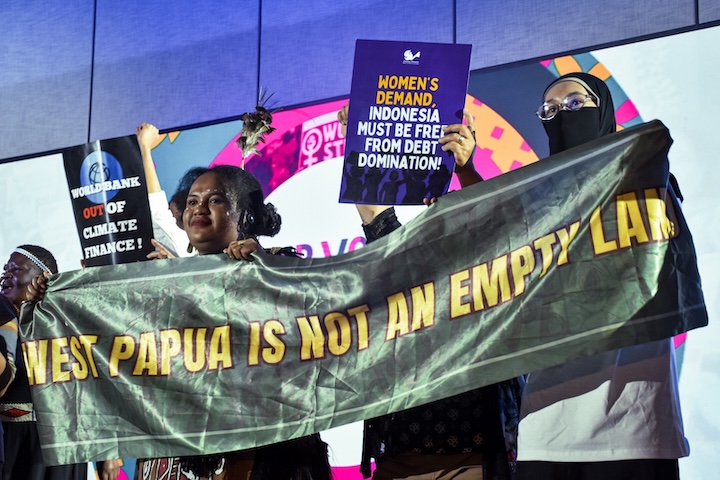
Photo courtesy of Asia Pacific Forum on Women Law and Development
Historically, West Papua was supposed to be an independent nation when the Indonesian government occupied their land. The Indonesian government implemented policies like the Repelita (Five-Year Development Plan) in 1969 where ancestral lands of the people of West Papua were taken over by projects like the building of Sentani Airport.
“The transmigration program, which relocated people from outside Papua to Papua, marked the beginning of the dominance of the non-Papuan population in almost every aspect of Papua’s economy, even though the fate of the transmigrants in the Repelita program was not entirely as favorable as the government had promised; nevertheless, at least 9,916 households were relocated to Papua during Repelita I–III, followed by another 137,800 households sent to Papua during Repelita IV,” Felle said, adding that during the pre-Repelita period in 1964, there were more than 267 or 1,000 migrants who were already relocated.
This development plan, she said, relied heavily on loans from the World Bank. The development in West Papua did not only dispossess the Indigenous People of their land, they also faced low paying jobs.
“Village lands and farmland have been transformed into modern markets, schools, military bases, government offices, and hunting grounds have been converted into an airport. All of our families now live in urban areas that have been reshaped in the name of fervent development. We have left behind the lake that once defined our tribal identity,” Felle said.
“Every time I walk through Sentani Airport, I don’t see people from my clan holding important positions. I see members of my Indigenous community pushing carts, running after people arriving at the airport to offer their services,” Felle said, adding that compensation for the airport land has never been paid, yet management and all other affairs are controlled by Indonesians.
No justice
“Since their founding, the World Bank and IMF have perpetrated violence and colonial structures across the global majority. The World Bank Group has violated its own safeguards, deceived communities, and systematically ignored demands for justice, remedy, and reparations,” said Felipe Mesel of the International Network for Economic, Social and Cultural Rights who read the verdict on October 15. He was one of the panels of the Tribunal.
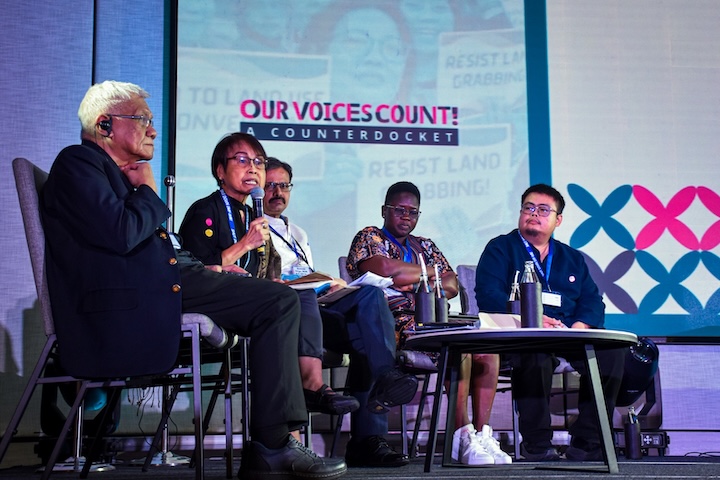
Photo courtesy of Asia Pacific Forum on Women Law and Development
He added, “The World Bank Group should suspend support for all projects shared here today and provide meaningful remedy and reparations to these communities based on how they define remedy and reparations, how communities define remedy and reparations.”
The cases presented at the Counterdocket as well as the verdict were handed to Ibrahim Pam, chairperson of the World Bank Inspection Panel and Acting Director General of the Compliance Advisor Ombudsman, who attended the event.
The World Bank Inspection Panel and the Compliance Advisor Ombudsman are two of the independent accountability mechanisms of the World Bank Group.
But critics said that these mechanisms have not given justice to damages the financial institutions have caused the marginalized communities.
Mesel added, “The Tribunal recommends that the World Bank Group suspend support for the projects presented, provide community-defined remedy and reparations to all affected communities, respect Indigenous Peoples’ right to free, prior, and informed consent and self-determination, and immediately withdraw from the Board of Peace.”
The Board of Peace is an international organization established by US President Donald Trump to oversee ceasefire and reconstruction of Gaza.
Groups held a lighting protest at the venue of the Counterdocket to call for the junking of the IMF-WB. (DAA)
The post IMF, WB cause misery for marginalized communities appeared first on Bulatlat.
From Bulatlat via This RSS Feed.