

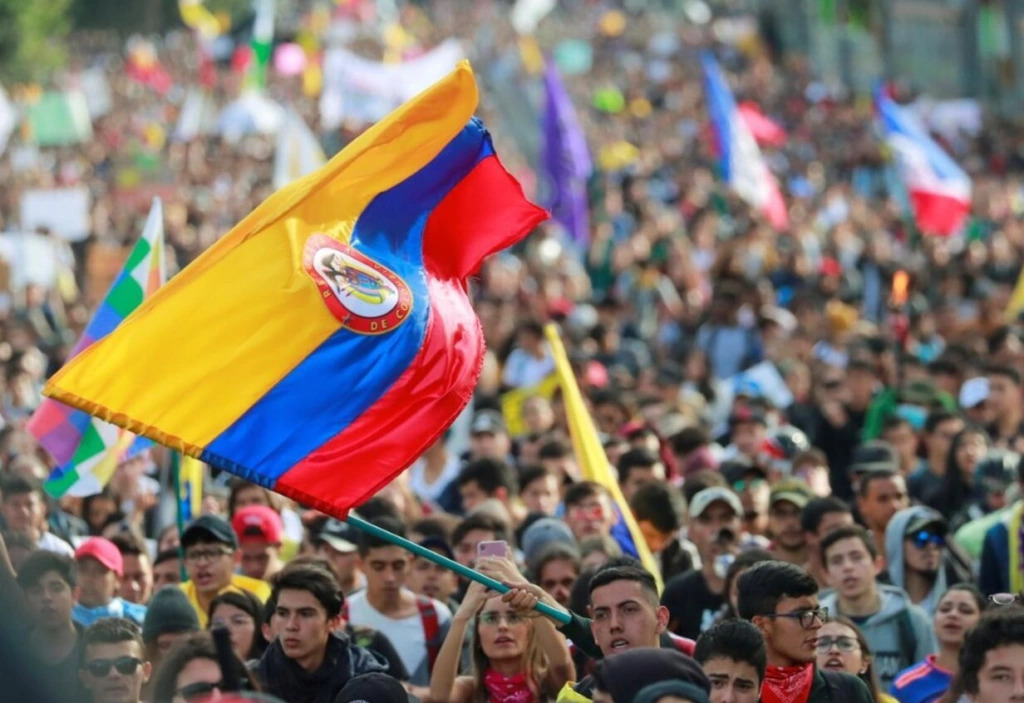
Colombia’s Historic Part party vowed to block the government’s Fiscal Rescue Law in Congress and called supporters into the streets on November 19, arguing the tax reform would deepen hardship for low-income families and working people.
The Historic Pact announced it will fight the government’s tax reform in Congress and urged citizens to demonstrate on November 19 against the measure.
The progressive organization released the call in a statement issued in Bogotá, framing the bill as an “assault on working families.”
RELATED: Colombian Police Repress Peaceful Student Protest Against President De la Espriella
The party described the proposal as the most regressive in the country’s recent history, arguing it harms low-income families, popular sectors and the working class. Its leaders also accused President Abelardo de la Espriella of trying to import economic policies designed abroad.
“The Unified Regime to Generate Business Stability (RUGE) is the adaptation of Milei’s Argentine Large Investment Incentive Scheme (RIGI), creating long-term tax exemptions for mega investment projects without employment generation commitments and with little national productive linkage”, the statement denounced.
Desde el Pacto Histórico convocamos a las calles este 19 de noviembre para frenar la reforma tributaria de Abelardo de la Espriella. ¡Defendamos el bolsillo de las familias, los recursos del SENA y el ICBF! Nos movilizamos para hundir esta reforma. ¡No… pic.twitter.com/FFI9qrP2mD
— Pacto Histórico Oficial (@PactoCol) November 11, 2026
Text reads: “From the Historic Pact we have called for a meeting on November 19 to halt Abelardo de la Espriella’s tax reform. Defend the pockets of families, the resources of SENA and the ICBF! We are mobilizing to sink this reform”.
Historic Pact’s projections place inflation at 7.67% under the law, with food prices climbing 13.29% and unemployment reaching 10.11% after 32 months in force. Following this, the organization estimates half a million people would suffer direct harm.
The communiqué went further, accusing the government of sidelining public debate to advance the privatization of state companies such as Ecopetrol and regional electricity providers. It warned that spending caps, staff cuts and new contracting rules could erode the capacity of hospitals, schools, local governments and social programs.
“We warn of risks to employment and public services if spending restrictions, staff reductions or changes in contracting reduce the capacity of hospitals, schools, territorial entities and social programs to serve the population“, the party stated.
Faced with these warnings, the Historic Pact insisted that “taking to the streets” is the only way to stop the initiative, and declared that its approval will not be permitted. The November 19 mobilization is the concrete expression of that position.
🔴🇨🇴 ¡Colombia se moviliza!
✊ La CUT convoca al Paro Nacional del 19 de noviembre. Unidad, organización y lucha para defender la democracia y los derechos del pueblo colombiano. pic.twitter.com/Q0fP5Y2M34
— Central Unitaria de Trabajadores (@cutcolombia) November 9, 2026
Text reads: “Colombia mobilizes! The Central Unitary Workers’ Union (CUT) calls for the National Strike on November 19. Unity, organization and struggle to defend democracy and the rights of the Colombian people”.
Congress Splits Deeply
The bill arrives in Congress with alliances already fractured. The Liberal Party strongly questioned the proposal, directing its sharpest criticism at the 19% increase in value-added tax on the basic family basket.
The right-wing Democratic Center party,led by former President Alvaro Uribe, who governed from 2002 to 2010, proposed deep changes to the text. That party rejects taxes on food and basic services, but defends restructuring the state and privatizing Ecopetrol, positions that collide directly with oil unions.
The divisions stretch beyond the opposition. Government and opposition benches alike have voiced rejection of the Fiscal Rescue Law, a sign that de la Espriella cannot count on a stable majority to push the bill through.
Labor pressure is mounting in parallel. The Central Unitary Workers’ Union (CUT) has already convened a national strike against the fiscal adjustment, and the November 19 demonstration would bring the political and union fronts together.
The bill’s fate remains uncertain. With no single bloc commanding a majority and divisions running through both camps, the coming weeks could reshape the debate far beyond the next march.
From teleSUR English via This RSS Feed.