

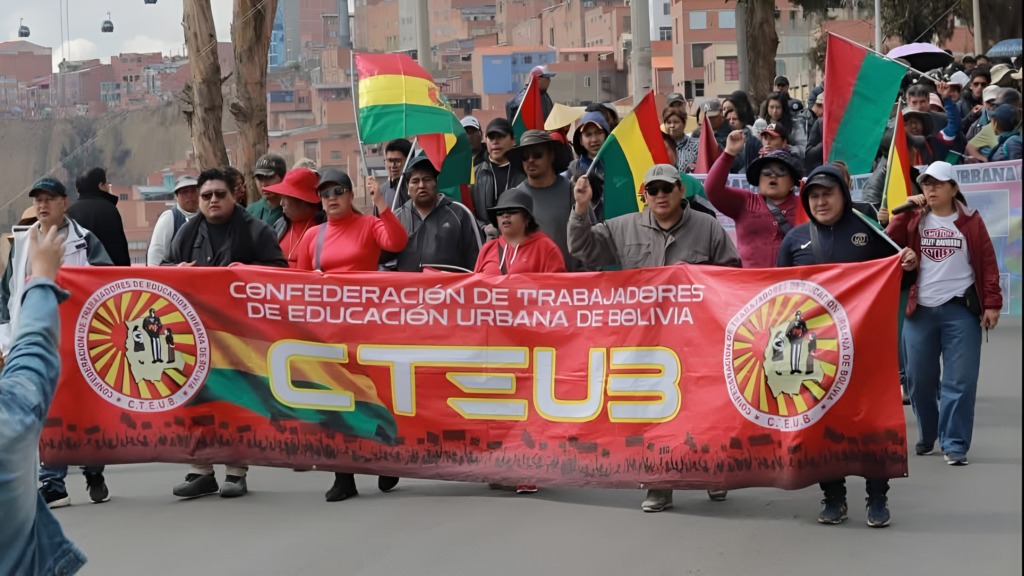
Bolivia’s urban educators initiate national hunger strikes as President Rodrigo Paz proposes education system decentralization to departmental governorates.
In October, Bolivia entered a period of social conflict with nationwide labor strikes, street blockades, and hunger strikes. At the center is the Rodrigo Paz proposal for structural reform of the national education system.
The Executive power submitted a draft bill to reform the administrative framework for higher technical education. The proposal seeks to transfer the management of financial resources, personnel, and infrastructure for the Preschool, Primary, and Secondary Levels, as well as the technical, technological, and artistic institutes, from the central Ministry of Education to the nine departmental governments.
RELATED: Bolivia: Teachers Continue Strike Against Educational Decentralization
This legislative effort of the far-right Rodrigo Paz’s administration has drawn strong resistance from urban teaching unions, trade federations, and technical students.
These groups said that the decentralization policy is a step toward fiscal austerity and the privatization of public education. This wave of conflict occurred in the first year of President Rodrigo Paz Pereira’s administration.
After 48 hours of the second round of strikes, Bolivia’s standoff highlights broader debates over state centralization, regional governance, and the protection of public services in the country.
Teachers in Bolivia have launched a 48-hour nationwide strike in protest of the government’s proposal for educational decentralization. 🇧🇴📢
Educators took to the streets to voice strong opposition to the planned reform, warning that decentralization threatens public education… pic.twitter.com/LmgOpGM4hQ
— teleSUR English (@telesurenglish) November 9, 2026
Details of the Conflict and Proposed Decentralization
The mobilizations against the government’s educational decentralization plan in Bolivia began on October 23, 2026, when the urban teachers’ union made its first 24-hour national strike, organizing simultaneous protest marches across all nine departmental capitals of Bolivia.
At the time, officials from the Ministry of Education signed an initial administrative agreement with the Santa Cruz departmental government to formally initiate the transfer of oversight powers over technical and technological institutes.
Attempts to negotiate the policy quickly collapsed. On October 29, 2026, formal talks between government representatives and national union leadership broke down without an agreement. After the dialogue breakdown, rank-and-file teachers escalated their protest actions, occupying the premises of several technical institutes and taking their demonstrations directly to urban thoroughfares.
By November 4, teachers’ and students’ protests underwent rapid radicalization. Striking educators established more than 40 hunger-strike encampments in key cities nationwide, including La Paz, Sucre, and Oruro. Protesters also initiated strategic road blockades along vital transit corridors, attempting to cut off the main highway connecting La Paz and El Alto.
The escalation culminated between November 9 and November 10, when the union leadership launched a coordinated 48-hour national strike. This action resulted in a widespread suspension of classes across public primary, secondary, and post-secondary technical institutions.
The primary driver of the conflict remains the proposed administrative restructuring of post-secondary education. Under the current national system, the central Ministry of Education holds sole responsibility for allocating operating budgets, maintaining structural items, and covering payroll for higher technical, technological, and artistic institutes.
The Paz administration’s bill transfers these financial and administrative obligations directly to departmental governorates. Union leaders maintain that departmental governments face severe structural budget deficits and cannot guarantee future payrolls or facility maintenance without instituting tuition fees.
Bolivia’s urban teachers are holding a 48-hour national strike on Nov. 9–10 against the government’s education decentralization plan, La Razón and Red Uno report.https://t.co/jEsHzBWxVE pic.twitter.com/uSA1U211s1
— TheOverlooked.News (@newsoverlooked) November 9, 2026
Government Positions
The Bolivian administration has maintained its position regarding the educational decentralization initiative. In public addresses, President Paz stated that regionalization and improved connectivity, including agreements signed with local municipalities, are essential tools to modernize public institutions and broaden educational access.
The Executive power argues that transferring preschool, primary, secondary, higher technical, technological, and artistic institutes to departmental governments does not constitute privatization.
At a press conference on November 9, Minister of Education Erick Sanjinés directly addressed labor leaders. Sanjinés stated: “To say that we are privatizing education is to lie to the population. Transferring the administration of higher technical institutes to the governorates does not mean transferring them to the private sector; it means transferring them from one public entity, such as the Ministry of Education, to another public entity, such as the governorates”.
Minister Sanjinés further emphasized that the central state will retain regulatory authority and quality control standards over technical curricula. The Ministry also committed to transferring the existing institutional budgets alongside administrative responsibilities to ensure the payment of salaries.
Government representatives have additionally criticized the trade unions’ tactical choices. Sanjinés labeled the 48-hour strike illegal and politically motivated, asserting that classroom suspensions risk harming 2.2 million primary and secondary students across the country.
The administration warned that unexcused teacher absences would result in mandatory salary deductions under labor law guidelines.
Resistance Tactics and Opposition Voices
The leadership of the Urban Education Workers and regional trade federations rejects the government’s characterization of the reform.
Union spokespersons, such as La Paz Union’s Executive Aní Bozo, argue that shifting administrative responsibilities to underfunded departmental governorates will undermine the unitary public school system. Protesters point out that the trade sector already absorbs over 700,000 hours of uncompensated labor annually to cover structural staffing shortfalls.
Resistance tactics have intensified following the November 4 launch of the national strike. Teachers have combined street marches with sit-ins outside government buildings in major capital cities. According to some media outlets, more than 30 people, both teachers and students, have already been detained.
During demonstrations in La Paz, police units deployed tear gas to disperse groups of marching teachers near the Plaza del Estudiante, leading to calls from union representatives for law enforcement to respect the constitutional right to peaceful assembly.
Protesters have explicitly called for the resignation of Education Minister Erick Sanjinés, warning that the mobilizations will continue until the decentralization draft bill is formally withdrawn.
Political opposition groups have also aligned against the executive proposal. Former President Evo Morales publicly criticized the Paz administration’s bill, framing the decentralization of technical education as a regressive economic measure.
Morales claimed that transferring public education infrastructure to regional governments mirrors prior structural adjustment policies and threatens the state’s obligation to guarantee free public education.
Some legal analysts aligned with trade unions also point to potential constitutional conflicts. Article 77 of the Plurinational State Constitution of Bolivia establishes that the state holds the primary responsibility to guarantee, finance, and direct the public education system. “Labor representatives argue that delegating payroll and operational funding to local administrations fragments the single national framework and threatens labor protections established under national law,” the article says.
#Bolivia | Urban teachers launched a 48-hour strike, suspending classes and staging demonstrations against a government plan to decentralize education that they warn could undermine public schooling by shifting responsibilities to regional authorities.https://t.co/v7tN9kddKe
— teleSUR English (@telesurenglish) November 10, 2026
Potential Outcomes and Institutional Resolution
The conflict surrounding the October 2026 educational reform reflects ongoing debates regarding central state authority, regional funding, and labor rights in Bolivia.
As hunger strikes continue and trade unions threaten further strikes, the administration faces pressure to reconcile its decentralization agenda with demands from the public sector.
While President Rodrigo Paz maintains that regional administration will improve institutional governance and digital connectivity, organized labor sectors view the proposal as a financial risk to public institutions.
The resolution of this dispute will likely depend on formal dialogue between the Ministry of Education and union federations. Key legislative questions remain regarding whether the draft bill will be amended to include explicit central funding guarantees, postponed for legislative revisions, or withdrawn entirely.
Ver esta publicación en Instagram
Una publicación compartida de teleSUR English (@telesurenglish)
Sources: El Deber – La Razón – El Diario – Los Tiempos – Agencia Noticias Fides – Urgente.bo – Revista Nomadas – Muy Waso – La Brava – Guardiana – OtroKanal – Redes de la Fundación IRFA – La Izquierda Diario – DW – France 24 – TeleSUR – NODAL
From teleSUR English via This RSS Feed.