

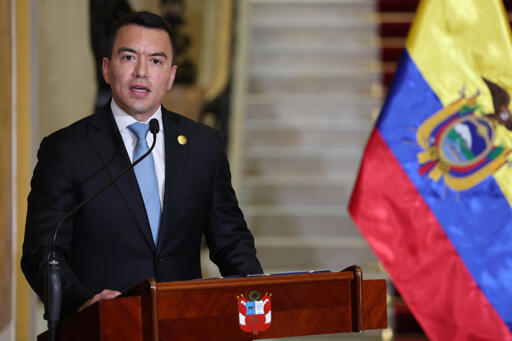
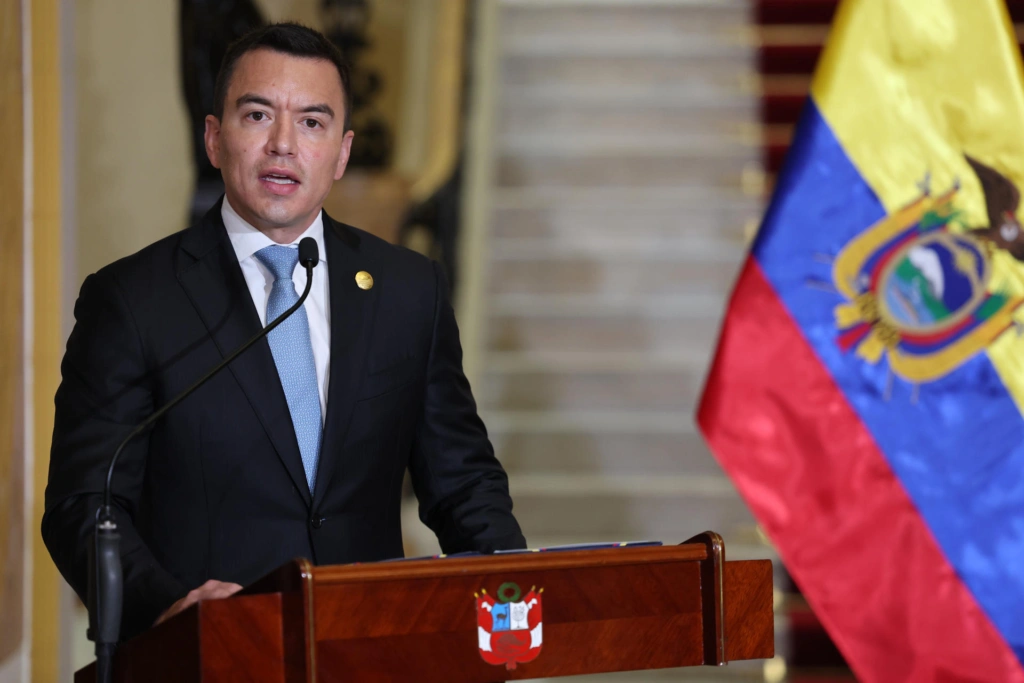
Ecuador’s President Daniel Noboa signed a decree on Wednesday renewing a state of emergency for 30 days across eight provinces, citing grave internal unrest and the need to weaken criminal organizations.
The measure seeks to give continuity to the extraordinary security actions put in place in response to the circumstances that prompted the original declaration, which, according to the government, remain in force.
The decree covers the provinces of El Oro, Esmeraldas, Guayas, Los Ríos, Manabí, Pichincha, Santa Elena and Santo Domingo de los Tsáchilas. Several of them, including Guayas and Esmeraldas, are in the coastal region, while Pichincha is home to the capital, Quito.
According to the official text, the additional period is considered “indispensable to consolidate territorial control and to weaken the operational and logistical capabilities of criminal structures.” The government describes the measure as extraordinary, temporary and proportional.
RELATED: Ecuadorian Court Denies Habeas Corpus to Luisa Gonzalez
In Ecuador, a state of emergency allows the President to temporarily suspend certain constitutional rights and mobilize the military in response to grave internal commotion, and it is meant to be exceptional in nature. Under the decree, the rights to the inviolability of the home and of correspondence remain suspended in the affected provinces. The order also provides for the involvement of the Armed Forces, working in coordination with the National Police, as well as the temporary requisition of goods and services of lawful origin. The renewal keeps the restrictions already in place across the eight provinces and extends a declaration that was already in effect.
The South American country has lived under repeated states of emergency and curfews as authorities respond to its security crisis. The latest renewal reflects the government’s position that the circumstances behind the original declaration have not disappeared.
Noboa has relied on emergency powers since early in his administration. He first declared a state of emergency in January 2024, amid a spike in violence that included prison guards being taken hostage and the armed takeover of a television station during a live broadcast, and soon after declared an internal armed conflict. Since then, the measure has been renewed repeatedly in different combinations of provinces and cantons, including a 30-day extension signed on August 14 that covered ten provinces and three cantons.
Critics question the results. Emergency declarations have become a near-permanent feature of daily life across much of Ecuador, yet violence remains entrenched. The decree signed Wednesday frames the extension as a step toward stability. The administration insists it needs more time to consolidate control of territory and dismantle the logistical networks that sustain armed groups.
⭕️ #ATENCIÓN | Mediante Decreto Ejecutivo No. 532, el presidente Daniel Noboa renovó por 30 días el estado de excepción por grave conmoción interna en ocho provincias: El Oro, Esmeraldas, Guayas, Los Ríos, Manabí, Pichincha, Santa Elena y Santo Domingo de los Tsáchilas.… pic.twitter.com/2JZVBSCFYG
— Radio Pichincha (@radio_pichincha) November 11, 2026
Text reads: “By Executive Decree No. 532, President Daniel Noboa renewed for 30 days the state of emergency due to serious internal disturbance in eight provinces: El Oro, Esmeraldas, Guayas, Los Ríos, Manabí, Pichincha, Santa Elena and Santo Domingo de los Tsáchilas.”
Violence Drives Decision
Ecuador is going through a wave of violence in 2026. According to the Interior Ministry, 6,285 intentional homicides were recorded between January and September, an 8.1% decrease compared with 2025. That works out to an average of roughly 700 homicides a month.
The figure nevertheless contrasts sharply with the 1,310 cases registered in 2014. Although killings have fallen year on year, the numbers show that the country remains far from the levels recorded back then, evidence of a violent scenario that persists.
With the new decree, the emergency measures will stay in force for another month across the eight provinces, keeping the military deployed alongside the police, while the government says territorial control requires more time. The next renewal will likely arrive before the current one expires, and with it another debate over the balance between public safety and civil liberties in Ecuador.
From teleSUR English via This RSS Feed.