

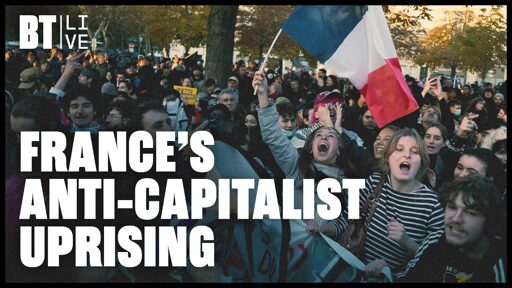

Macron offered “crumbs.” France answered with a general strike against austerity that brought the country to a standstill and more than 1.6 million people to the streets. Iman D., a student organizer with the Party for Socialism and Liberation, was on the ground at the Paris protests. She tells Zoe Alexandra and Rania Khalek the multinational, multigenerational movement behind the shutdown names capitalism as the problem, not just Emmanuel Macron and Prime Minister Sébastien Lecornu.
Iman explains why Nov. 5 general strikers carried Palestinian flags and wore keffiyehs, and unpacks how Black and Arab youth from the suburbs – the children and grandchildren of the people France colonized – helped spark the uprising. She recounts a visit to a high school in Saint-Denis, where students described unchecked Islamophobia, from the school hijab ban to police abductions from classrooms, and a system that pours money into war while their schools crumble. It’s “continued colonialism,” they say, carried out by forces descended from those that brutalized their grandparents in Algeria.
A Minnesota organizer herself, Iman draws the line from Paris to the Minneapolis general strikes against ICE’s Operation Metro Surge. And after the midterms’ blue tsunami that won Democrats control of Congress, she stresses now’s not the time to settle for crumbs: “It’s mass movements that really create change.”
#breakthroughnews
******
Rough transcript follows:
[Speaker 1:] The people of France truly understand that their fight against racism, anti-Blackness, anti-Muslim fascism, and state violence is tied to Palestine. They’re aware that the same system funding the war in the streets of France against Black and Arab youth is the same system funding genocide and imperialism abroad. They see and understand their struggle as one.
Nationwide protests against austerity have continued in France following the massive general strike on November 5th when 1.6 million people took to the streets. Protests are taking place across the country even today, November 10th, and they’re also planned for November 14th, 17th, and 19th. People are not stopping this struggle against austerity and to demand an end to the cuts-based policies put forward by Emmanuel Macron and the government of Prime Minister Élisabeth Borne. Students, trade unionists, and pensioners are all demanding that this government takes seriously the long set of demands they have presented to Macron and Borne. As of now, all of these groups, especially the student movement, have dismissed the offers of dialogue and proposals from this government as crumbs. That’s why they’re staying on the streets.
To discuss this massive uprising that has been quite inspirational for people across the world, we are very excited to be joined by Iman D. She is a student organizer with the Party for Socialism and Liberation, and she was on the streets last week in Paris speaking to people about why they’re out there. So Iman, thank you so much for joining us.
[Iman D:] Yes, thank you so much, Rania and Zoe. Super excited to join you all today.
[Speaker 1:] Iman, you were in Paris last week, witnessing history. Let’s be honest. You saw the general strike which took place on November 5th. Again, there were 1.6 million people according to trade unions that participated in mobilizations on this day. So talk to us first about your impressions of this strike. What was the mood on the streets? And what was it like speaking to people?
[Iman D:] Thank you again. On November 5th, France had a general strike, and I had the opportunity to be on the ground and witness it. I don’t even know where to begin. I don’t think I or any American has ever witnessed something at that scale. We were walking for about four hours, and the streets were packed with people on multiple blocks and intersections. There were moments where we couldn’t even move because of the sheer amount of people. There were dozens of different groups and contingents out there, bands playing songs, and chants filling the streets with so much energy.
A majority of people there came from different walks of life. The general strike reflected France’s multinational and multigenerational population. It wasn’t just students out there. Talking to the people on the ground—the students, the elders, the mothers, the labor union members—they all expressed concerns around the economic and material conditions in France becoming more detrimental to everyday people as the year has progressed. People mentioned issues with wages, their ability to attend college, access to healthcare, and affording housing and food with rising inflation costs in France.
They were telling us that the state of the education system reflects the larger economic issues within the French system. We also saw people on the street tying these economic issues to war and imperialism and the severe state violence and racism against Black, Arab, and Muslim people in France. Even though the media may try to paint it as though people are protesting against Macron and just the government, on the ground, people said these issues aren’t just created by Macron and his government. They were quite literally naming capitalism as the issue and fighting for a new system where people are placed above profit.
It was truly inspiring to be on the ground and hear people naming that clearly. Even when we were there on November 5th, there was a perception of, “Oh, what’s going to happen? Is this going to be the end of the movement?” But no, talking to people on the ground, they were energized and determined to continue taking to the streets. As you mentioned, Zoe, they have plans for the weeks ahead to continue blockading their schools. Even this week, many universities and high schools are continuing to be blockaded. Dozens of political groups and unions are pushing for other mass shutdowns in the coming month.
It was very clear, talking to people on the ground, that they believe it’s people power that transforms society. The main demonstration in Paris was in an important site in the history of the French Revolution. People in the streets are well aware of that history and know the history of France’s revolutionary past and the history of former colonies of France as well. Many people in the streets come from second and third-generation immigrant families from former French colonies like Algeria and many other African countries. They know that it’s people organizing and taking to the streets that makes change inevitable and will build a new system for them.
[Speaker 1:] I’m so happy you mentioned that because it segues perfectly into our next question. We’ve been watching the coverage of the protests in France and covering it here on Break Through News over the last month. Something that’s really animated those protests is the omnipresence of Palestinian flags and keffiyehs. We know these are symbols of Palestine, but they’ve also become symbols synonymous with resistance for movements around the world. We also know that these protests in France have been led by Black and Arab youth from the suburbs of Paris, who are the children and grandchildren of people from parts of the world that France colonized. Talk to us about the connection with the movement against genocide, the struggle of Black and Arab youth in France against racism and Islamophobia, and how that’s all connected in this movement against war and austerity that you’ve been witnessing today.
[Iman D:] For myself, being a student organizer for Palestine, I was in awe of the sheer number of keffiyehs, Palestine flags, signs, and banners standing in solidarity for Palestine during the general strike and other demonstrations we attended that week. I got goosebumps seeing people on the streets during the general strike chanting “Free, free Palestine” and connecting all these struggles.
When I talked to the students and different people in the anti-imperialist contingents on the ground, many people made the point that Palestine opened up their consciousness. It made them think about the French government and its capacity to commit and aid in genocide, the inflated war budget, while they’re sitting in classrooms with no seats, crumbling walls, no heating, and no plumbing in cold weather conditions. Each time we asked students and youth where the government money is going, they always mentioned war and genocide.
For many of these people, a free Palestine means having a better world where they don’t have to experience the racism and abuse they face under the system in France. You brought up the working-class Arab and Black youth. It was them that truly paved the movement we see in France. It started in the suburbs, led by Arab and Black youth. For many of them, they talked about seeing this struggle in France and seeing themselves with the struggle for Palestine. Palestine changed their minds and built this level of consciousness for them, and they were aware that the same system investing millions and trillions in dehumanizing and killing Palestinians is the same system in France investing over 34 billion euros annually in the police system to dehumanize them in their neighborhoods and kill Black and Arab youth every day.
The youth described police violence and terrorism against Black and Arab neighborhoods as continued colonialism. They tied this to the fact that cops in France train with the IDF, which is nothing new, coming from America knowing this. These police forces originate from colonial police forces that brutalized their grandparents and killed people in Algeria, North, and West Africa in the 20th century under French occupation. They were well aware that for them, there is no choosing one cause over another or abandoning one cause for another. There’s no sacrificing their language to appeal to a broader audience. These kids were speaking more to international solidarity than their local politicians and anyone else. It was truly inspiring to see and hear that.
We also had the opportunity to go to Saint-Denis, a suburb in Paris with a historically Arab, Black, and Muslim working-class majority. We visited the high school there and heard from students about the systemic Islamophobia and racism they witness every day. They talked about the 2004 French law prohibiting wearing any religious symbols to schools and shared stories about having their hoodies pulled down at school if they covered their hair. We even witnessed Muslim girls having to remove their hijab before entering school and the trauma of enduring that every day.
Additionally, students shared stories of cops coming into their classrooms and abducting their peers. They showed us videos of that happening and described how cops randomly bag check them in their cities, follow them around, and how one wrong look at a cop can lead to a life or death incident. They said their neighborhoods are literally occupied by militarized police forces. I myself can attest to experiencing police intimidation during my week there. We were stopped multiple times entering and leaving protests, doing bag checks. Our group was circled by cops and forced to do random bag checks, and they even claimed my sister and I had false passports.
Witnessing that and hearing those stories and experiences, these youth are well aware that the struggle against state violence they experience in France is the same as the struggle against the war forces that France is investing in. In the US, we see many similarities. Youth across the nation have become conscious and have continued to tie their struggles to the fact that the US war machine is the largest investor in the genocide of Palestinians in the world. College students in the US question why they are drowning in college debt and healthcare debt, not even being guaranteed a job after graduation with the state of the economy, while the country continues to invest trillions in war and the war machine.
People have tied their struggle against the war machine to police violence and brutality. The NYPD and LAPD are trained by the IDF. Black people are brutalized and murdered by cops across the nation daily. Our struggles against state violence from France to the United States to Palestine are all one struggle against the same system, which is capitalism. The people of France truly understand that their fight against racism, anti-Blackness, anti-Muslim fascism, and state violence is tied to Palestine. They’re aware that the same system funding the war in the streets of France against Black and Arab youth is the same system funding genocide and imperialism abroad. They see and understand their struggle as one.
They’re asking why, in the same way that in the US, we’re asking why our system is investing billions and trillions in police and war abroad and then cutting social services, telling us we can’t afford healthcare for all or housing because we don’t have enough money. The math is not adding up, and people in France and the US know that.
[Speaker 1:] Iman, you gave me chills describing those scenes. That is extremely powerful. You are not only Algerian, but you are also Minnesotan. You were on the streets of the Twin Cities for the historic general strikes on January 23rd and January 30th. What was it like having lived through and organized for the Minnesota general strikes and then to see one play out in France? What similarities did you draw, and what lessons do you take from both of these experiences as people across the world face growing inequality, declining living standards, and a seemingly endless desire from the ruling class to wage war and enrich themselves?
[Iman D:] As we know, in December 2023, Operation Metro Surge began in Minnesota, where over 2,000 ICE agents were deployed to the Twin Cities to carry out one of the largest DHS operations ever in history. During their time there, we witnessed the arrest and abduction of over 3,000 people. Importantly, we saw the extent of violence that state and federal agents were willing to go to, including the murder of Renee Good and Alex Kueng. After the murder of Renee Good on January 7th, the people of Minnesota refused to back down. They were like, “Enough is enough.”
We saw unions, political organizations, student organizations, and even some local officials join the call for a general strike on January 23rd to fight against this. Similarly to the people in France, the masses of Minnesota knew that the occupation of federal agents in their city and these agents killing their neighbors wouldn’t end by complying with Trump. They also knew that public officials like the Minneapolis mayor Jacob Frey or former governor Tim Walz weren’t going to do anything about it, quite transparently, the same way that in France they knew public officials aren’t going to change their conditions.
In Minnesota, especially from the memory of 2020 after the murder of George Floyd and millions taking to the streets across the nation to demand change, Minnesotans knew this time again that it takes organization and people taking to the streets to create that change. On January 23rd, we saw this historic general strike where over 100,000 Minnesotans from all walks of life, similarly to France, took to the streets in negative 20° weather. That’s one difference. [laughter] They made it clear who holds power in our system. They knew it’s not Trump, DHS, millionaires, or billionaires. It’s people. It’s working people that hold power. Like France, people are well aware that it’s people that transform society collectively if we take serious organizing and show up in unity.
That was such a historic moment. The day after January 23rd, one of the largest general strikes in Minnesota’s history, we witnessed the murder of Alex Kueng in the streets of Minneapolis. It was very clear the message that the federal government was trying to send, which is either comply or be killed. Like the people in France who have been protesting for over six weeks now, the people of Minnesota knew they wouldn’t just back down after this incident.
After the murder, I was out on the block where Alex Kueng was murdered because a bunch of people had gathered there. We heard folks chanting “strike, strike, strike” on the ground. I remember people telling me we need to extend the strike to be a week-long strike. I heard people demanding more than that, demanding a whole new system, very similarly to what I was hearing in France where people were saying it’s not just this one issue, it’s the whole system that’s the issue. People were done with state violence and the system that passively allows for this.
Seeing all these similarities was very clear with people knowing it’s only themselves that can change their conditions, not one local or political figure. The next day after January 24th, who made the call for the January 30th shutdown? It was Black and Somali students at the University of Minnesota, and the shutdown spread across the nation. In France, the call was made by Black and Arab students in the suburbs.
Honestly, being on the ground in France last week, witnessing the general strike brought me to tears. It gave me a lot of revolutionary optimism to see the people power on the ground. Knowing the history of Minnesota and people power there, we can’t let anyone forget about that. They want us to forget about this history. They want us to forget about the history in the US of different movements where it’s people power that made change, like the civil rights movement, like the 2006 Day of Immigration. Seeing all of that together makes me think about how we really have to hold on to our history, remember our history of resistance in the US, and seeing that power in the streets of France brings me optimism.
In Minnesota, we saw that it wasn’t like the ICE operation ended and Tom Homan was kicked out because of public officials. It was people taking to the streets and staying on the streets until real change happened. They didn’t do it willingly. They were left with no choice but to end the operation.
[Speaker 1:] I want to ask you lastly, given, as I’m sure you saw, people in the US ushered in this crushing blow to Donald Trump in last Tuesday’s midterm elections. We saw this unprecedented blue tsunami, but people were voting overwhelmingly not necessarily for the Democrats, but actually against Trump’s party, his MAGA movement, to register their rejection of many things, including the illegal criminal war of aggression on Iran, their anger about the escalation, the attacks from ICE on immigrant communities, the economic and cost of living crises, many of which are directly resulting from the Iran war, opposition to the genocide in Gaza, which ironically the Democrats also participated in. But all that’s to say, you’ve been on the ground seeing this movement energy. You saw this movement energy in Minnesota. Now that we’ve seen the MAGA movement really collapse since these midterms, as somebody who’s an organizer and who’s in movement building, what do you think comes next in this moment with regard to the US?
[Iman D:] When we were on the ground in France, each time we told people we were American, a lot of people asked us immediately about our thoughts on the midterms. [laughter] We reciprocated that question back, asking their thoughts on the US midterms. Many people talked about the midterms in the US and this blue tsunami giving them a sense of optimism against the MAGA movement and this right-wing agenda more than in support directly of the Democratic Party. They connected that with their upcoming presidential election in April 2027, talking about these right-wing forces and Macron needing to be out of office. But they also highlighted the importance of continuing to take to the streets regardless of the results in April 2027.
We can acknowledge last Tuesday was a blow to the MAGA movement and the right-wing agenda, showing a clear shift in American public opinion and voting for progressive politicians. It’s clear people are looking for change. But again, talking to the people in France, a lesson we’re familiar with and can bring to the US is that we know it’s mass movements that create change. Now that we see the shift, our task is to hold public officials accountable and push for more, like the people in France. We know that ICE and police violence will continue. The war on Iran is still looming. Rent prices will continue to spike. More and more people will continue to drown in student and healthcare debt. It’s important to remember the power we have as people.
Even thinking back to Minnesota, we had Democratic officials in office in the state, and they didn’t do anything to push out ICE. It was people power that did that. As we’re seeing these crises unfold, climate change continuing to detriment our neighborhoods and communities, war escalating with Iran, ICE terror continuing in our communities, and AI backed by billionaires leaving more young adults jobless and unemployed, it’s clear we can’t just depend on the Democratic Party or public officials to change our system. We’re going to need to take to the streets like France to organize and build towards a mass movement demanding a whole change in our system. We know our conditions won’t change unless we do that, and we can learn that through the history of the US, through January, and through the protest movements happening in France. We just have to remind ourselves of that history and continue to organize and build towards a new system.
[Speaker 1:] Iman, you have really radiated that revolutionary optimism. I’m feeling pumped. I know we have to go through the laborious task of talking about what’s happened on Capitol Hill since these midterm results, but I think that point is well taken. It will be the mass movement that decides the future and what policies will get implemented, what policies will get passed. Very important lessons to take there. Iman D, student organizer, we thank you so much for joining us here on BT Live and bringing that very vivid recap of your time in Paris because it sounds like you witnessed history. Really powerful stuff there.
[Iman D:] Yes, thank you, Zoe and Rania. It was great being able to discuss with you all today.
From BT News via This RSS Feed.