

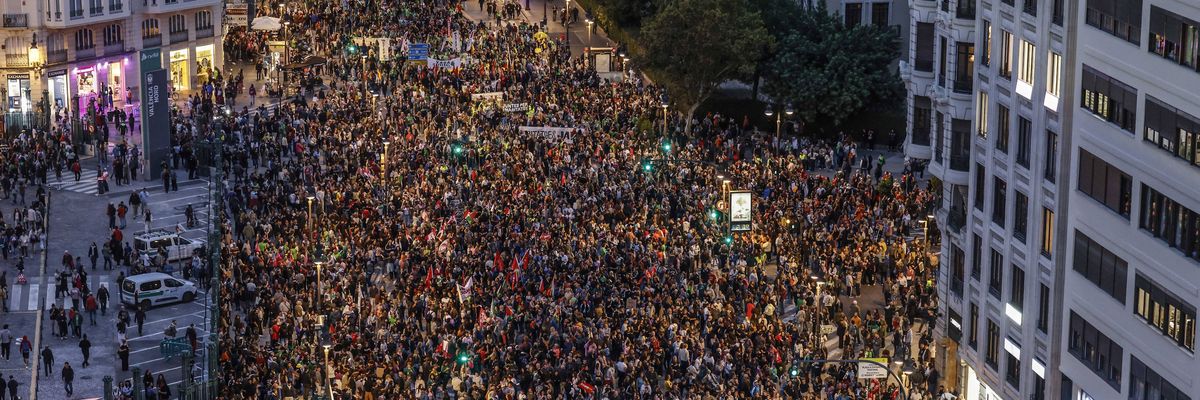
Spain was rocked by its first general strike in years on Wednesday, as millions of housing rights defenders, students, and workers took to the streets in a nationwide revolt against an affordability crisis and a housing system that critics say prioritizes enriching property investors and landlords over providing homes for people.
The 24-hour walkout, known as the 11N, disrupted transportation, schools, businesses, ports, and industrial production, with demonstrations and picket lines reported in Madrid, Barcelona, and dozens of other cities.
Organized by a coalition of labor unions and tenant organizations, the unprecedented mobilization sought to unite historically separate struggles. The Madrid Tenants’ Union said that, despite autumn storms throughout much of Spain, as many as 4 million people took part in the day of action.
“It’s time to change the rules of the game. We must end a housing system based on speculation and create a rights-based system,” 11N organizers said. “The 11N is not only a labor strike or a strike of tenants, it is a general strike for housing and against the cost of living.”
The immediate trigger of the 11N strike was the September eviction of María del Carmen Abascal—popularly known as Maricarmen—an 87-year-old woman who had lived in her Madrid apartment for seven decades. The investment fund that bought her building jacked up her monthly rent by more than 400% from €500 to €2,650 a month—an amount far exceeding her modest pension.
Despite previous legal efforts to prevent her eviction, Maricarmen was forcibly removed from her home and taken away on a stretcher before a deal was reached amid mass protests and she was allowed to return. However, she died in a hospital two weeks later.
Millions of people in Spain who work full-time increasingly cannot afford a decent place to live. Average rents have nearly doubled over the past decade, while housing prices have risen substantially faster than wages.
According to Spain’s central bank, the country faces a housing deficit of approximately 750,000 homes, potentially exceeding one million by 2028. Publicly owned rental housing accounts for less than 2% of the country’s housing supply, compared with a European Union average of around 8%.
The consequences are particularly severe for younger workers. The Spanish Youth Council estimates that the average monthly rent of €1,176 consumes approximately 98.7% of a young person’s average monthly salary.
“I doubt I’ll ever be able to own a home, let alone have a family like my parents could have at my age,” Elena Carmona, a young bookstore employee participating in the strike in Madrid, told Público.
Pablo Pérez, a spokesperson for the Madrid Tenants’ Union, told Público that “what is at stake is who keeps the wealth we produce and who has the power to decide over our lives.”
“This is a strike of everyone who is fed up with working so that others can enrich themselves at their expense,” he continued. “It can’t be that we work harder and harder and that much of our salary ends up directly in the pocket of those who live in our homes.”
“What began with the fight against the eviction of Maricarmen has triggered a mobilization that no one imagined,” Pérez added.
Anti-capitalist activist Beatriz Payo, 26, said Maricarmen’s eviction marked a turning point for her. She described witnessing firsthand “the level of violence and injustice behind a system that makes business out of such basic necessities as housing.”
That violence was on display Tuesday as police in cities across Spain attacked protesters with batons and pepper spray. At least four people were hospitalized in the capital, according to the Madrid Tenants’ Union. Officers also assaulted some of the demonstrators who blocked the M-30 highway in Madrid’s Vallecas neighborhood.
Video footage recorded in Granada also showed police literally beating back strikers.
LGBTQ+ activist Samantha Hudson said police pepper-sprayed her and other protesters including actress Laura Weissmahr and journalist María Barrier, in the face during a demonstration on Madrid’s Gran Vía.
“Does it bother them that much that we exercise this basic, fundamental right?" Hudson asked after the assault. “A boy’s head has been split open. I’m having a terrible panic attack.”
Amnesty International Spain said, “We are documenting concerning police conduct in Madrid, Alicante, Castellón, Vitoria, Valencia, Málaga, Granada, and Santiago.”
“Force must be a last resort and can only be used proportionately,” Amnesty asserted. “Blows to the head must be avoided because of the risk of serious injury, and police batons and pepper spray must only be used against people who are being violent. They must not be used indiscriminately against protests or to disperse peaceful demonstrations.”
“We call on the authorities to guarantee the right to protest at this afternoon’s demonstrations, to ensure that officers visibly display their identification numbers, to ensure that pepper spray is not used and that police do not charge peaceful demonstrators, and to investigate the excessive use of force,” the group added.
Despite police repression and stormy weather in many cities, the strike caused significant disruptions. Organizers reported 90% participation in the automotive and port sectors, with complete stoppages at Volkswagen and SEAT factories. There were also widespread shutdowns in waste collection, meat processing, and energy sectors.
“The strike has exceeded the labor unions’ expectations,” Workers’ Commissions secretary-general Unai Sordo told The Associated Press. “It has been a success in terms of turnout.”
Following the protests sparked by Maricarmen’s eviction, social-democratic Spanish Prime Minister Pedro Sánchez called an early election on November 29 in a bid to secure four more years of rule for his leftist coalition government.
However, last month’s high-speed train collision in Toledo province that killed 69 people—the second major rail disaster in the country this year—has complicated Sánchez’s strategy.
“The Socialists need for the strike to be a success and for there not to be any violence so that the election campaign can swing back to being about housing,” Autonomous University of Barcelona political science professor Oriol Bartomeus told the AP.
Meanwhile on the right, the Popular Party and far-right Vox "both want the strike to be a flop and to end in scenes of burning dumpsters and shattered shop windows,” Bartomeus said, so that “they can say, ‘This is chaos, and we are coming to establish order.’”
Pepe Álvarez, general secretary of the General Union of Workers, told El Diaro that, after Wednesday’s strike, “whoever governs, no matter what happens on the 29th, they will have to listen to the street."
N11 organizers expressed similar sentiments.
“Whoever governs,” they said, “we will conquer the right to housing.”
From Common Dreams via This RSS Feed.