

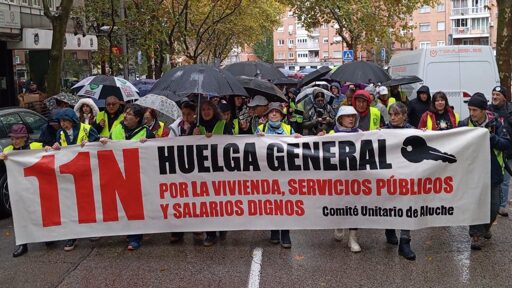

Hundreds of thousands of workers in key sectors – with total participation likely in the millions – responded to a general strike call in Spain on Wednesday, November 11, demanding solutions to the housing crisis and protection of labor rights. The action represents the first nationwide work stoppage in 14 years.
The strike was called by the country’s largest trade unions – the General Union of Workers (Unión General de Trabajadores, UGT) and the Workers’ Commissions (Comisiones Obreras) – alongside tenants associations and other unions, including the General Confederation of Labor (Confederación General del Trabajo, CGT).
Read more: 1.6 million join general strike in France against austerity
“More than 2,500 picket lines across the country are out informing people about the reasons for the strike – a mobilization for the right to housing and for wage increases that is both massive and unprecedented in our history,” the CGT stated on the day.
“This day of action is mobilizing thousands of people across the country with one clear goal: to demand solutions on housing and wages,” added CGT General Secretary Miguel Fadrique. “As unions, we must heed this message and keep up the fight.”
Broad response to the strike call
The UGT and Comisiones Obreras reported that early data indicated a 90% strike adherence in the automotive sector, followed by industrial action in the meat industry and waste collection at 85% and 82%, as well as 75% in the energy sector. “The response in the ports of Algeciras and Valencia is also notable, with participation reaching 90%,” the unions wrote.
Overall adherence varied by region. Unions reported figures ranging from 41% in Castilla-La Mancha and Extremadura to over 80% in Catalonia and Andalusia. This translated into disruptions of public transport and air traffic around Barcelona, as well as a full halt at the SEAT factory in the region, unions emphasized.
Media workers joined the strike as well, with broadcasts on some public television stations going dark.
Additionally, the UGT and Comisiones Obreras pointed out that “one significant effect of the strike was a reduction in electricity consumption of more than 10% – a sharper decline than during previous general strikes.” The decrease in electricity consumption is being read as another sign of strong strike adherence, suggesting that significantly fewer people are adhering to their usual schedules.

Trade unions denounced police repression and violence, including the use of tear gas, against picketers. Source: UGT/X
On the other hand, trade unions denounced attempts to obstruct the strike and police repression against picket lines. They reported the use of pepper spray against protesters in Madrid, as well as several arrests and attacks against pickets blocking roads and building entrances.
Unions also criticized regional governments – especially in Madrid – for imposing minimum service requirements at a level that effectively curtailed the right to strike. The UGT and Comisiones Obreras linked these decisions to a somewhat lower strike adherence in sectors including post services and healthcare – but insisted this did not diminish the overall success of the strike.
A historic alliance with tenant associations
The nationwide industrial action is taking place three weeks ahead of a snap election called by Prime Minister Pedro Sánchez after parliament failed to pass emergency housing bills last month. The legislation was drafted after the eviction – and later death – of 87-year-old Maricarmen Abascal triggered massive demonstrations and encampments denouncing the commodification of housing and real estate speculation in Spain.
The protests pushed trade unions to issue the first general strike call since 2012, connecting housing grievances to the broader cost-of-living crisis. “The housing situation has become a catalyst for the discontent that cuts across Spanish society,” wrote Comisiones Obreras General Secretary Unai Sordo. “An increasing number of individuals and families find themselves choked by the burden of unaffordable mortgage or rent payments – or are even unable to lead an independent life.”
Read more: Housing crisis leads to snap election in Spain
In addition to labor unions, the November 11 general strike was co-launched with tenant associations, ushering in a collaboration of historic importance. “We’ve proven we can organize on a scale no one thought possible,” the Madrid Tenants’ Union (Sindicato de Inquilinas e Inquilinos de Madrid) wrote on the eve of the strike. “We’ve built alliances that until very recently seemed unthinkable. We’ve made an entire country talk about housing – using our terminology and our images.”
“We have lost our fear. And no one can take that away from us now. Not a struck-down decree, not a vulture fund, not a hostile headline.”
From BT News via This RSS Feed.