

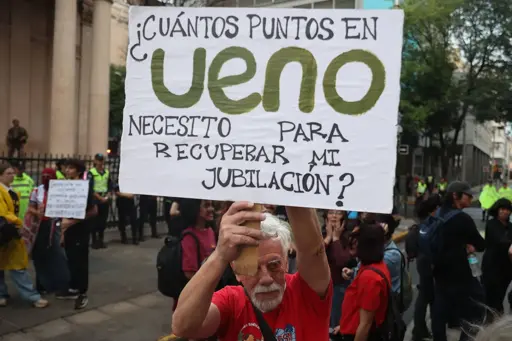
Following the bankruptcy of Ueno Bank in Paraguay, the interim president of Paraguay, Pedro Alliana, announced that the Deposit Guarantee Fund has disbursed $330 million to partly compensate 1,740,000 small savers who had accounts in the bank and now cannot access their funds.
This number is almost 95% of those who lost their deposits, so the president stated that the government responded “with actions” and promised to pay the remainder in the coming days. “The recovery of pension resources will be a priority,” he said.
Compatriotas:
A días de la resolución de Ueno Bank, respondimos con hechos: completamos el pago a casi el 95% de los ahorristas. El remanente será abonado hasta mañana, conforme a la ley del Congreso.
Pagamos a 1.740.000 ahorristas, equivalente a 330 millones de dólares del Fondo de Garantía de Depósitos.
Aportantes y jubilados del sector público: la recuperación de los recursos previsionales tendrá prioridad.
Vamos a trabajar hasta que cada familia recupere la tranquilidad que se merece.
— Pedro Alliana (@AllianaPedro) November 10, 2026
However, labor unions and social movements demonstrating in Asunción interpret the disbursement as a socialization of the losses. They argue that the use of state funds to cover deposits absolves Ueno Bank’s executives of responsibility.
The unions demand that the assets of those involved in the scandal be confiscated immediately, instead of plugging the hole with public money. Mass marches throughout the country are expressing the social discontent at the government’s handling of the scandal.
🚨Paraguayos denuncian impagos tras cierre de Ueno Bank
🏦 Trabajadores de Ueno Bank alzaron su voz para denunciar el impago de sus salarios y el flagrante abandono institucional tras el intempestivo cierre del banco. #Paraguay #UenoBank #teleSUR
Reporte: @OsvaldoteleSUR https://t.co/rP2hKuf3ln
— teleSUR TV (@teleSURtv) November 10, 2026
According to the protesters, the bailout with state resources shifts the cost of the bankruptcy, caused by private decisions and the convergence of interests between regulators and economic power, onto the citizens.
Social organizations also highlighted that Alliana held the vice presidency during the administration of Santiago Peña, involved in the scandal, and maintains a strategic alignment with Washington. This trajectory fuels the protesters’ distrust.
In Paraguay, Ueno Bank, belonging to the Vázquez Group of which former president Santiago Peña was a partner, raised funds from the state and pensions and lent them to companies owned by the bank owner. The Attorney General’s Office of Paraguay has charged 27 people with attempted fraud. The profits were private; meanwhile, the bailout for almost three million account holders is now being covered with public funds.
When the Central Bank intervened in Ueno Bank on November 3, the entity was managing some $800-850 million of public funds, 355 million of which were for the pensions. Two days later, Santiago Peña, who had been a shareholder in a holding company of the same business group, submitted his resignation, which was not approved by Congress, and thereafter he was impeached.
According to the case file, the Ueno Bank scandal is not a bankruptcy. The Attorney General’s Office charged 27 people with breach of trust and attempted fraud, and the Central Bank reported that Ueno lent public money to companies owned by its own owner, Miguel Vázquez, disguising the companies as independent. On November 5, Vázquez and five other executives were remanded in custody.
A bank that was born with the new government
Ueno Bank obtained its banking license at the end of 2023, the same year Santiago Peña became the president of Paraguay. Carlos Carvallo, who was the president of Ueno Bank until August last year, was then named by Peña as the president of the Central Bank, the entity that was supposed to oversee the same Ueno Bank.
Six months later, when Ueno absorbed Visión Banco and its non-performing loans, the Central Bank approved the merger with two facilities amounting to 5.1 trillion guaraníes, approximately $691 million, and allowed it to defer the recognition of the impaired portfolio of the absorbed bank. With that backing, the newly born digital bank became one of the four largest banks in the country, and its growth began to rely on another source—public funds—which was not visible in the balance sheets.
Ueno lend money to its own owner
Mowi SA, Grupo Hendy SA, and Grupo M SA, firms associated with the Vázquez Group, owner of Ueno Bank, owed Ueno 743.784 billion guaraníes in April 2026, which is about $123 million. However, the existing law allowed the bank to lend its own group a maximum of $82 million.
To bypass that limit, the bank declared that the three firms were no longer related to the Vázquez Group. The Central Bank supervisors concluded the opposite. The shares had passed to former managers and employees of the group, including a head of Human Resources, and 12 of the people who managed their online accounts worked for ITTI, the technology company of the group.
The loans were issued “on signature only,” without guarantees and for amounts that the debtors could not pay. When the Central Bank did the calculations, it demanded adjustments of more than 1.6 trillion guaraníes, and Ueno’s solvency fell to 5.56%, less than half of the 12% required by law.
Bank Implicated in Paraguayan Financial Crisis Sponsored Far-Right Gala at Trump’s Mar-a-Lago
State funds and retirees’ savings
Since Peña took office in August 2023, Ueno started to exponentially receive state funds as deposits. By the end of June 2026, these amounted to about $869 million, 29% of all the bank’s deposits. Unofficial estimates point to a higher figure, around $1.2 billion in public money, which official sources do not confirm.
The pensions followed the same path since October 2024, when the Social Security Institute (IPS) bought Ueno bonds for $32 million and Peña dismissed the criticisms as a “media campaign.” Eleven months later, the IPS had $316.4 million in the bank, almost half the public money deposited there. Economist Rodrigo Ibarrola noted that the jump coincided with a change in the IPS investment regulations.
This change was just one among many changes in laws, which included laws of the Central Bank of Paraguay, the organic law of the IPS, and new decrees and regulations. Today, $355 million of the retirees’ pensions are frozen. Almost 32,000 people used to receive their pension through Ueno. The IPS claims that this sum is equivalent to 9% of its portfolio; the judicial indictment places it close to 11%, above the 10% limit that the regulation sets for a single bank.
(Telesur)
Translation: Orinoco Tribune
OT/SC/CD
From Orinoco Tribune via This RSS Feed.