

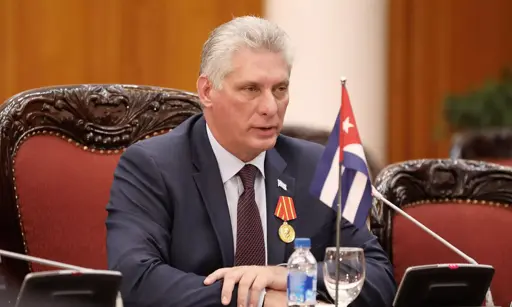
“The future of Cuba will never be decided in the north. We made that clear from January 1, 1959, and it will not change no matter how twisted the US plans are to try to bend us,” declared the president of Cuba, Miguel Díaz-Canel, in a message published on social media, in response to recent statements by US President Donald Trump and the Secretary of State Marco Rubio regarding regime change in Cuba.
The Cuban head of state stated that the defense of national sovereignty constitutes a historical position of the Cuban Revolution and asserted that pressures from Washington will not change the island’s determination to decide its own destiny.
In his post, Díaz-Canel condemned the consequences of US economic blockade on the Cuban population and said that it is “perverse” that Washington does not take responsibility for the “collective punishment,” referring to the restrictions on fuel supply and the sanctions affecting the country.
He criticized the arguments of the Trump administration to justify its policy toward Cuba and stated that Washington’s accusations are losing credibility in the eyes of the international public. “Cuba will continue fighting for truth and justice,” he said, adding that “Cuba is not a threat, the blockade is.”
Díaz-Canel’s statements come after Trump once again labeled Cuba as a “failed nation” and claimed that the government of the island could fall “quite soon.” Similarly, Rubio stated that Cuba represents a threat to US national security and interests, and defended the continuation of the blockade, the lifting of which he conditioned on changes in Cuba’s political and economic spheres.
This exchange of statements takes place in a context of growing tensions between the two countries. On November 5, Washington announced new sanctions against individuals and companies associated with Cuba’s oil, maritime, electronic, and technology sectors, in addition to extending restrictions on foreign companies that maintain operations with the island.
China Defends Cooperation With Cuba Amid Illegal US Sanctions
The escalation of sanctions is part of Washington’s maximum pressure strategy against Cuba. On January 29, US President Donald Trump signed an executive order declaring a “national emergency,” claiming that Cuba constitutes an “unusual and extraordinary threat” to US national security and regional stability.
In the text, the Trump administration accused the Cuban government for its relations with countries that Washington considers adversaries, Cuba’s alleged links with organizations that the US has classified as terrorist entities, and the supposed presence of Russian and Chinese military and intelligence capabilities on Cuban territory. Following this decision, Washington reinforced economic pressure measures against the island, which has been under a commercial and economic blockade for more than six decades. Among the announced actions is the possibility of imposing tariffs on countries that export oil to Cuba and reprisals against those that do not comply with the provisions of the executive order.
For its part, the Cuban government has dismissed the US accusations and reiterated its stance of defending the country’s sovereignty, independence, and territorial integrity against any form of external pressure or interference.
(HispanTV)
Translation: Orinoco Tribune
OT/SC/CD
From Orinoco Tribune via This RSS Feed.