

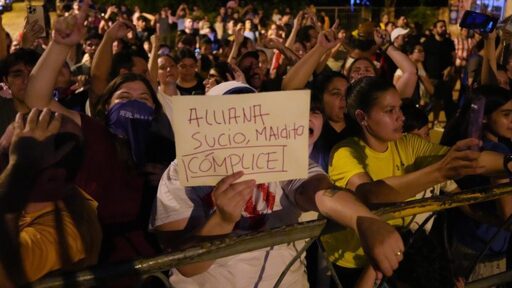

Although many had hoped Santiago Peña’s resignation as president of Paraguay would calm the anger of millions of Paraguayans, it did not. As the hours pass, hundreds of protesters are joining spontaneous demonstrations against Paraguay’s political and economic establishment.
And the truth is, this comes as no surprise. It has been revealed that Ueno Bank was a financial institution that grew rapidly thanks to contributions from pensioners and other state-linked sources that Peña’s own government ordered to be injected into a bank that had only just been officially recognized as such in 2023.
Privatization becomes national scam
But what has outraged millions of Paraguayans the most is that, according to several judicial investigations, Ueno’s own shareholders were taking the money coming in from the government and lending it to companies linked to themselves. And this perverse cycle of Paraguayan taxpayers’ money being used so cynically by private individuals appears to have been orchestrated by several people, including former President Peña himself – or at least that is what the prosecution alleges.
As a result, a judge ordered Peña’s pretrial detention at a military barrack, where he will be allowed to receive visitors and use his phone – a development that has further inflamed the anger of thousands of Paraguayans demanding their money back and justice.
When a young Paraguayan woman was asked if she had been affected by the Ueno case, she said something that perfectly captures the sentiment of millions: “Of course, it affects me and everyone else. The money they’re using to reimburse us comes from all the public banks. That means that Ueno customers had their money stolen, and those who don’t have [accounts at Ueno] also had their money stolen, because the money they’re using to reimburse us comes from everyone. They’re stealing to replace what was stolen.”
The prosecution alleges that the right-wing former president of the long-standing Colorado Party committed breach of trust and mismanagement for personal gain through his dealings with a bank owned by a business group in which Peña himself had invested in previous years. Furthermore, Peña appointed Carvallo, the former president of Ueno, to head the Central Bank, a move that has also led to the opening of a criminal investigation against Carvallo.
The Colorado Party and neoliberal economics
For its part, the ruling Colorado Party has attempted to distance itself from its member Peña, hoping that its image will not be so severely compromised. Former President Cartes even quickly called for Peña’s removal. In his place, former Vice President Pedro Alliana assumed the presidency; in an attempt to gain some legitimacy, he has called for the resignation of all ministers appointed by Peña.
However, several analysts perceive in the streets of Paraguay not only great disappointment with the political system (which is largely controlled by the Colorado Party and Paraguay’s major neoliberal business leaders) but also a great deal of anger and frustration among the population, especially among younger people.
“They’re all the same – everyone in the Colorado [Party] is a bunch of hypocrites, rats, who stick together and ask God to bless Paraguay. But God will bless Paraguay when all of you go to hell,” the same protester declared, while the interviewer noted that other young people had told him on the streets of Asunción that they feel completely let down and disappointed.
Possible change?
However, it remains to be seen whether such disappointment and anger can translate into a political and economic alternative for Paraguay, a country that was controlled for much of the 20th century by the US-backed dictator Alfredo Stroessner (1954–1989), who led one of the harshest and longest-lasting dictatorships of the century through force and electoral fraud.
Stroessner had been a member of the Colorado Party since 1951 and was one of the key figures in Operation Condor, in which other military governments acted in concert to repress, assassinate, rape, and disappear the region’s progressive and revolutionary forces.
And although he was overthrown in a military coup, the party that supported him the most – the Colorado Party – continued to dominate Paraguayan politics for most of the 21st century, except for the brief presidency (overturned by the old Paraguayan powers) of the progressive Fernando Lugo.
For now, it remains to be seen whether the Colorado Party will manage to save itself once again as Paraguay’s main (and virtually sole) hegemonic political force, or whether a new political alternative might emerge from the ashes of the biggest economic scandal in Paraguay’s contemporary history (and one of the most traumatic in the region) although, unfortunately, this is by no means the only story of the rich and powerful shamelessly exploiting the state for their own gain.
There are still vivid examples of this in Latin America: Paraguay seems to be just one more case, though perhaps it could become the case that opens the eyes of more than a few, and that is why so many are keeping a close watch on its streets.
From BT News via This RSS Feed.