

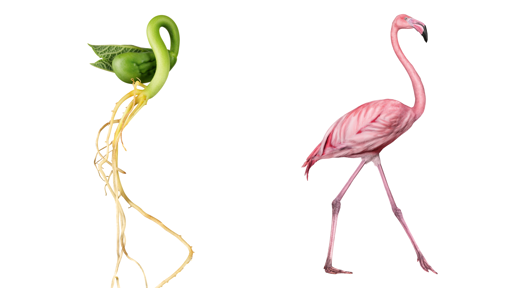
Photographer Andrew Zuckerman took a moment longer than usual to look closely at a bean that was sprouting in his studio. “There was this one bean that sort of had this incredibly elegant curve, and I thought, ‘God, that’s exactly like the flamingo from like 15 years ago,’” Zuckerman tells Mongabay in a video call. He took out an old photo he’d taken of a flamingo, set both side by side, and kept looking at the pair. The connection set off a journey through his own archive of some 2,500 images, taken over the last 25 years, and culminated in his latest book, United Nature. Zuckerman’s method for documenting the natural world involves taking several photos, shifting the focus slightly with every shot. A camera, like the human eye, can keep only a thin slice of a close-up subject in focus at once. He then combines the sharpest details into a single image, a technique known as focus stacking. “I can use this optical tool, this technique, to give you something that your eyes can’t see,” Zuckerman says. Unlikely connections emerged between seeds and birds, jellyfish and crystals; pairings that cut through shapes, colors, sizes, and textures. He says he tries to turn his brain off to do this work. “No intellect, all feeling, all intuition, trying to get to a more primordial part of my response system where I could feel my way through something rather than think my way through something,” Zuckerman says. “I began noticing these kinds…This article was originally published on Mongabay
From Conservation news via This RSS Feed.