

Amelia Schafer
ICT
Emcees, announcers or eyepahas are an important part of any powwow. The person behind the microphone keeps the event moving, they offer humor and insight into the dances, and keep the event exciting. Rarely though, is that role held by a Native woman, something that’s due to change, according to one Anishinaabe kwe (woman) who knows a thing or two about the role.
Heavy discourse circulated Indian Country in mid-October, after some jokes made by a Native male emcee at a large contest powwow which left some community members feeling uncomfortable. This incident has led to a larger discussion in Indian Country in the following weeks regarding the severe lack of Native women in emcee roles.
This discourse has emphasized to Deanna StandingCloud, Red Lake Nation and a woman emcee, the growing need for more opportunities for women behind the microphone leading events like powwows or round dances.
“I kind of want to pass the torch a little bit,” StandingCloud said.
StandingCloud, who lives in the Twin Cities, said her goal is to help create pathways for Native youth, particularly girls, to find their confidence and fill these roles. StandingCloud said she wants to help coach Native youth in person or virtually, and help them learn how to hold these roles and the knowledge needed to properly fill in as an emcee.
“I’m Anishinaabe, so I can kinda speak from our perspective, we’re [women] the storytellers and we’re very much charismatic,” StandingCloud said. “And the nurturing vibes, I think, really are something that we could all use as a community. I think it’s really important to hear women’s voices because we are the leaders and we are the storytellers. It’s time to hear more women on the microphone.”
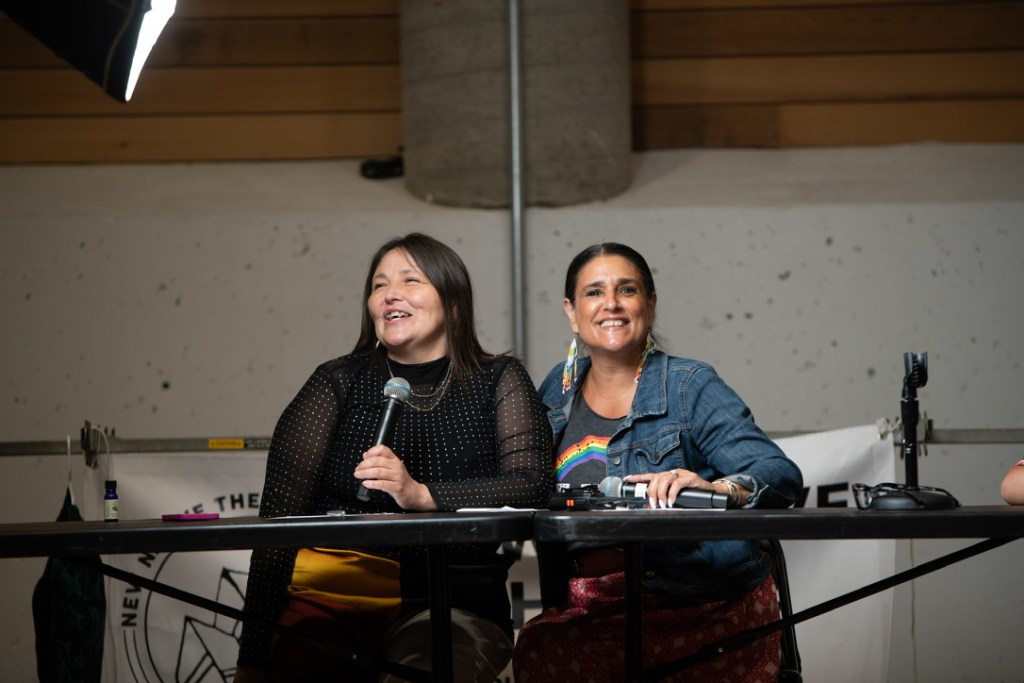
Deanna StandingCloud and Trish Cook are pictured at the emcee table during the fifth annual Minneapolis two-spirit powwow. StandingCloud served as emcee for the event. Credit: Photo by Jeff Shad
Women across Indian Country are finding themselves in leadership roles more and more, the United States is seeing its first Native American woman senator Peggy Flanagan and could have a second with Alaska Native woman Senator Mary Peltola if she wins the Senate race. There’s a building movement in Indian Country, StandingCloud said, and it’s time powwows catch up.
Traditionally, the role of an emcee has gone to male community members, something StandingCloud said she thinks can be traced back to the invention of powwows post-colonization. As different ideas spread and powwows grew throughout Indian Country, communities may have adopted a First Nations tradition of male helpers at ceremonies holding this role, she said.
Further, powwow’s creation as a result of the Buffalo Bill’s Wild West Show may have led to the integration of western patriarchal concepts in the celebration, such as predominately placing men in leadership roles.
“It’s kind of running parallel to the colonized settler mentality,” StandingCloud said. “And I think because it’s a tradition and it just went on so long that we just didn’t question it. And I think that’s kind of how it’s just a traditional thing. When you have that pathway that’s, you know, so ingrained, we just can’t think of a different paradigm, I think.”
But it’s difficult to break into these spaces, she said, there’s no official training or pathway to becoming an emcee – often it happens by chance. StandingCloud said she herself first ended up as an emcee by chance, after the chosen emcee asked a local community member to help out pronouncing local names.
“Pretty soon he just handed me the microphone,” StandingCloud said. “He was really open to having a woman take the lead. It sounds a little harsh to say that, but when Native men allow Native women to take the lead, a lot of magical things can happen.”
Emcees are a crucial part of any powwow, and StandingCloud emphasized that it’s not an easy role to fill. The person behind the microphone has to have a knowledge of the military and its presence in Indian County as well as the protocol and history behind the different powwow dances seen in the circle. The role comes with heavy expectations and a need to stay in-the-know, she said.
And there’s a lot of pressure that falls onto the emcee, she said, pressure that can lead to uncomfortable jokes in the pursuit of keeping everyone entertained. As a comedian, StandingCloud said she can admit she’s fallen into making “deadly auntie/uncle” jokes in the past which are commonly heard across Indian Country online and offline.
“Deadly auntie or uncle” humor can refer to sometimes-stereotypical jokes about rude or blunt aunties or sleazy uncles. These jokes can cross a line when comedians overplay into stereotypical “rez” accents or overly-sexualized, objectifying humor like the often heard: “frybread thighs, chokecherry eyes.”
Jokes and humor have historically been a big part of Indigenous culture, but it may be time we examine the harm that some of the more sexualized jokes can have on the community, she said, especially as communities grapple with the epidemic of missing and murdered Indigenous women and oversexualization Native women have been historically subjected to.
“I feel like it is time to move towards a more healthier, healed kind of way [of joking],” StandingCloud said. “I know like in Indian Country it’s really hard to break that because that was what kept us you know, the joking and the teasing and things like that. But we have to be more mindful, I think.”
StandingCloud said she’s noticed a definite shift in the room when a woman is behind the microphone, it proves that women can hold this role and even can send a different message to the audience, she said.
“Seeing women or their aunties in these celebratory leadership roles is good for all of us and I think the kids will see that and then they can think, ‘I could do that too,’” StandingCloud said. “I think there’s so many opportunities for [that change] just to kind of ripple out.”
The following year, StandingCloud said that the same powwow committee asked her to be the emcee.
“It was really incredible because if our men allowed us to kind of shine, find our strength and our voice, that would be very supportive and I would really be behind that,” StandingCloud said.
The post Native women emcees: ‘It’s time to hear more women on the microphone’ appeared first on ICT.
From ICT via This RSS Feed.