

Philippine-based and international human rights groups called for the adoption of the proposed Crimes Against Humanity Convention to provide more avenues for victim-survivors and strengthen accountability mechanisms against high-level perpetrators, governments, and corporations.
Crimes against humanity is the only core international crime without a dedicated treaty on prevention, punishment, and inter-state cooperation. The only international legal remedy available for the victims-survivors is the prosecution of the International Criminal Court (ICC), which is currently facing consecutive sanctions from the Donald Trump administration of the United States.
Read: US intensifies sanctions vs. ICC
The proposal of the Crimes Against Humanity Convention is one of the topics that takes center stage during the ASEAN Civil Society Conference in the Philippines this year, October 27 to 29, 2026, weeks before the official summit.
“Victims and survivors of human rights violations, wars, and genocide must have more avenues to pursue justice and accountability,” Karapatan Secretary General Cristina Palabay told Bulatlat.
Crimes against humanity are defined by the Rome Statute as acts committed as part of a widespread or systemic attack directed against any civilian population, with knowledge of the attack. This includes, but not limited to murder, extermination, enslavement, deportation or forcible transfer of population
Palabay said that the Convention is of utmost significance, especially in the quest for justice of families and communities affected by widespread extrajudicial killings during the administration of Rodrigo Duterte, who is now in ICC custody, awaiting trial starting on November 30.
The Prosecution is expected to present some witnesses, followed by the observations of the Common Legal Representative of the Victims. The Defense (Duterte’s counsel) will also have the opportunity to present its case and witnesses.
Duterte is charged with three counts of crimes against humanity — extrajudicial killings when he was the mayor of Davao City from 2013 to 2016 (Davao Death Squad killings), murder of ‘high-value targets’ across the Philippines, and the murder and attempted murder cases during the barangay clearance operations when he was President (‘Oplan Tokhang’ killings).
Rights groups monitored more than 30,000 extrajudicial killing victims of Duterte’s anti-illegal drugs campaign, which is significantly higher than the official government records of over 6,000 victims. Only five cases resulted in conviction and some of them remain on appeal.
During the ASEAN CSO conference, Jerrie Abella, Amnesty International’s regional campaigner, said that the prosecution of the perpetrator of crimes against humanity brings hope to the families of extrajudicial killings under Duterte’s so-called “drug war”.
“A mother took a long time to muster the courage to talk about her loss and to actively fight for justice. Inspired and empowered not just by the support that her newfound community offered, but also by the fact that Duterte is now in jail and awaiting trial,” said Abella.
“This is just one of the more tangible results of prosecuting an alleged perpetrator of crimes against humanity, even as we may still be years away from the actual court decision,” he added.
However, Abella enumerated several critical gaps for the accountability of the perpetrators and full justice, including Duterte’s co-perpetrators who remain free and are hiding, the national judicial system’s failure to prosecute perpetrators with only a handful of police officers convicted, and the failure of the government to prevent the crime from happening in the first place.
“Impunity persists precisely because the system we have in place allows it,” Abella said. “With this Convention, states will be obligated not just to investigate and prosecute these crimes, but also to adopt concrete measures to prevent their commission.”
A key recommendation from Amnesty International is to recognize the survivors’ right to truth in the context that disinformation happens during the anti-drug campaign until the present administration when coordinated online attacks against victims and their families have intensified.
Read: Women human rights defenders face rising tech-assisted violence
The Convention is not only relevant for the Philippines but for all countries, especially in Asia like Palestine, Myanmar, Cambodia, Indonesia, and Timor-Leste, among others.
Asia Justice Coalition, an international human rights organization campaigning for the Crimes Against Humanity Convention in the region, mapped the position of Asian states based on the submission of member countries in the United Nations and the Sixth Committee Session in October 2026. The Philippines is one of the countries with a positive position.
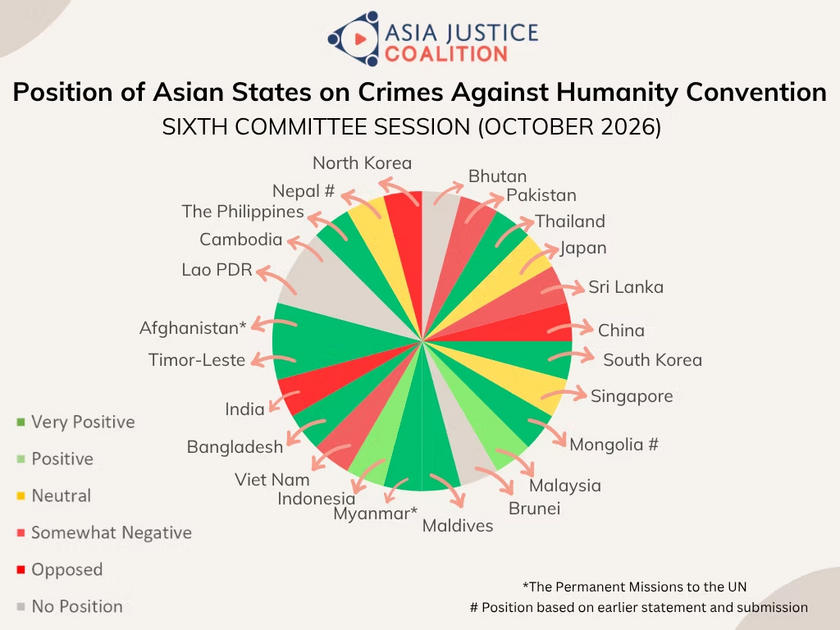
“We do not have a regional court, we do not have regional units coming. And therefore, I think it will be an important step for us to advocate for such conventions,” said Aakash Chandran, senior law and advocacy manager of AJC.
With the adoption of the Crimes Against Humanity Convention, states will be able to prosecute, not only individuals, but also companies who are engaged in facilitating the crime. Since prevention is a novel aspect of the treaty, the victims’ right to truth mandates states to prevent disinformation against victims and regulate companies like Meta.
The Draft Articles, created by the United Nations International Law Commission, stipulated that the treaty will not create a court, but enable inter-states cooperation for the investigation and prosecution of perpetrators, complimenting the ICC. Jan Wetzel, Senior Policy Advisor of Amnesty International, makes fugitive-Senator Ronald “Bato” Dela Rosa as an example, saying that if he is found in Thailand, the country would have to investigate, arrest, potentially try, or extradite him.
“If any country finds a suspect of crimes against humanity in their territory, they need to arrest that person. They need to make an initial investigation: they must try or hand them over to somewhere else to be tried. This is the global community responding,” Wetzel said.
The ICC can only address the individual criminal responsibility, leaving the state responsibility for the crimes against humanity aside. With the treaty, the states can be held accountable by the International Court of Justice (ICJ) for its failure to adequately prevent and/or punish the crimes that occur within their territory.
The Philippines assumes the ASEAN chairship this year. The country will be hosting the 49th ASEAN Summit from November 16 to 18, 2026, with more than 10,000 expected delegates from various countries.
Filipino progressive groups launched 12 days of protest ahead of the summit and the visit of United States President Donald Trump, whom they accuse to be a human rights violator and the brainchild of the Pax Silica initiative.
Read: Trump out! | Progressive groups launch 12 days of protest
“Soon they [Trump administration] will come down hard because this is everything that they’re against,” said Weltzer. “So at some point, they will discover us and they will start actively working against this, which has a practical implication since all negotiations happen in New York.”
The Trump administration has previously sanctioned 13 prosecutors and judges of the ICC, three Palestinian human rights organizations, and the United Nations special rapporteur on human rights in the Occupied Palestinian Territory Francesca Albanese. The sanctions escalated after the ICC looked into war crimes committed by US troops in Afghanistan in 2018 up to the ongoing genocide of the U.S. and Israel in Palestine.
He added, “We know by now that access to New York is getting more and more limited, not just because of costs but also of visa restrictions. Organizations like us, if you work with the ICC, maybe you cannot come in because it is under sanctions. Even [United Nations] special rapporteurs cannot come in. The space is getting smaller, which is why we call for regional consultations.”
The treaty negotiations will start in 2028 on the basis of the draft articles. The Preparatory Committee for the Convention already started its meeting this January 2026. Their second session is scheduled in April 2027 to discuss rules of procedure, stakeholder participation including civil society, and finalization of the compiled text for the official negotiations. (RTS, RVO)
The post Rights groups support proposed treaty on crimes against humanity appeared first on Bulatlat.
From Bulatlat via This RSS Feed.