

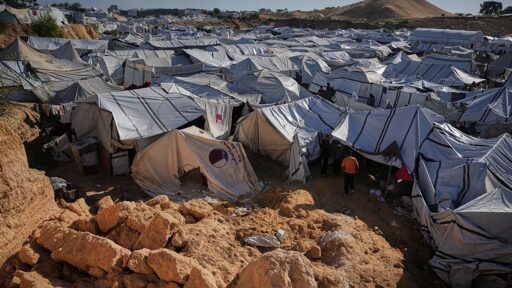

For the fourth consecutive year, and more than a year after the US-brokered ceasefire deal was reached, Palestinian people in Gaza continue to suffer from a severe humanitarian crisis caused by extreme weather conditions amid ongoing Israeli assaults and restrictions.
On Sunday, November 8, a steep sand dune collapsed onto tents sheltering displaced people in Deir al-Balah in the central Gaza Strip, killing five people, including four children and a woman. A number of other injured people were rescued from the site, according to media reports.
A report issued by the United Nations International Children’s Emergency Fund (UNICEF) on Monday, November 9, revealed that the catastrophic weather conditions have affected over 106,000 people in the besieged enclave.
Seasonal storms have flooded at least 70,000 tents, while 22,000 others collapsed completely, as Israel continues to restrict and delay the entry of essential shelter supplies, heating equipment, repair machinery, and maintenance parts to the war-ravaged territory.
Heavy rainfall also overwhelmed Gaza’s already damaged water and sewage infrastructure, resulting in widespread flooding of raw sewage across displacement camps.
Moreover, the sudden drop in overnight temperatures below 10°C (50°F) triggers life-threatening risk, particularly for children and sick people, especially with the shortage of winter clothes, blankets, and heating fuel.
International organizations hold Israel accountable for exacerbating the impact of severe weather conditions
The Euro-Med Human Rights Monitor accused the Israeli government of subjecting “Palestinians’ right to shelter and recovery to Israeli electoral calculations, particularly amid reports that measures to reconstruct Gaza have been postponed until after the elections.”
“Electoral interests and political or military conditions cannot justify suspending civilian protection or depriving people of life’s necessities,” the Geneva-based organization noted.
It also blamed international measures for falling short “to stop these practices and hold those responsible accountable,” which the organization said “has allowed Israel to continue using such deprivation as leverage, without facing a deterrent cost.”
Meanwhile, Regional Director for the Middle East, North Africa and Eastern Europe at Save the Children International, Ahmad Alhendawi, criticized the US-brokered ceasefire for failing “to protect Palestinian children.”
“This is not simply the result of bad weather. Tents, shelter kits, and fuel are waiting at Gaza’s borders while children sleep in floodwater, because the Israeli authorities are blocking their entry. This is a choice, and children are paying the price. More than a year into the so-called ceasefire, it has failed to protect Palestinian children,” Alhendawi stated.
From BT News via This RSS Feed.