

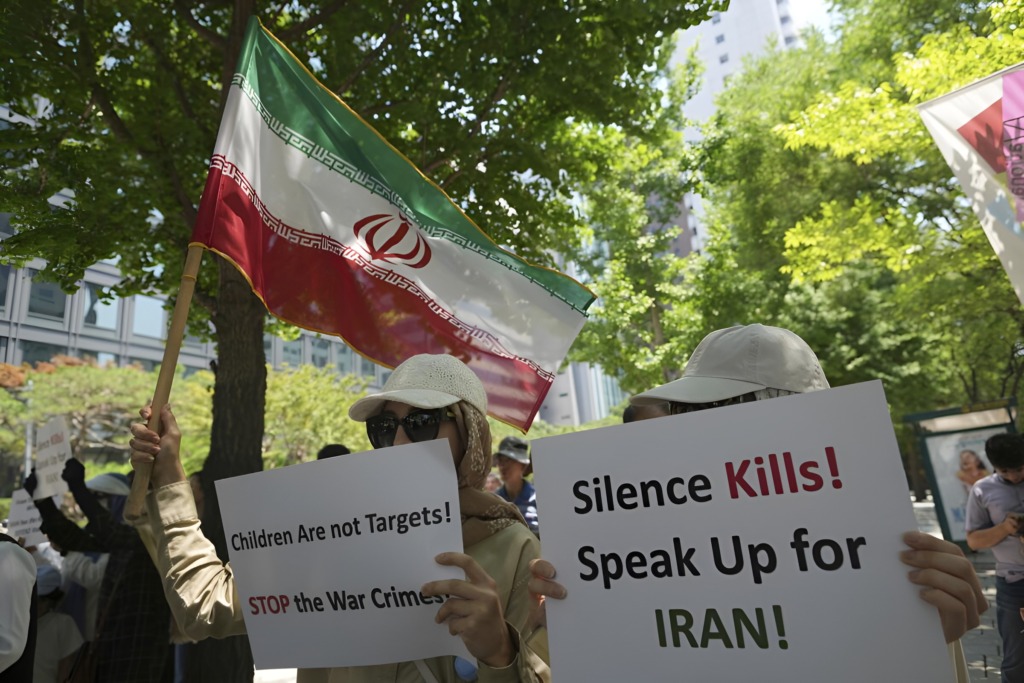
Official Tehran spokespersons frame military response as legal self-defense while rejecting unilateral U.S. and Israeli security conditions.
The U.S. Operation Epic Fury and Israel’s Operation Roaring Lion, launched on February 28, 2026, above Iran, mark a change in West Asian geopolitical relations.
The joint offensive began with the Israeli Air Force (IAF) dropping over 1,200 air strike sorties within the initial 24-hour period, targeting Iranian defense installations, infrastructure, and nuclear research facilities.
RELATED: Iran Urges the U.S. to Accept Tehran’s Seven Conditions and Denies Negotiations in Doha
This military engagement represents a continuation of long-standing U.S. and Israeli policy aimed at altering the political structure of the Islamic Republic of Iran.
The conflict stems from disputes over sovereignty, energy transport routes, and military capabilities. The geographical point remains the Strait of Hormuz, through which approximately 20 percent of global petroleum supplies transit daily.
The structural roots of this hostility trace back to the U.S. withdrawal from the Joint Comprehensive Plan of Action (JCPOA) in 2018 and the subsequent reimposition of economic sanctions.
Political pressure inside Washington contributed significantly to the escalation. Legislative oversight was bypassed as the executive authorized military action following intensive campaign efforts by domestic lobbying groups, including the American Israel Public Affairs Committee.
Diplomatic negotiations regarding Iran’s nuclear program continued through mid-February 2026. During these discussions, Iranian representatives offered to limit enriched uranium stockpiles in exchange for verified sanctions relief and security guarantees.
Dialogue between United States, Israel, and Iran appears to be at a standstill, yet military activity in the region has not ceased since February 28.
In this article, we review the conflict involving the U.S.-Israeli coalition against Iran and how it has unfolded over the past few months.
#Iran | Tehran insists Washington must meet seven conditions before negotiations resume, rejecting reports of direct talks in Doha. Demands include ending hostilities, lifting sanctions and addressing the Strait of Hormuz.#UnitedStates #Diplomacy #MiddleEast #teleSUREnglish pic.twitter.com/fbV6BJx3SQ
— teleSUR English (@telesurenglish) November 10, 2026
Six-Month Retrospective Military Actions
The initial phase of the U.S. – Israel war against Iran, since its beginning, has resulted in human and infrastructural damage across the region.
According to data compiled by the Legal Medicine Organization and the Iranian authorities, casualty figures in Iran reached 3,528 individuals killed and over 33,000 injured during the first quarter of operations.
On the other side, U.S. Central Command (CENTCOM) recorded 23 service members killed and over 800 wounded, alongside the loss of multiple aircraft and damaged installations.
For its part, Israeli defense reports cited 41 military fatalities and 31 civilian deaths, with over 7,000 injured during Iranian retaliatory missile strikes.
To achieve a ceasefire, the parties initiated diplomatic conversations that led to a brief pause in hostilities. In April 2026, a temporary two-week ceasefire was brokered in Islamabad, Pakistan, with mediation assistance from the host country and diplomatic support from China.
The resulting Islamabad Memorandum outlined steps for a permanent cessation of hostilities, unconditional unfreezing of Iranian state assets, war reparations, and the mutual reopening of commercial shipping routes.
However, the agreement collapsed by July because of disagreements surrounding the enforcement of a dual naval blockade deployed by U.S. forces in the Persian Gulf.
The last period of the year, until now, was characterized by structural shifts on the battlefield. Following a military lull in August, active hostilities resumed in September and October, marked by targeted drone and missile strikes against military installations.
This phase was defined by localized, retaliatory exchanges centered around the Strait of Hormuz, southern Iranian coastal bases, and regional facilities hosting U.S. forces.
Beginning August 30 and September 1, 2026, U.S. Central Command (CENTCOM) launched targeted air and missile strikes in response to Iranian harassment of commercial shipping in the Strait of Hormuz.
These strikes targeted Islamic Revolutionary Guard Corps (IRGC) naval, air defense, and missile launch infrastructure across southern Iran, specifically hitting installations in Bandar Abbas, Jask, Kenarak, Sirik, and Asaluyeh.
Also, U.S. forces repeatedly struck Qeshm Island near the Strait of Hormuz, targeting military radar arrays, drone command centers, and naval mine-laying facilities. Tehran and allied militias (including Iraqi factions and the Houthis) responded with coordinated ballistic missile and one-way attack drone barrages against installations across the Middle East.
Retaliatory drone and missile strikes targeted military facilities hosting American forces and equipment across Jordan (such as Muwaffaq Salti Air Base), Kuwait (including Camp Arifjan and Ali Al Salem Air Base), Bahrain (Naval Support Activity Bahrain), and bases in Iraq.
By early November 2026, U.S. executive statements described the war as reaching a military status quo, while maintaining a deployment posture in the Gulf.
Iranian Vice President and head of the Department of Environment Shina Ansari has called for pursuing legal action over environmental damage caused by the war, describing war-related environmental damage as acts of ecocide.
🔴 LIVE updates: https://t.co/8lNpFZYu69 pic.twitter.com/LwHJi3VFKN
— Al Jazeera English (@AJEnglish) November 10, 2026
Strait of Hormuz and Regional Stances
Official communications from Iranian state representatives emphasize national defense and adherence to international law. Iranian Foreign Ministry spokespersons have repeatedly stated that military actions by Tehran constitute legitimate self-defense under Article 51 of the United Nations Charter.
Statements from the Supreme National Security Council underline that Iran seeks neither regional expansion nor escalation, but will respond decisively to any violation of its territorial integrity.
Iranian officials have criticized Western double standards regarding international law, pointing to the lack of enforcement mechanisms against the U.S. and Israeli coalition while economic sanctions target civilian populations.
It is a fact that the Strait of Hormuz remains a central strategic factor in the conflict. Iranian military authorities have reiterated their sovereign right to regulate passage through territorial waters and enforce maritime security protocols in response to the naval blockade imposed by United States and allied forces.
Approximately one-fifth of the world’s petroleum supply passes through this waterway, making it vital to international energy markets. While Western military leadership asserts the necessity of maintaining open shipping lanes under U.S. and Israeli coalition protection, Tehran maintains that regional security must be managed by littoral states rather than external military powers.
Neighboring nations have adopted varied diplomatic and security postures in response to the escalation. Saudi Arabia and other Gulf Cooperation Council member states have navigated a careful diplomatic path, seeking to prevent the conflict from spreading to domestic infrastructure while balancing security commitments with Western allies.
Official statements from Riyadh and Doha have emphasized diplomatic resolution, expressing concern over regional economic stability and the security of energy installations.
Meanwhile, regional allies of Iran have maintained active military engagement. In Yemen, Ansar Allah forces have intensified maritime operations in the Red Sea and the Bab al-Mandeb strait, targeting commercial and military vessels associated with the U.S. – Israeli coalition to enforce a counter-blockade.
Ceasefire Dynamics and Military Realities
Negotiations between U.S., Israel, and Iran remain stalled due to mutually exclusive preconditions. United States and Israel maintain that any formal cessation of hostilities requires the total dismantlement of Iran’s nuclear enrichment facilities, strict caps on its ballistic missile production, and the unhindered opening of Persian Gulf shipping channels under coalition oversight.
Conversely, official Iranian representatives reject unilateral demands, maintaining that any lasting framework must guarantee a multi-front regional ceasefire, extending to Lebanon and Yemen, alongside the complete lifting of economic sanctions and war reparations.
With neither side willing to grant structural concessions, mediation efforts led by neutral regional entities have produced limited leverage.
U.S. and Israel continue relying on long-range standoff precision strikes and naval blockades, while Iranian defense units utilize decentralized missile batteries, air defense systems, and asymmetrical naval tactics.
Diplomatic tension flared at the United Nations General Assembly when a foreign delegation walked out during Iranian President Masoud Pezeshkian’s address. The abrupt exit occurred as Pezeshkian denounced military aggression and defended Iran’s position on regional security.… pic.twitter.com/QY4lf8iVrg
— teleSUR English (@telesurenglish) September 23, 2026
Impact on Markets and Infrastructure
The economic consequences of the joint military operations have extended far beyond the conflict. Global energy markets experienced severe volatility following the disruption of commercial shipping lanes through the Strait of Hormuz, where daily transit volumes dropped by more than 60 percent during peak operational phases.
International benchmark crude prices spiked dramatically, causing compounding inflation across both industrialized and developing economies.
Shipping insurers systematically revoked coverage for commercial vessels operating within the Persian Gulf, forcing merchant fleets to reroute around the African continent and sharply increasing global transport costs.
Civilian infrastructure in urban and industrial zones sustained extensive damage throughout the campaign. Independent assessments by international humanitarian bodies record widespread disruption to civil electrical grids, municipal water treatment facilities, and public healthcare systems across multiple provinces in Iran.
The displacement of civilian populations expanded as combat operations reached dense urban centers and neighboring territories. Humanitarian organizations estimate that hundreds of thousands of civilians were internally displaced, straining regional relief capacities and creating urgent demands for emergency medical supplies, food aid, and shelter.
International aid agencies have highlighted the cumulative burden of ongoing financial sanctions, which continue to restrict the procurement of essential pharmaceuticals and humanitarian materials required by affected populations.
Iranian President Masoud Pezeshkian denounced the terrorist attacks by the United States and Israel and rejected accusations that his country harbors a terrorist state.
“Those who are terrorists and train terrorists describe us as such,” Pezeshkian said during his address to the… pic.twitter.com/wWT9PxwhSZ
— teleSUR English (@telesurenglish) September 23, 2026
Long-Term Security Implications
International institutions, including the United Nations Security Council, faced structural gridlock as consensus could not be reached regarding resolution enforcement, ceasefire implementation, or accountability measures.
This diplomatic paralysis has intensified calls from nations across Asia and Latin America for a fundamental restructuring of international security bodies to prevent unilateral military interventions.
Regional energy security architecture is undergoing permanent structural adjustments. Countries heavily reliant on West Asian oil imports have accelerated strategies to diversify energy supply chains and expand domestic reserves.
The outcome of the conflict underscores the limits of military dominance in achieving political settlement or regional stabilization. Rather than securing long-term compliance, coercive strategies have strengthened cross-border defense cooperation among regional non-state and state actors opposed to external intervention.
Sources: TeleSUR – Al Jazeera – Al Mayadeen – Press Tv – Democracy Now – IRNA – Hispan TV – irangov.ir – DW – BBC – EuroNews – CNN
From teleSUR English via This RSS Feed.