

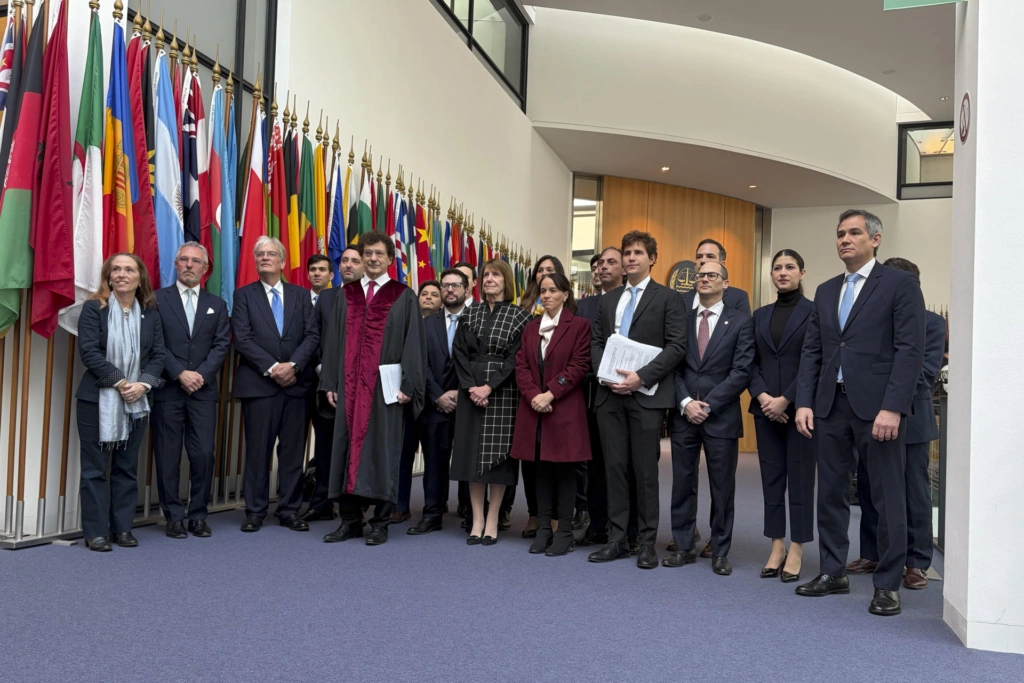
Argentina is pressing its sovereignty claim over the Malvinas Islands, South Georgia and the South Sandwich Islands before the International Tribunal for the Law of the Sea in Hamburg, where judges are deciding whether to adopt precautionary measures against British resource exploitation.
Argentina formally asked the International Tribunal for the Law of the Sea on Tuesday to order the United Kingdom to immediately halt oil exploration and extraction in the Malvinas Islands and their surrounding maritime zones.
The delegation from Buenos Aires presented what it called an “urgent demand” during the opening day of hearings in Hamburg, Germany. The legal action seeks precautionary measures to freeze the disputed Sea Lion project, which is being developed by Navitas Petroleum and Rockhopper Exploration in the North Malvinas Basin.
RELATED: Argentine President Milei Toughens Malvinas Claim at UNGA
Experts contend that unilateral oil development in an area subject to a historic sovereignty dispute deepens bilateral geopolitical tensions and endangers the environmental preservation of the South Atlantic.
The Argentine government has framed the case as a defense of national strategic resources against what it calls a British corporate offensive. Proceedings in the German port city continue along their procedural course. The court is weighing whether to adopt preventive measures in the short term.
The dispute now operates as a central axis of regional geopolitics in the Southern Cone, binding together questions of sovereignty, resources and continental security.
[POLÍTICA] En Hamburgo, la delegación argentina exigió ante el Tribunal del Mar frenar la explotación petrolera británica en Malvinas: María Ibarzabal Murphy, secretaria Legal y Técnica de la Presidencia, estuvo acompañada por consejeros y asesores jurídicos. 📸 https://t.co/H7zLwdH0xP pic.twitter.com/teGJjLIhLW
— ElCanciller.com (@elcancillercom) November 10, 2026
Text reads: “In Hamburg, the Argentine delegation demanded before the International Tribunal for the Law of the Sea to halt British oil exploitation in the Malvinas: María Ibarzabal Murphy, Legal and Technical Secretary of the Presidency, was accompanied by advisers and legal advisors.”
Oil and Fishing Rights
The contested waters carry value far beyond the islands themselves. Rich fisheries, a southward projection toward Antarctica and untapped hydrocarbon reserves in the surrounding sedimentary basins have transformed the South Atlantic into an economic prize.
Argentina argues that the United Kingdom has pursued a systematic strategy of consolidating its colonial presence through unilateral exploitation of the disputed maritime spaces. For it part, London has repeatedly ignored resolutions from the UN General Assembly that urge both nations to return to peaceful bilateral negotiations.
Those resolutions embody the position that sovereignty must be settled through dialogue between the two countries. Argentina points to Britain’s repeated disregard of those calls as evidence that London prefers unilateral action over the multilateral order.
The shift toward international courts reflects a deliberate Argentine effort to judicialize the defense of its sovereign rights. By placing the matter before specialized maritime law bodies, Buenos Aires seeks to halt what it describes as the systematic plunder of non-renewable natural resources.
That confrontation carries consequences beyond the courtroom. The permanent tension it sustains in the Southern Cone challenges the fundamental principles of public international law and the territorial integrity of Latin American states, according to Argentine officials and their regional partners.
What the Hamburg tribunal decides in the coming weeks will shape the next stage of the dispute. A ruling on precautionary measures could constrain British activity in the disputed waters. A rejection, by contrast, would leave the status quo intact while the broader case advances.
For Argentina, the stakes are framed in stark terms. The government describes its legal campaign as a barrier against an ongoing corporate offensive and a defense of resources it says belong to the Argentinean people. Argentine officials have long maintained that the islands and their surrounding waters were forcibly taken and never lawfully surrendered. The case now before the Hamburg court gives that historical argument a contemporary legal vehicle.
The regional institutions backing the claim insist the matter reaches beyond a single nation. British colonial pretension in the South Atlantic, they argue, threatens the peace of the entire zone and the international rules that should govern it.
British Delegation Rejects Jurisdiction
Mario Oyarzábal, Argentine Ambassador to the tribunal and legal adviser to the Foreign Ministry, addressed the court directly. He said that what is at stake cannot be restored, because hydrocarbons are non-renewable resources and their definitive extraction will permanently alter the marine ecosystem.
The British delegation, comprising legal advisers Sally Langrish and Paul McKell, Attorney General Ellie Reeves and colonial authorities Simon Young and Jack Ford, delivered a formal response rejecting the international body’s jurisdiction. London argued that the tribunal lacks material competence to settle the litigation.
The British defense claimed the core of Argentina’s claim conceals a direct dispute over territorial sovereignty of the islands rather than a purely maritime controversy. London also maintained that no urgency or imminent danger of irreparable harm exists to justify imposing provisional measures that would paralyze the oil project.
The case could establish a global legal precedent on the prohibition of unilateral economic exploitation in maritime spaces under dispute.
The hearings continue as the tribunal weighs whether to grant the suspension Argentina is seeking. A ruling on provisional measures could come within weeks, shaping the future of the Sea Lion development and the broader South Atlantic dispute.
From teleSUR English via This RSS Feed.