

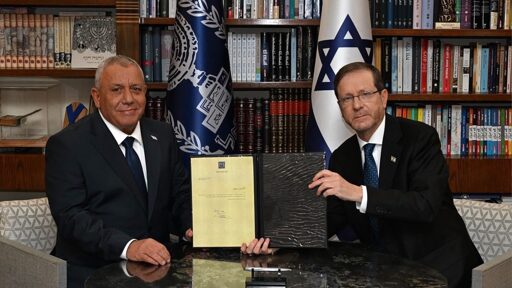

Israeli President Isaac Herzog officially tasked the leader of the anti-Netanyahu bloc, led by Gadi Eisenkot, with forming the next government, on Sunday, November 8.
This came after Eisenkot secured 67 Knesset recommendations (combining 48 from his own coalition and 19 from Arab-led parties) surpassing the 61-seat threshold needed to form a government.
After receiving the mandate, the designated candidate has a 28-day window (plus a potential 14-day extension granted by the Israeli president) to assemble a majority coalition in order to form a government with a minimum of 61 lawmakers.
In the meantime, Benjamin Netanyahu remains caretaker prime minister until the new government takes office, as per Israel’s Basic Law.
Read more: Final vote count for Israeli elections yields no clear winner
Eisenkot’s four core principles for his proposed government
Gadi Eisenkot set out four major principles for his proposed coalition government as follows.
Recognition of Israel as a Jewish and “democratic” state
Under this principle, all parties willing to join the coalition would be required to recognize Israel’s identity as the national home of the Jewish people. This requirement has long been a point of friction for the Arab parties, currently holding 19 Knesset seats.
The principle also stipulates that coalition members commit to upholding Israel’s democratic institutions and the rule of law. This, in turn, may prevent far-right and ultra-Orthodox factions from joining the coalition, given their recent support for judicial reforms aimed at limiting oversight of the government.
Embracing the values of the Declaration of Independence
Eisenkot invoked Israel’s foundational 1948 Declaration of Independence, which purportedly calls for creating a state that represents a safe home for Jewish people, while maintaining a democracy based on peaceful coexistence, freedom, and equal rights for everyone.
The principle ignited controversy as it underscored deep divisions over Israel’s national identity, secular–religious boundaries, and political calculations needed to maintain the balance of power.
Mandatory military service for all Israeli citizens
In accordance with this principle, Eisenkot demands that all Israeli citizens – regardless of their gender – perform either mandatory military service or an approved civilian-national alternative.
This principle sparked debate because it challenges Israel’s delicate social, religious, and political balance.
Ultra-Orthodox Haredi communities view military conscription as a major threat to their full-time Torah study and religious lifestyle. As a result, their leaders consider draft exemptions an absolute prerequisite for remaining in coalition governments.
Concurrently, secular and mainstream Israelis argue that exempting Ultra-Orthodox citizens from military service violates the principle of equality by making non-religious citizens bear an unfair share of military risks during wartime shortages. This stance was supported by Israeli Supreme Court rulings that invalidated the exemptions.
On the other hand, Arab leaders view the extension of mandatory national or community service to Arab citizens as inequitable as long as structural inequalities remain unaddressed.
Recognizing Hamas as a “terrorist” organization, and committing to dismantle it
All the Arab parties in Israel’s Knesset refrained from publicly endorsing this precondition.
Ra’am leader Mansour Abbas expressed an “unequivocal” private position supporting the disarmament of Hamas. However, he avoids making a public declaration, citing safety concerns for his family, precarious ideological positions within the Islamic Movement with which he is affiliated, and a practical need to remain neutral enough to act as a mediator while preserving support from his Palestinian constituency.
Meanwhile, the Joint List refuses the requirement on political and national grounds, arguing that labeling Hamas as a “terrorist group” would delegitimize broader Palestinian national aspirations, and justify Israel’s ongoing military operations in the Gaza Strip.
Netanyahu slams assignment of Eisenkot, calls for unity government
In protest to Herzog’s decision, Israeli Caretaker Prime Minister Benjamin Netanyahu posted a video, calling for the formation of a unity government.
“Now unity. Two days ago, I called for the formation of a unity government. It is the need of the hour. Do you know why it is the need of the hour? First and foremost, because it is impossible to form a government that includes or is dependent on supporters of Hamas,” Netanyahu said.
“You cannot fight Iran and its various proxies within radical Islam, if your own government relies on supporters of that very same radical Islam. Therefore, a unity government is an absolute necessity,” he asserted.
From BT News via This RSS Feed.