

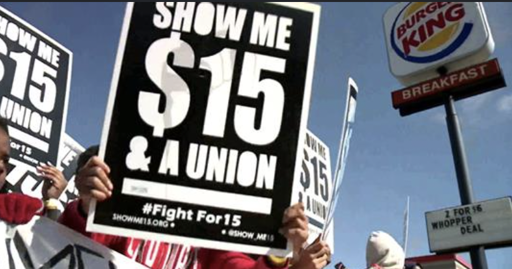
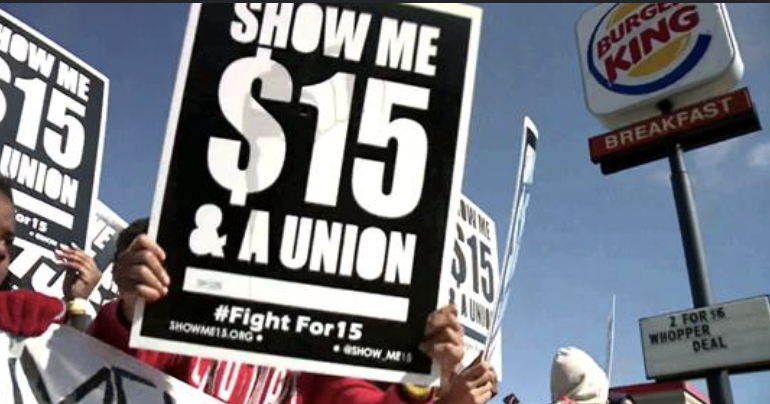
RIO DE JANEIRO, BRASIL - As Democrats decide what to do when they take back Congress, many in labor say that their first fight should be to double the minimum wage to $ 15 an hour, a move which would give a raise to an estimated 30 million Americans.
The fight to stop Trump from vetoing a minimum wage increase could mobilize the popular working-class support needed to pass other initiatives. Democrats should look at how Lula scored one of the most impressive comeback victories of all time by fighting to reduce the Brazilian workweek from 6 days to 5 days without reducing pay.
On October 5th, Lula, a former auto workers’ union leader turned President, trailed Flavio Bolsonaro by 2.2 million votes. Most political observers, even on the left, predicted Lula was unlikely to make a comeback.
Then, Lula supporters started mass street protests around the country numbering in the hundreds of thousands, even more than a million, like the one that I filmed on Copacabana Beach.
His supporters formed a massive WhatsApp group called Lula’s Army that soon grew to over 11 million members nationwide, coordinating actions and social messages among activists with very different political viewpoints across Brazil.
Suddenly, things began to shift as people took to the streets, and Lula found himself with the political momentum to call a vote in the Brazilian Senate to shorten the workweek from 6 days to 5, while keeping the same pay.
For 40 years, Lula’s Workers’ Party had tried and failed to shorten the Brazilian workweek, but on October 14th, just 11 days before the election, Lula used the energy of street protest to pass the measure. Only one right-wing member of the 81-member Brazilian Senate voted against it. Flavio Bolsonaro skipped the vote altogether because he knew that voting against it was political suicide.
Suddenly, the vote gave Lula new momentum, and some polls in Brazil even began to show the unthinkable: Lula was leading the presidential race.
On October 25th, Lula came back to win in Brasil - gaining an amazing ten million votes in less than three weeks, the most impressive comeback victory in the history of the Americas. That night, I drank and danced with hundreds of thousands on Avenida Paulista as Lula rode around on a sound truck, thanking his supporters for having his back.
Congressional Democrats could similarly inspire mass throngs of union members and activists in the streets through a major fight right now over raising the minimum wage to $15 an hour.
The federal minimum wage has not been raised in this country since 2007, the last time Democrats took power and used the power of mass organizing to embarrass a Republican president, George W. Bush, into signing the increase. Twenty years later, it’s possible that Democrats could scare Donald Trump into signing a similar wage increase.
During the pandemic, Donald Trump worked with Senator Bernie Sanders to triple unemployment benefits. Sanders thinks that Trump, in a crisis, might pass raising it to $15 an hour, something that has already happened in 17 states and is soon to happen in Pennsylvania, where Democrats have a ruling trifecta.
“I think, when Trump looks out in the world and he sees millions of people working for starvation wages, he might not be unsympathetic to raising the minimum wage to a living wage,” Sanders told Meet the Press this past weekend.
Polling shows that raising the minimum wage is politically popular on both sides of the aisle. According to an exit poll by Data for Progress, 2/3rds of voters polled in key battleground states support raising the minimum wage to $ 15 an hour.
Much like how Brazilian right-wingers refused to fight on shortening the workweek, Republicans would know it would be political suicide to oppose a raise for more than 30 million Americans making less than $ 15 an hour.
The AFL-CIO president thinks an unusual bipartisan alliance is likely to form around the minimum wage.
“People are very, very anxious. They’re frustrated,” Shuler said earlier this month. “This is a moment for some unconventional and unusual allies coming together.”
Not only would 30 million Americans get a raise, but millions of other Americans would likely also see higher wages as pay rises across the board and the bottom wage tier is raised. Unions would be more likely to demand a wage increase at the bottom, potentially leading to more strikes and workers in the streets.
An early win on raising the minimum wage for the first time in 20 years could give Congressional Democrats the type of popular support they need to push through the rest of their agenda.
Donate to Help Us Cover the Fightback
Support our mission
Donate Yearly
| | | | $36.00 USD - Yearly $60.00 USD - Yearly $180.00 USD - Yearly $420.00 USD - Yearly $1,200.00 USD - Yearly |
Donate Monthly
| | | | $3.00 USD - Monthly $5.00 USD - Monthly $15.00 USD - Monthly $35.00 USD - Monthly $100.00 USD - Monthly |
One-Time Donation

Patreon

Venmo

From Payday Report via This RSS Feed.