

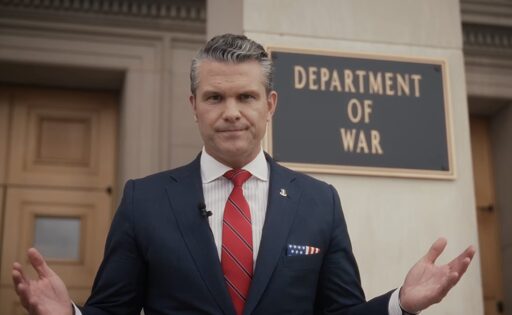
Pete Hegseth might be one of the biggest losers of the midterm elections. Mere hours into election night it was clear that voters were fed up with Trump’s administration, in no small part because of the consequences of his unpopular war on Iran. This has enabled Democrats and Republicans to begin a bipartisan effort to impeach the self-styled “Secretary of War.”
On November 9, less than a week since election night, Republican congressman Thomas Massie introduced eight articles of impeachment against Hegseth, accusing him of high crimes and misdemeanors. Among the charges are waging a war unauthorized by congress, carrying out extrajudicial killings by bombing boats in the Caribbean, and kidnapping Venezuelan leader Nicolás Maduro.
Massie is not simply trying to impeach Hegseth for his well-known incompetence. He is attempting to make a case that Hegseth, as the head of the United States military, committed war crimes which tarnish the supposedly high standards of how the U.S. military conducts itself. While introducing the articles in the House, Massie emphasized the bombing of the Minab girls school at the start of the war on Iran.
The attack on this elementary school was not an isolated targeting error that can be separated from the conduct of the Secretary of Defense. Nor can Secretary Hegseth’s conduct be excused as merely an isolated targeting mistake or an occasional error resulting from the ambiguity and confusion of the battlefield.
The Secretary of War has deliberately and systematically disregarded the laws and directives established to protect civilians during armed conflicts.
Massie is by no means a progressive (he has already proposed Ron DeSantis as a replacement), but the impeachment investigation opened by Congress is a reaction to the healthy instinct of segments of the masses, expressed in the midterms, who view the war in Iran with hatred and who condemn the U.S. military’s bombing of a girls’ school. For the youth in America, Hegseth is also a symbol of the genocide in Palestine that they have fought on the streets and on their campuses.
Hegseth has been defiant. Last week, he took to social media to post a nearly six-minute long video (produced with taxpayer money) to defend his leadership, summing up the message with the caption “At the War Department: We Stand. We Fight. We Defend the Republic.” After Trump announced that he would be appointing Stephen Miller as his new chief of staff, Hegseth congratulated Miller by posting a picture of the two together. On November 10, the morning after Massie introduced his articles of impeachment, Hegseth held a press conference dismissing the impeachment as a political spectacle.
Despite his protests, Hegseth’s days appear numbered. His net approval rating is an abysmal -29 percent, even worse than Trump’s (who is now the most unpopular president in U.S. history). Hegseth was always going to be unpopular among Democrats, especially due to his crusade against “woke” in the military in which he has purged the military of Black and women leaders and sought to ban trans people. But even Republicans have come to oppose him, as shown in the case of Senator Thom Tillis expressing that his vote to approve Hegseth was “the biggest regret of my career.” Nor does Hegseth have much support from within the military: a survey conducted by the veteran-led organization Common Defense found that about 50 percent of active duty troops disapprove of his leadership.
The Problem Is the Military, Not Its Leader
As The Intercept reports, even if Hegseth can survive the various bureaucratic obstacles to a successful impeachment, it is unlikely he’ll be able to last for the next two years of the administration. After all, he has become the face of the most unpopular war in U.S. history, and unlike Vice President JD Vance who has started to distance himself from the fiasco, Hegseth is too stupid and too bloodthirsty to do anything other than boast about his role in the war.
It would be a mistake, however, to see the impeachment effort as a serious reckoning with the U.S. war machine. In fact, the effort to oust Hegseth should be understood as an effort to restore civil-military relations which are at one of their lowest points in U.S. history.
This deeper motivation isn’t exactly subtle. Leading publications that aim to advise the administrators of U.S. imperialism on how to conduct themselves have been saying out loud what their goal is. For example, Peter D. Feaver and Heidi Urban write in Foreign Affairs that this should be the beginning of Congress playing a bigger role in shaping how the military conducts itself. Kori Schake of the American Enterprise Institute makes a similar argument in Foreign Policy.
Underlying these arguments, and the bipartisan opposition to Hegseth, is ultimately a desire for the United States to be able to keep conducting wars in the long run. The idea they hope to paint is that Hegseth is an anomaly, but the U.S. military is still an institution worth saving, with an important role to play in the world.
Socialists should play no part in trying to restore civil-military relations. Instead, we should use the reckoning with Hegseth’s crimes to deepen the conclusions people are drawing about the crimes that the U.S. military carries out, from the Middle East to the Caribbean. Importantly, we need to show that this violence is the point; it is the norm.
Against the Whole Institution
Hegseth might be the most candidly reactionary leader of the U.S. military, at least in recent history, but he has no less blood on his hands than the military leaders who under President Biden provided the aid that enabled Israel’s genocide in Gaza. Hegseth’s actions are no less horrific than the drone warfare that developed under President Obama’s Pentagon or the siege of Fallujah carried out by the Bush administration.
Hegseth has been able to commit war crimes because the most powerful military in the world exists to maintain U.S. global power through the systemic dehumanization and infliction of violence on its targets. Thousands of Americans, especially young people, are beginning to understand this after witnessing the War on Terror and the Gaza genocide. This is the reality that those in power hope to rewrite by treating Hegseth like a sacrificial lamb.
What this impeachment doesn’t do is address the fact the United States military is still locked into two wars —a proxy war in Ukraine and an active war on Iran. It doesn’t address that SOUTHCOM is spreading like a cancer across Latin America and the Caribbean. It doesn’t address that the military budget goes up every year. And that is the point. The bipartisan regime has no way to address these issues without posing a serious challenge to the country’s position as the (declining) head of a global imperialist system. The Democrats and Republicans, imperialist parties alike, can’t bring that challenge, so they focus on Hegseth instead.
As usual, Trump recently said the quiet part aloud. When asked about the calls to impeach Hegseth, he deflected by asking about previous U.S. wars, citing Vietnam, Afghanistan, and Iraq, and noting “There was nothing won. Just lots of death, and then let’s leave.” He then went on to suggest that Hegseth is “winning” the war on Iran — which, in Trump’s view, is totally different from other U.S. wars — before asking “What about impeaching the people that ran the Vietnam War? What impeaching that ran Iraq [sic] and Afghanistan?”
A far-right warmonger like Trump shouldn’t be the loudest voice posing these questions. Instead of following the lead of politicians trying to save the credibility of a brutal institution, the U.S. Left should follow the lead of class struggle in Europe: the Italian port workers who led a strike to “Block everything” against genocide, German youth who are refusing en mass to register for conscription, and the high schooler-led rebellion in France which is uniting the country against austerity carried out in the name of preparing for war. These examples must inspire an anti-war movement in the United States, which from below wages a struggle in the streets, workplaces, and schools against every last warmonger, starting with Hegseth.
The post Hegseth Takes the Fall, but the War Machine Doesn’t Stop appeared first on Left Voice.
From Left Voice via This RSS Feed.