

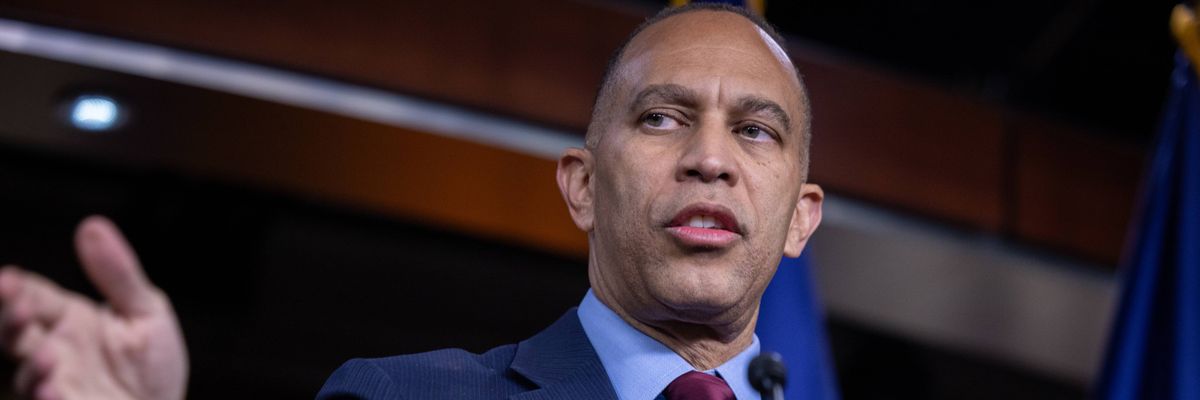
House Minority Leader Hakeem Jeffries declined to say on Monday whether he’d support holding up a spending bill next month in an effort to force President Donald Trump to end his war in Iran before Democrats retake Congress in January.
“We’re going to end the war in Iran one way or the other,” Jeffries (D-NY) said during a news conference Monday, but added that the appropriations process was “in the hands of” Rep. Rosa DeLauro (D-Conn.) and Sen. Patty Murray (D-Wash.), the top Democrats on their chambers’ respective appropriations committees.
Since Republicans’ resounding defeat in last Tuesday’s midterms, Trump has fluctuated wildly between declarations that the Iran War may soon end and bellicose threats to “destroy the rest” of the country. Some Democrats have taken this as a sign that urgent action is needed even before their new majorities take office in January.
Their most immediate point of leverage is the next government funding bill, which needs to be enacted by December 11 in order to avert a government shutdown.
With Trump ignoring the war powers resolution passed by Congress earlier this year, some Democrats have said they will withhold their votes unless the next bill contains clear language prohibiting federal funds from being used to continue waging the unauthorized war.
A Reuters/Ipsos post-election survey published Monday showed that 71% of all adults supported legislation to end the war, including 51% of Republicans.
Sen. Chris Van Hollen (D-Md.), who has suggested launching a leadership challenge against Senate Minority Leader Chuck Schumer, said Tuesday morning that Democrats must use their leverage to end the war as soon as possible.
“The American people have spoken loudly and clearly: We need to end the war in Iran now,” Van Hollen said in a video posted to social media. “We’re now 255 days into that war, a war that Donald Trump said would be over in a matter of weeks.”
“What’s the fastest way to end this war? Well, to stop funding it, to stop giving it the fuel it needs to keep going,” he continued, pointing to the December 11 deadline for a new spending bill.
“If President Trump wants to tell the country that he’ll shut down the entire government, all federal agencies, in order to keep his illegal war going, that’s his decision,” Van Hollen said. “But the American people have rendered their decision. Let’s end this war and end it now: not a penny more.”
Schumer, whom several incoming members of the Senate Democratic caucus have pledged to vote against as majority leader, has not publicly stated a position on whether he’d support using the December 11 deadline to force concessions from Trump. Last week, he told Politico he was working with Murray to “get something done” on government funding before December 11, but did not say whether he would demand a cutoff of war funding.
In a joint statement Monday, following a Democratic leadership meeting, Schumer and Jeffries pledged to “stop the reckless war of choice in Iran," but did not indicate what action they planned to take. They added that “a new day is coming on January 3.”
Jeffries said last week that his goal was “to reach a spending agreement that meets the needs of the American people and prioritizes their economic well-being, health, and safety.”
Drop Site News co-founder Ryan Grim suggested that Van Hollen’s demand for Democrats to hold up the December spending bill may put more pressure on Schumer to endorse a similar strategy. Jeffries, on the other hand, has not had his leadership role challenged, and several progressive members of Congress have said they’ll back him as speaker despite their policy disagreements.
Grim said Jeffries’ response showed he was “feeling absolutely no pressure to end this war, clearly very confident he’ll become speaker regardless.”
Since Trump launched the war in February, critics have argued that Jeffries’ response was lackluster. As independent journalist Adam Johnson recounted, Jeffries focused largely on procedural objections to the war while reinforcing many of the Trump administration’s justifications for it, including saying that Iran needed to be “aggressively confronted.”
While Reps. Ro Khanna (D-Calif.) and Thomas Massie (R-Ky.) were pushing for a war powers resolution as Trump built an “armada” in the Middle East weeks before the start of “Operation Epic Fury,” Jeffries did not force a vote on it to occur until several days after the bombing began.
Johnson argued that Jeffries has been “at best sleepy, useless, and indifferent” in response to the war.
The anti-war group Just Foreign Policy, one of the groups that pressured Democrats to ultimately invoke the War Powers Resolution against Trump, said that cutting off funding was one of the only guaranteed ways to bring the war to an end.
The group noted that Congress’ July 1973 decision to cut off funding played a decisive role in forcing President Richard Nixon to end direct combat operations elsewhere in Southeast Asia amid the US withdrawal from Vietnam.
It noted that the US bombing of Cambodia ceased the day that the funding prohibition took effect. After the House voted to restrict funding, then-Secretary of State Henry Kissinger declared, “That finishes us.”
“The ONLY way to truly rein in war criminals like [Defense Secretary Pete Hegseth] and Kissinger is for Congress to be willing to force the White House to risk a government shutdown if it wants to continue the war,” Just Foreign Policy said. “Time to shut the funding down like Congress did for Vietnam. Force Republicans to fund it themselves if they refuse.”
From Common Dreams via This RSS Feed.