

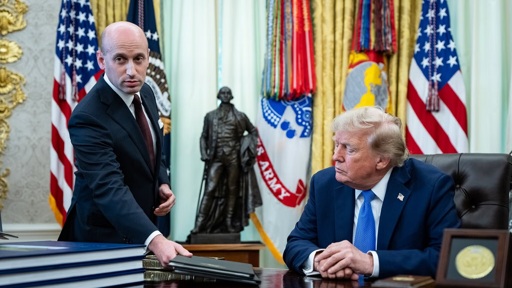
Less than a week after the Republican Party’s crushing defeat in the midterm elections, Donald Trump is trying to distance himself from the brutal consequences of his immigration agenda. In a television interview, he admitted that his deportation policy was “too harsh” and that it cost him decisive votes at the polls. However, the White House’s cynicism was laid bare when it appointed Stephen Miller—the architect of the repressive raids—as chief of staff. The example of Minneapolis, which dealt a severe blow to the anti-immigrant agenda, shows how to finally defeat the racist offensive.
During an interview on “60 Minutes” — Donald Trump’s first in-depth public appearance following his electoral defeat in the midterms — the president had to admit a setback in one of his “flagship” policies. When asked whether the mass raids and deportations carried out by his administration had gone too far, the tycoon replied: “I think it was too tough. I think it might have been too tough, yes. And ultimately that hurt me.”
The cornerstone of the White House’s racist agenda ended up becoming a political boomerang that led to the loss of both chambers of Congress to the Democrats. The loss of the Latino vote compared to the 2024 presidential election was one of the key factors in Trump’s defeat in last Tuesday’s elections. The Republicans lost support across other sectors as well, including young people, white workers, and retirees — all of whom were hurt in one way or another by the administration’s actions, such as economic crisis, the rising cost of living, the war in Iran, and support for Israel amid the genocide in Gaza.
The backlash at the polls reflected the deep discontent of the working class and sectors that have been battered by the systematic violence of U.S. Immigration and Customs Enforcement (ICE). The militarized operations have been utterly brutal, involving forced entry into schools, hospitals, workplaces, homes, and businesses. ICE hunted down working families with deep roots in the community, separating parents from their children and sowing terror in communities. Although Trump tried to defend himself by claiming he earned an “A+” from voters for closing the borders, he openly acknowledged that deporting people with stable jobs and no criminal records took a decisive electoral toll.
However, the White House’s supposed remorse lasted little longer than the “60 Minutes” in the program’s name. On the very day of the interview, Trump officially promoted Stephen Miller to White House chief of staff, replacing Susie Wiles. Miller is no ordinary official: at 41, he is recognized as the true ideologue of the administration’s most reactionary and imperialist wing. For nearly a decade, he was the mastermind behind aberrant measures such as the separation of immigrant children from their families at the border, the 2017 travel ban on Muslim-majority countries, the near-total suspension of asylum, and the deployment of masked and heavily armed agents in working-class neighborhoods. Far from toning down his stance, the very day after the election defeat, Miller was already making internal calls demanding that the pace of mass deportations be accelerated.
In this context, Trump’s statements offering to reach a bipartisan agreement with the Democrats to “ease” the persecution of migrants who have resided in the country for more than 10 or 15 years are a crude diversionary tactic. The working class and social movements can place no trust in either the White House or the Democratic Party leadership. The Democrats have historically proven to be active partners in the militarization of the border, voting for multimillion-dollar budgets for ICE and refusing to disband this repressive agency or curb its methods of employer-backed violence in the states they govern.
The only force capable of pushing back against the racist machinery of the capitalist state is independent organization and action in the streets. The most tangible example of this approach was seen this year in Minneapolis, where the resistance of migrants alongside workers, youth, and the organized community forced the regime itself to back down.
When the administration deployed “Operation Metro Surge” — a contingent of more than 3,000 agents focused on terrorizing Somali and Latino communities — the popular response was immediate. Following the brutal murders of legal observer Renee Good and intensive care nurse Alex Pretti at the hands of federal agents, the people of Minnesota turned their outrage into direct action.
In Minneapolis, neighborhood committees organized early-warning networks using whistles and real-time tracking of ICE patrol cars, preventing arrests and physically intervening to protect those being targeted. Teachers and parents coordinated to shield schools and local businesses, workers refused to provide services to federal forces, and the struggle culminated in a massive day of protest featuring strikes, “no work, no school, no shopping” walkouts, and work stoppages backed by unions. This massive pressure in the streets broke the repressive apparatus and forced Trump to remove Gregory Bovino, the infamous Border Patrol commander responsible for the most brutal raids.
Trump’s setback in Minneapolis — which did not halt raids in every state but did deal a blow to the administration’s racist policies — categorically demonstrates that the Far Right cannot be stopped by campaign promises or the Democrats’ backroom diplomacy. To crush the racist agenda of Trump and Stephen Miller, the urgent task is to replicate the Minneapolis approach on a national level: build community self-defense committees, coordinate resistance alongside grassroots unions, and call for a general strike until ICE is driven off the streets and the working class secures the freedom of movement and full rights for all immigrants. Following the crushing defeat of Trump and the Republicans in the midterm elections, this is no time to sit down and negotiate, but rather to go on the offensive to deal a final blow to racist and xenophobic policies.
The post Trump’s Promotion of Stephen Miller Shows Only the Streets Can Stop ICE appeared first on Left Voice.
From Left Voice via This RSS Feed.