

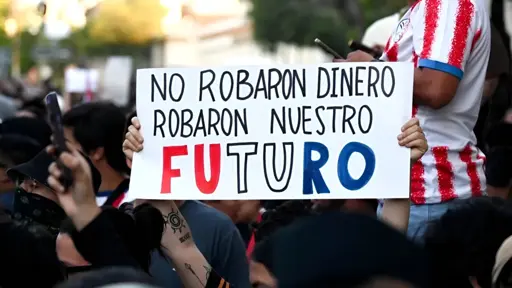
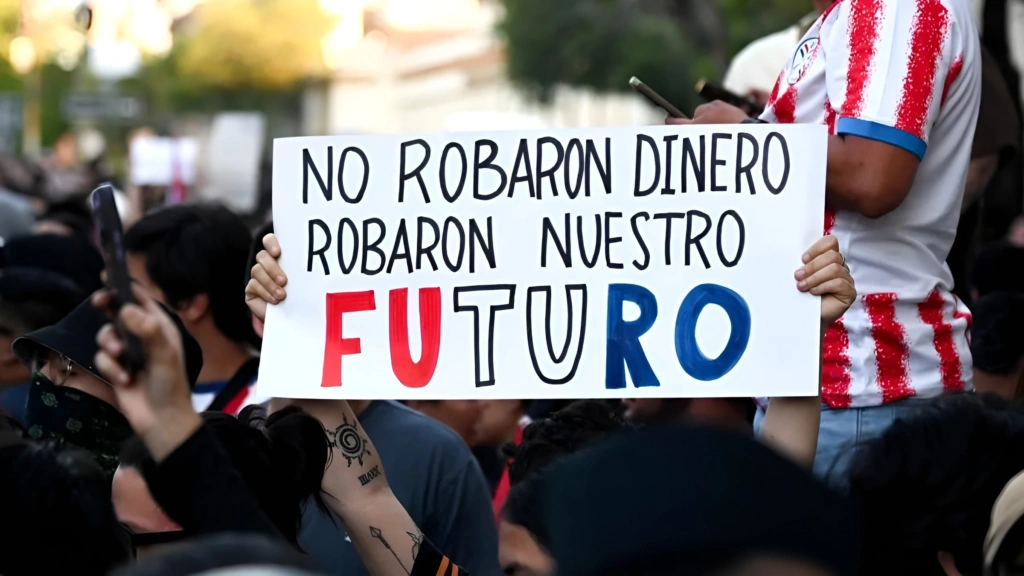
Roughly three million customers lost immediate access to digital funds as Ueno Bank went into Paraguay’s Central Bank resolution.
On November 3, 2026, Paraguay faced a severe political and economic crisis following the intervention and immediate dissolution of Ueno Bank, the country’s largest digital lender.
RELATED: Paraguayan Teachers to Protest Over Frozen Pension Funds
The sudden collapse of Ueno Bank froze nearly three million customer accounts, affecting roughly 60% of the adult population. Within days, the crisis escalated from a corporate failure into a constitutional emergency.
On November 6, the Paraguayan Senate voted unanimously to impeach and remove President Santiago Peña from office. Vice-president Pedro Alliana was immediately sworn in to complete the presidential term ending in August 2028.
The events unfolded rapidly after the Central Bank of Paraguay (BCP) seized control of Ueno Bank due to severe capital shortfalls and unauthorized related-party lending.
As public protests erupted outside the National Congress in Asuncion, lawmakers rejected President Peña’s attempt to resign, choosing instead to pursue formal impeachment proceedings.This legal distinction stripped Peña of the lifetime Senate seat and parliamentary immunity typically granted to former presidents. Consequently, prosecutors filed criminal charges against Peña and placed him under house arrest, citing potential conflicts of interest and financial misconduct.
Ver esta publicación en Instagram
Una publicación compartida de teleSUR English (@telesurenglish)
Anatomy of the Ueno Bank Crisis
Ueno Bank expanded rapidly within the Paraguayan financial sector after its transition from a financial company to a licensed bank on November 22, 2024.
Using digital marketing campaigns, cashback incentives on retail purchases, and extensive sponsorships of national sports organizations, the institution amassed approximately $2.9 million to $3 million retail accounts.
This rapid growth transformed Ueno Bank into a major financial provider in a country with a total population of approximately 6.1 million people.
The crisis began when audits led by the Central Bank of Paraguay (BCP) revealed that Ueno Bank’s solvency ratio had fallen below required minimum standards. At the time of the intervention, Ueno Bank’s solvency ratio was below the 50% minimum required by the Central Bank. The minimum total capital (solvency ratio) mandated by the Central Bank is 12%.
Following accounting adjustments and the reclassification of overdue or irregular loans, as imposed by the Superintendency of Banks, Ueno Bank’s actual ratio plummeted to less than 6%.
Investigators said that Ueno Bank had engaged in extensive connected and insider lending involving entities linked to Vazquez Group, one of the largest business conglomerates and holding companies in Paraguay.
Investigations also revealed that Ueno Bank served as the economic engine for the Vazquez Group, accounting for 59% of its operating profitability (EBITDA). The Vazquez Group controlled the bank through a corporate structure, organized both domestically and internationally, designed to channel investments. It maintained ties with, and extended multi-million-dollar loans to, U Holdings, U Paraguay, Federico Vázquez, and the financial firm Vinanzas.
Official reports indicated that approximately 380 million dollars in public funds, including assets belonging to state pension entities and municipal accounts, were concentrated within the institution.
When the Central Bank of Paraguay placed Ueno under resolution, mobile applications, debit cards, and branch operations were suspended overnight.
After the intervention, the Public Prosecutor’s Office issued arrest warrants for 27 individuals, including Ueno’s controlling shareholder Miguel Vázquez and bank president Juan Manuel Gustale, on charges of breach of trust and financial mismanagement.
Ver esta publicación en Instagram
Una publicación compartida de teleSUR English (@telesurenglish)
Social and Economic Impact of the Bank Freeze
The regulatory shutdown of Ueno Bank created socio-economic disruption across Paraguay. The sudden freezing of nearly three million accounts severely restricted liquidity, blocking low-income households, small business owners, and gig economy workers from accessing their savings and daily earnings.
Because Ueno Bank handled major digital payment processors and retail transactions nationwide, commercial activity slowed significantly in urban centers like Asuncion and Ciudad del Este.
Consumers found themselves unable to purchase food, medication, or basic household necessities as card terminals and digital transfers linked to the bank failed.
The crisis extended into public administration and essential municipal services. Public entities, including local government councils and public utility companies, had tens of millions of dollars in operating budgets locked inside the institution.
The national electric utility reported over twenty million dollars in trapped reserves, delaying infrastructure maintenance and vendor payments.
In response, labor organizations, trade unions, and student groups organized mass protests outside government buildings. Demonstrators demanded the immediate release of individual deposits, full transparency regarding state pension investments, and strict judicial accountability for financial executives.
Ver esta publicación en Instagram
Una publicación compartida de teleSUR English (@telesurenglish)
Resignation Attempt, Impeachment Proceedings
As civil unrest mounted, Santiago Peña faced growing pressure over his links to Ueno Bank. Before taking office, Peña served as a board member and shareholder in financial entities associated with the group.
The investigations pointed to regulatory approvals granted during his administration, as well as the placement of hundreds of millions of dollars in public pension funds into Ueno Bank, as evidence of severe conflicts of interest and influence peddling.
In a televised address on November 5, Peña defended his administration’s oversight record but announced his formal resignation to preserve national stability.
However, the National Congress refused to accept Peña’s resignation letter. Under the Paraguayan constitution, former Presidents automatically assume life-tenured, non-voting seats in the Senate, a position that carries parliamentary immunity from criminal prosecution.
To prevent Peña from acquiring this legal protection, lawmakers across political parties -including factions within the ruling Colorado Party- voted to reject his resignation and initiate immediate impeachment proceedings.
The Chamber of Deputies voted unanimously to approve articles of impeachment. Hours later, the Senate convened in an emergency session and voted to remove Peña from office for breach of trust and failure to perform presidential duties. Following the vote, prosecutors formally filed criminal charges against Peña, requesting preventive custody and placing him under house arrest while investigations into financial self-dealing continue.
Ver esta publicación en Instagram
Una publicación compartida de teleSUR English (@telesurenglish)
Succession and Economic Management Under Alliana
Following the congressional removal of Santiago Peña, Vice-president Pedro Alliana was immediately sworn in to complete the presidential term ending in August 2028.
Alliana assumed power during an extraordinary legislative session designed to maintain institutional continuity amid acute political polarization. In his initial public addresses, the new head of State emphasized restoring administrative stability, cooperating fully with the Public Prosecutor’s Office, and expediting the recovery of funds for affected depositors.
However, some factions expressed skepticism regarding elite continuity within the ruling Colorado Party, noting that Alliana’s administration shares deep political ties with party leadership structures previously aligned with Peña.
To address the severe economic contagion triggered by the Ueno Bank intervention, the Executive power coordinated emergency liquidity measures with the Central Bank of Paraguay.
Authorities deployed the national Deposit Guarantee Fund to begin reimbursing small and medium depositors, covering accounts up to statutory limits. Reports from financial authorities indicated that initial disbursements reached over one million customers, totaling more than 150 million dollars in payouts.
Despite these stabilization efforts, the Paraguayan financial sector experienced heightened volatility, reduced lending confidence, and intensified scrutiny over the management of municipal and public pension reserves across commercial banks.
Ver esta publicación en Instagram
Una publicación compartida de teleSUR English (@telesurenglish)
Accountability, Systemic Losses, and Institutional Reform
The collapse of Ueno Bank and the subsequent political fallout shifted national attention toward judicial accountability and the recovery of illicit assets.
The Paraguayan Public Prosecutor’s Office expanded its investigations beyond the initial group of twenty-seven indicted individuals, focusing on real estate transactions, irregular credit lines, and corporate financing structures linked to the Vazquez Group.
Legal experts indicate that criminal proceedings for breach of trust, money laundering, and influence peddling will likely extend for months as courts examine how hundreds of millions of dollars in public funds were funneled into private financial entities.
While deposit guarantee mechanisms provided immediate relief to millions of small savers, critics noted that Paraguayan public-backed funds ultimately bore the cost of private financial recklessness.
The Ueno Bank crisis prompted intense legislative debates concerning tighter regulatory oversight for digital financial institutions, mandatory transparency rules for public pension investments, and stricter conflict-of-interest prohibitions for elected public officials.
Ultimately, the events surrounding Ueno Bank exposed the fragile intersection of State’s power and private financial expansion, leaving lasting impacts on Paraguay’s political landscape and economic governance.
Sources: The Asuncion Times – The Japan Times – BBC – TeleSUR – El País – France 24 – DW – Xinhua – Al Jazeera – Revista Semana – Diario Red – El Espectador – La Tercera – CNN Español – Cuba Debate – Volcánicas
From teleSUR English via This RSS Feed.