

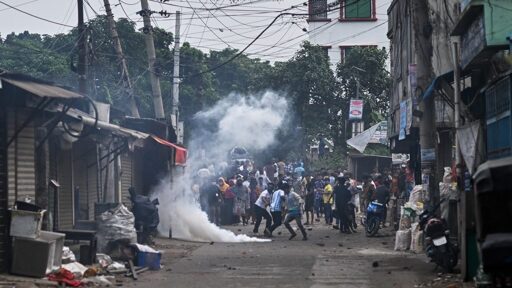

For multiple days, thousands of workers in Bangladesh, mostly from garment factories, protested for a raise in their minimum monthly wages and against the rising prices of essential commodities, defying the state’s oppressive measures.
On Tuesday, November 3, news reports indicated fresh clashes between workers and security forces at various places in the capital, Dhaka, with the agitating workers trying to block highways and other roads.
The protests broke out despite the Home Minister of the country Salahuddin Ahmed warning the workers to return to work on Monday after claiming their demands had been addressed by the government through the formation of a “wage board.”
Meanwhile, the authorities unleashed violence and repression on workers with police resorting to baton charges and firing tear gas at various places injuring several of them. The police have also arrested protesters after accusing them of indulging in arson and violence.
Workers are demanding a revision in their minimum monthly wages to at least 30,000 Bangladeshi Taka (around $240) from its present 12,500 (around $100) claiming the present wages are highly inadequate to live a decent life in the context of the rising prices of essential commodities, including food and fuel.
Several unions and progressive organizations, including the Workers Party of Bangladesh (WPB), however, have demanded an even higher wage of Taka 37,125 (around $300) along with measures to curb the rising prices of essential commodities.
The protests began in Dhaka in the last week of October and continued throughout the weekend. After the government failed to respond to their demands, workers blocked several roads in the city including some highways on Saturday and Sunday.
Dozens of factories in Gazipur and other industrial areas of Dhaka declared holidays on Monday and Tuesday in an attempt to avoid gatherings. The government has also increased the deployment of security forces at all major points in the city to prevent agitating workers from blocking roads and taking out other militant actions.
Decent living wages
Workers in Bangladesh argue that the minimum wages in the country have not been revised for years now despite the rise in profits for the companies, higher revenues from garment exports, and rising prices of the essential commodities.
Bangladesh is the world’s second largest exporter of garments, after China, with around 80% of all its export value coming from the sector alone.
According to various studies, the wages of garment sector workers in Bangladesh remain lowest among all the major exporting countries. Workers in the garment sector are also among the lowest paid workers in the country.
Bangladesh has seen a consistent increase in inflation in the last four years which, in the absence of a corresponding rise in wages, has actually led to a drop in the real wages. Just for an example, the official inflation rate in September was over 8%. This has created a severe cost of living crisis for most of the workers in the country.
The recent high inflation in the prices of the essential commodities in the country is partially attributed to the ongoing US-Israeli war on Iran and continued disruptions in the transportation of oil and gas through the Strait of Hormuz.
Bangladesh imports nearly half of its oil and gas needs from the Gulf. The US-Israeli aggression and Iranian retaliation has disrupted these imports, leading to severe shortages of cooking gas and oil also affecting the prices of other commodities, including food.
The WPB issued a press release on Monday in support of agitating workers and condemning the “brutal suppression by law enforcement agencies and hired thugs” on them.
Prothom Alo, a prominent local daily, reported on Tuesday that, along with the security forces, workers of the ruling Bangladesh Nationalist Party (BNP) were also involved in repressive activities.
The WPB also condemned the attempts by certain sections of the ruling establishment and the media to vilify protests by calling them a “conspiracy.” It expressed hope that the BNP-led right-wing government would understand the gravity of the situation and immediately address the demands raised by the workers.
From BT News via This RSS Feed.