

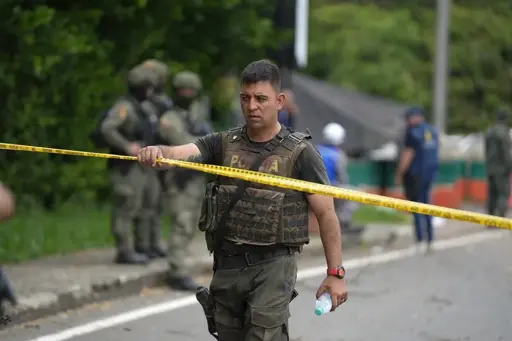
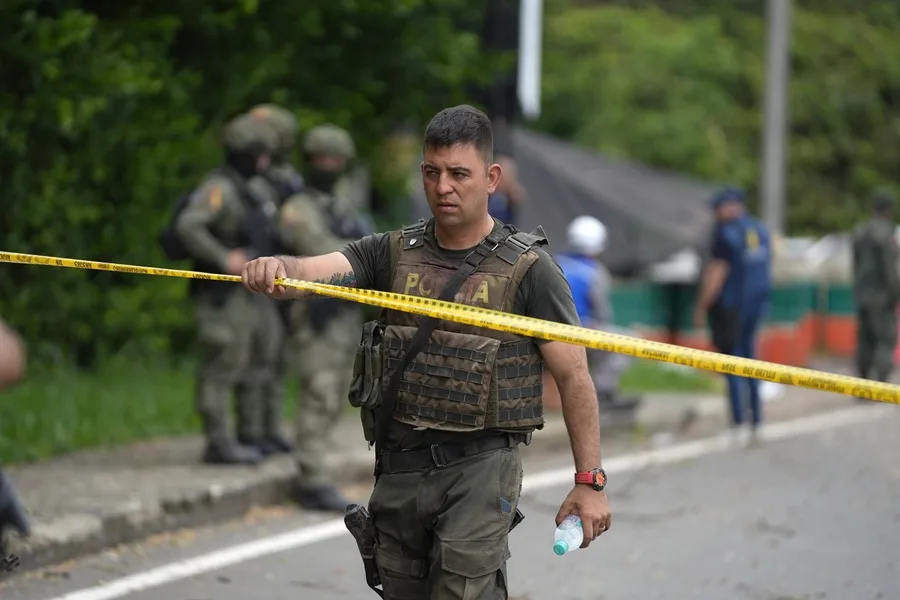
Colombia’s state ombudsman issued an urgent alert Monday over deteriorating security in southern Bolivar, two days after a bomb attack on an army base killed three soldiers.
Colombia’s ombudsman office, issued the alert on Monday, November 9, warning of a deepening humanitarian crisis in southern Bolivar, a department in the north of the country.
The warning came two days after a bomb attack on the Army Military Canton in the municipality of Santa Rosa del Sur. That strike left three soldiers dead and dozens wounded inside the military unit.
RELATED: Colombia Drone Attack: 4 Soldiers Dead, 44 Wounded in Bolívar
The attack unfolded at the same time as a local security council meeting that had been convened after three other people were killed the day before. The violent sequence stretched across three days. On Friday, three people were murdered. On Saturday, explosives struck the military base. On Monday, the ombudsman raised its warning to the State.
Colombia’s Defense Ministry blamed the National Liberation Army (ELN), for the attack. The ministry said the armed response came in retaliation for the capture of a man known as Carrito, the financial chief of the Guamocó Resistance Front. That detention, the ministry argued, triggered the strike against the base.
The ombudsman insisted these episodes are not isolated. They reflect a deeper crisis in the region, a pattern of sustained violence that goes far beyond any single incident.
Expresamos nuestra preocupación por el ataque con explosivos contra el Cantón Militar del Ejército Nacional, en Santa Rosa del Sur, Bolívar. Nos solidarizamos con los integrantes de la Fuerza Pública afectados por estos hechos y sus familias. El ataque en la cabecera municipal… pic.twitter.com/6jggP0hMKh
— Defensoría del Pueblo (@DefensoriaCol) November 7, 2026
At the root of the situation is the intensification of territorial clashes in the Serranía de San Lucas. Three armed structures are fighting for control of the area, the National Liberation Army, the Gulf Clan and dissident factions under a commander known as Calarcá.
The humanitarian toll has reached critical levels. Between May and September 2026, the Ombudsman counted 22 humanitarian emergencies linked to forced confinement and mass displacement. Confinement prevents people from leaving their territories. Displacement forces them to abandon them altogether.
More than 11,100 people were affected across the region in that period, belonging to nearly 5,000 families.
Civilians in the Middle
Peasants and native people stand at the center of the fight. Thousands are forced to flee or remain trapped in their own territories. Their survival depends on humanitarian assistance, in a scenario where forced displacement and confinement have followed one another for months on end.
The forced flight and the confinement translate into thousands of people who cannot work their land or reach basic services. For months, the two phenomena have repeated without interruption, leaving communities dependent on outside aid to eat and to survive.
Faced with that escalation, the ombudsman asked the State for an immediate response to halt the impact of the armed confrontation on civilians. It urged national, departmental and municipal authorities to apply safeguard measures without delay.
The office also demanded that the Attorney General’s Office produce results in the investigations into the homicides and terrorist attacks committed in the area. The alert seeks to ensure the State’s response arrives before the crisis grows worse still.
From teleSUR English via This RSS Feed.