

Miles Morrisseau
ICT
ONTARIO, Canada — Dozens of people gathered at the cenotaph on the Chippewas of Kettle and Stony Point First Nation to honor and remember Indigenous veterans, a scene and sentiment shared across Canada in ceremonies Nov. 8 to mark National Indigenous Veterans Day.
The annual event began in 1994 to acknowledge the sacrifices made by First Nations, Métis and Inuit people who stood up for a country that did not always stand up for them.
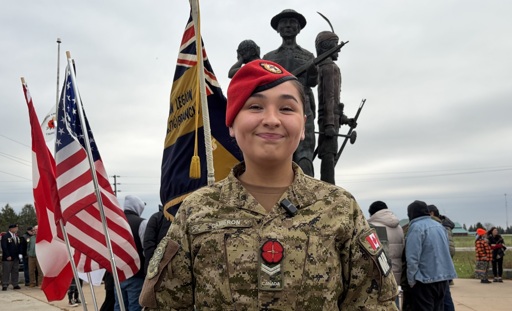
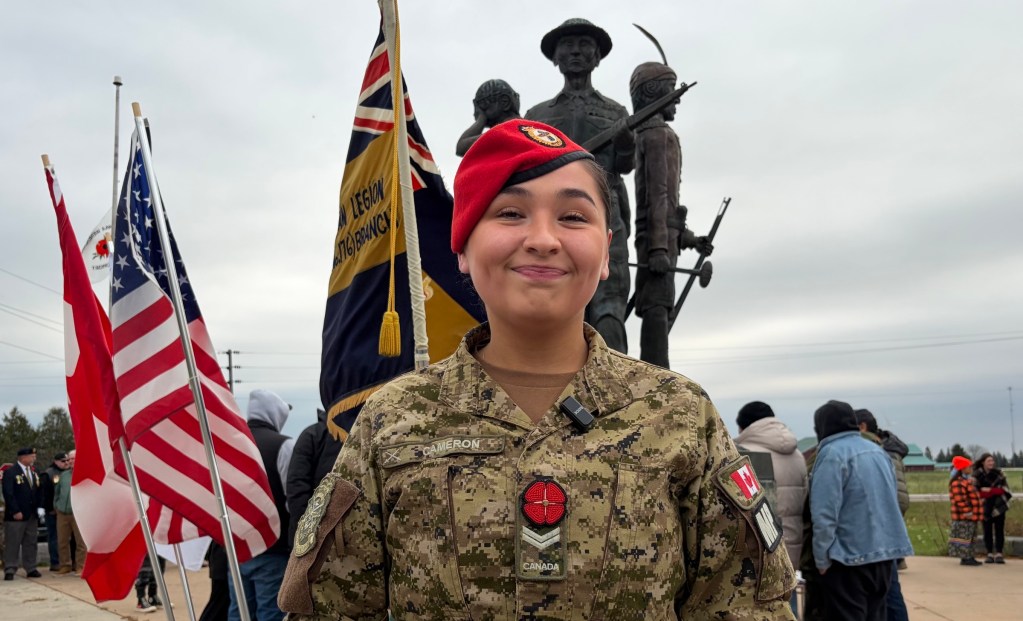
Corporal Darcie Cameron of the 2 Military Police Regiment of the Canadian Forces Military Police Group in Ontario, is a member of the First Nation and is proud of Indigenous peoples’ history of service.
“What Indigenous Veteran’s Day means to me is just the importance of remembering what our peoples have done for us in this country even today, and back in the day they were in residential schools they were deprived of who they are, their language,” Cameron told ICT.
“I just think it is so important to honor them for the fact that everything that they went through and we still choose, they still choose, to honor Canada today.” she said. “It’s just beautiful to look back and see how many indigenous peoples wanted to serve Canada.”
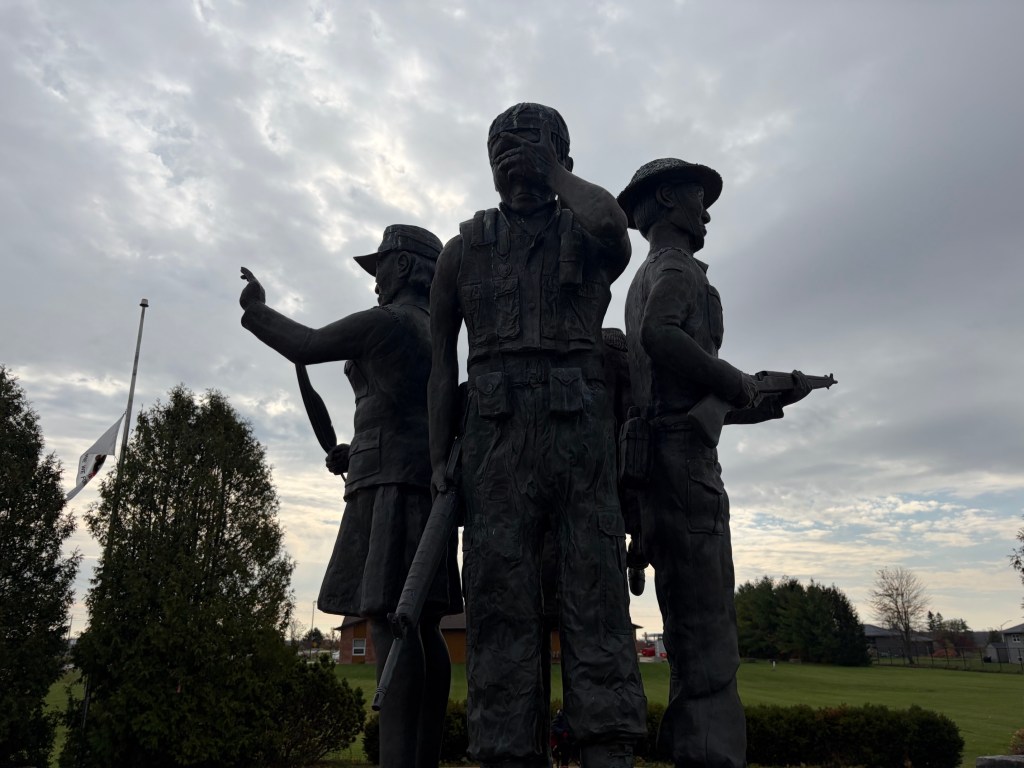
The community cenotaph for the Chippewas of Kettle and Stony Point in Ontario, Canada, is the Veterans Memorial Monument, located at the entrance of the First Nation. Designed by Bruce Bressette, it is built on top of a large turtle. Credit: Miles Morrisseau/ICT
According to Veterans Affairs Canada, over 12,000 Indigenous people from Canada served in World Wars I and II and the Korean Conflict, with 500 making the ultimate sacrifice, dying on the battlefield.
“It goes without saying that Indigenous Veterans have made invaluable contributions to the CAF (Canadian Armed Forces). They stood shoulder to shoulder with non-Indigenous members, demonstrating unwavering bravery and loyalty,” wrote Raquel Loth in a 2025 piece in The Maple Leaf, Canada’s military news.
“Yet, despite their service, many returned to a country that failed to honor them equally,” Loth wrote. “They were denied the same benefits, land grants, and reintegration support provided to non-Indigenous Veterans.”
Indigenous veterans were not welcome to Remembrance Day ceremonies in the years following World War II, and for decades their sacrifice was ignored despite personal sacrifices beyond the average Canadian soldier.
First Nations soldiers had to surrender their Indian status in order to sign up or they found upon their return that the Indian agent had removed them from membership. This was called “enfranchisement.”
Nevertheless, Indigenous peoples volunteered at a higher rate than other communities and contributed at the highest level. Cree soldiers served as code-talkers during the war, sharing strategy across enemy lines in a language that their foes could not decipher.
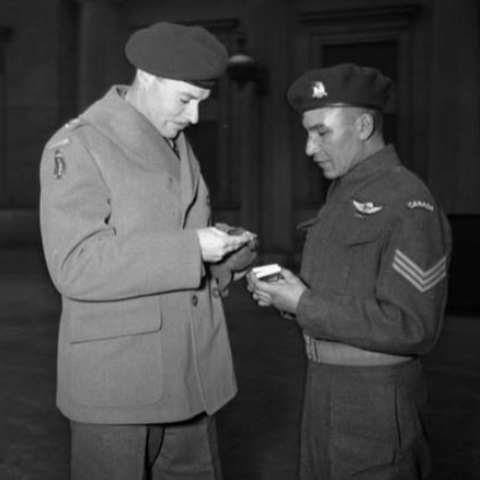
Sgt. Tommy Prince, right, Brokenhead First Nation, one of Canada’s most decorated soldiers, shows his Military Medal to Lt. Col. J.F.R. Akehurst, commanding officer, 2nd Battalion, First Special Service Force. The medal was presented to Prince at Buckingham Palace in England in 1945. Prince died in 1977. Credit: Photo via Canada Department of National Defence, Library and Archives
Tommy Prince, Brokenhead First Nation, was a residential school survivor who became one of the country’s most decorated soldiers after going behind enemy lines in southern France disguised as a local farmer to provide details of a German encampment. He was one of only three Canadians to be awarded the Military Medal from his home country and the Silver Star from the United States.
In addition to the international conflicts, Indigenous veterans from the Chippewas of Kettle and Stony Point were remembered for service during the American Civil War, the War of 1812 and during battles on the homefront to stand up for traditional lands. Among those honored was Dudley George, a land defender who was killed by the Ontario police on Sept. 6, 1995, following a raid on a peaceful occupation of the lands at Stony Point.
The land had been taken by the Canadian government during World War II as a training ground under the promise that it would be returned after the war. It wasn’t. Following George’s sacrifice and the ongoing occupation, the land was finally returned in 2009.
The cenotaph in the community recognizes veterans across the generations.
“Today we acknowledge the challenges Indigenous veterans faced both during their service and upon their return home,’’ Chief Kim Bressette told those gathered.
“Despite these hardships they demonstrated remarkable strength, resilience and dedication,” Bressette said. “Their contributions are an important part of our shared history and must never be forgotten as we gather in remembrance we pay tribute not only to those who served in times of war conflict and peacekeeping missions but also to the families who supported them and carried the burdens of their absence.”
Wreaths were placed in honor of the many veterans from the community. Honor songs were offered by the local drum and prayers were shared by elders.
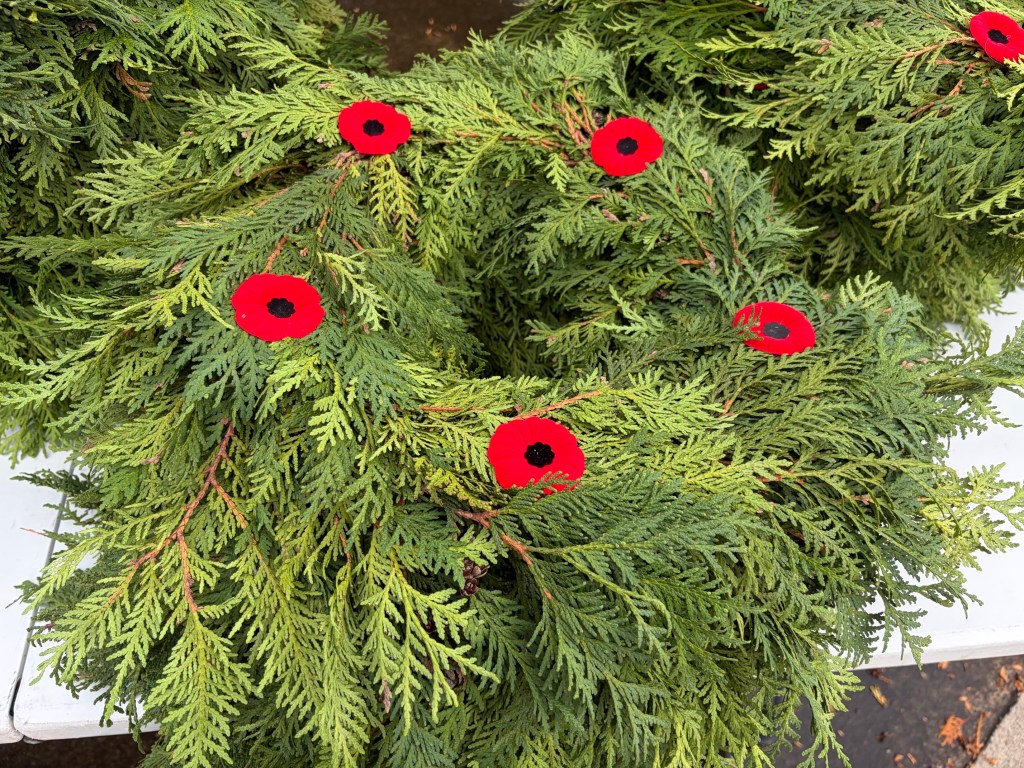
A wreath is placed at the Veterans Memorial Monument on the Chippewas of Kettle and Stony Point First Nation in Ontario, Canada, on Nov. 8, 2026, to mark National Indigenous Veterans Day. Poppies are worn for Remembrance Day on Nov. 11 in Canada, as immortalized in the poem, “In Flanders Field,” by John McCrae. Credit: Miles Morrisseau/ICT
The Canadian Armed Forces released a statement to mark the day’s significance.
“On National Indigenous Veterans Day, we remember the First Nations, Inuit, and Métis Peoples who have fought for this land for generations, going back to the pre-Confederation era,” Lieutenant-General Michael C. Wright, Commander Canadian Army and Defence Team Co-Champion for Indigenous Peoples stated.
“We owe them a profound debt and have a duty to honour that legacy, not only through commemoration, but in the actions we take today to ensure those following in their footsteps continue to be seen, heard, and respected as part of the Defence Team,” Wright said.
The history of service continues today, with a new generation stepping up to follow in the footsteps of those who went before them. As for Cameron, she looks to her grandmother Carmel Cameron who served in Afghanistan and Iran.
“My own grandmother, she is an Indigenous veteran,” Cameron said with pride. “She served in many wars in the 2000s and she was just a really big inspiration to me and I love her with my entire heart. … I just want to make her proud.”
The post Canada honors sacrifices of Indigenous veterans appeared first on ICT.
From ICT via This RSS Feed.