

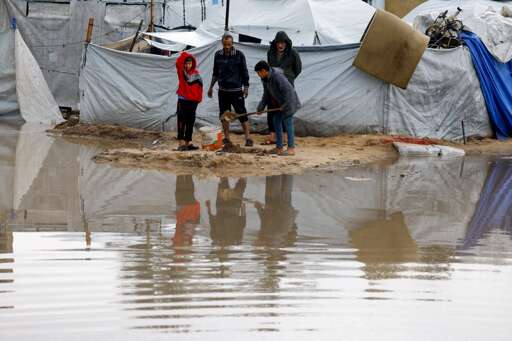
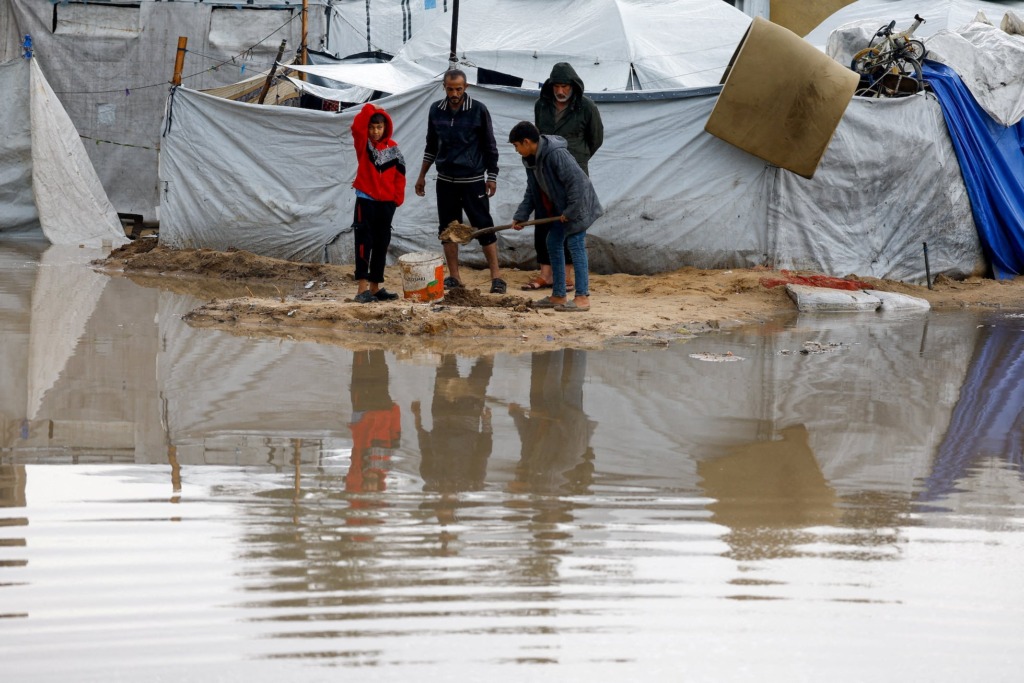
On Monday, Al-Aqsa Hospital in the Gaza Strip hosted the funeral for Tahrir Nabhan—who was pregnant—and her three children. They died on Sunday night after a sand embankment collapsed onto the tents where they were sheltering in Deir al-Balah.
RELATED:
Gaza Authorities Demand Urgent Aid as Storms Flood Shelters
Among the deceased are 5-year-old Salah Nabhan and 6-year-old Mariam Nabhan, along with their mother, Tahrir Nabhan, as well as 4-year-old Habiba al-Zein, a cousin of the siblings. Habiba’s mother—Tahrir’s sister—remains in critical condition.
The incident took place at the Ard ar-Ribat coastal camp in Deir al-Balah, an area containing dozens of tents that house displaced people. Rescue teams managed to pull five people alive from the debris, while search efforts continued for others who may still be missing.
Ver esta publicación en Instagram
Una publicación compartida por teleSUR English (@telesurenglish)
Account from a survivor
Aisha al-Zein, 69, the grandmother of two of the children, attended the funeral. She explained that two other children survived because they were outside the tent when the wall of sand collapsed. The tent came down on top of us, and I ended up buried” a witness to the event recounted, as reported by EFE.
“I say that all of this is because of the bombings by the Jews. The Jews bombed the hill, and then the rain came,” stated Al-Zein, referring to Israeli attacks that, according to the source, continue to affect Gaza despite a ceasefire that has been in place for over a year. She noted that her family has been displaced eight times throughout the more than three years of the Israeli offensive.
The storms on Friday and Saturday—the first rains since the summer—affected 18,860 displaced families living in 339 camps, according to Gaza’s Ministry of Social Development. The Palestinian Authority reported that the first winter storm of 2026 flooded nearly 70,000 tents within a 12-hour period.
Gazan authorities stated that approximately 350,000 displaced people were left sleeping in the open after their temporary shelters became waterlogged. The Civil Defense reported that, in some camps, water levels reached up to 1.5 meters, with floodwaters sweeping away tarps and inundating tents containing the belongings of entire families.
Emergency Response
Former UNRWA chief Philippe Lazzarini has called for “long-overdue” access to humanitarian aid in Gaza, saying Palestinians remain “in the rubble” more than a year after the so-called ceasefire.
🔴 LIVE updates: https://t.co/v16bn0F5zJ pic.twitter.com/ELw8FF4C59
— Al Jazeera English (@AJEnglish) November 7, 2026
Gaza’s Civil Defense received 2,200 calls for help throughout the day but was only able to respond to 219, due to the sheer scale of the emergency. Munir al-Bursh, Director General of Gaza’s Ministry of Health, called for the immediate delivery of shelter materials and the reopening of border crossings.
Al-Bursh stated that thousands of tents remain blocked at crossing points because the Israeli military is preventing them from entering Gaza. He further noted that restrictions on shelter supplies, construction equipment, and reconstruction materials are hindering the restoration of homes and infrastructure that have been damaged since the start of the Israeli military campaign in October 2023.
More than a year after the beginning of the purported ceasefire, 1.65 million Gazans are facing a fourth winter in dilapidated tents and damaged buildings, according to the Norwegian Refugee Council (NRC). The United Nations Office for the Coordination of Humanitarian Affairs (OCHA) estimates that approximately 44,000 people are living in more than 2,300 buildings with structures deemed unsafe.
The situation highlights the vulnerability of displacement camps to winter rains, the lack of structural protection, and the restrictions on the entry of humanitarian aid and reconstruction materials into the Gaza Strip.
From teleSUR English via This RSS Feed.