

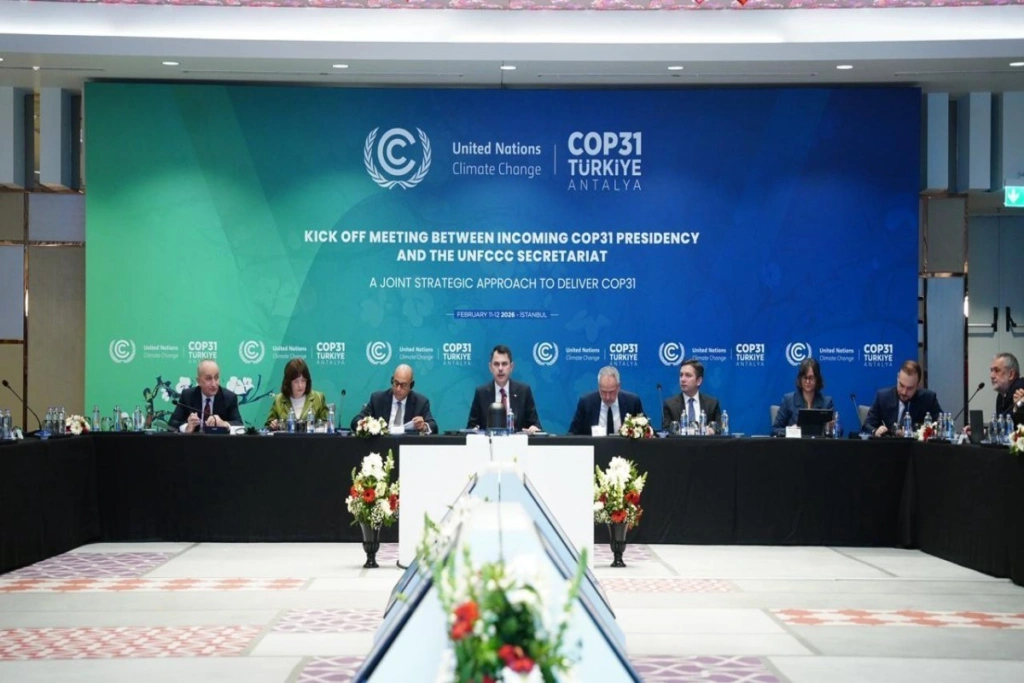
On Monday, the UN’s COP31 conference opened in Antalya, Türkiye, with the goal of accelerating the transition to clean energy, expanding climate finance, and addressing the impacts of global warming on the most vulnerable nations.
RELATED:
Climate Science and Emissions Cuts Face Growing Resistance Ahead of COP31
The conference will take place from November 9 to 20, bringing together representatives from 196 countries that are signatories to the United Nations Framework Convention on Climate Change, as well as the European Union.
The “Blue Zone” at COP31 will host events for world leaders on November 11 and 12, under the auspices of Turkish President Recep Tayyip Erdogan. According to Türkiye’s Ministry of Environment, Urbanization and Climate Change, leaders from 102 countries and more than 300 ministers have confirmed their attendance.
Additionally, requests were approved for the setup of 160 pavilions and 90 offices for the various delegations. Through November 20, the conference will bring together government representatives, scientists, businesses, international organizations, and members of civil society.
This gathering aims to translate climate commitments into verifiable actions, against a backdrop of record-breaking temperatures and growing demands for climate justice.
COP31 begins in a climate marked by rising temperatures, wars, and trade tensions—factors that complicate international cooperation. At the same time, nations most exposed to the impacts of climate change are calling for greater resources to adapt to and confront the consequences of global warming.
The World Meteorological Organization (WMO) has warned that global temperatures recorded so far in 2026 are 1.47 degrees Celsius above the pre-industrial average. This level is once again nearing the 1.5-degree limit established by the Paris Agreement. In its report on the state of the climate, the WMO indicated that 2027 will likely be even warmer. The organization emphasized that scientific evidence must be at the heart of discussions at COP31, amid growing pressure to reduce emissions and protect affected communities.
Shared challenges call for shared responsibility and solutions that deliver real change.
In his address at the #COP31 Opening Ceremony, COP31 President Murat Kurum set out Antalya’s call for stronger dialogue, renewed trust and action that bridges the gap between climate… pic.twitter.com/Mezzy8Symi
— COP31 Türkiye (@turkiyecop31) November 9, 2026
Climate action underway
The 2026 Global Climate Action Yearbook, presented by UN Climate Change, provides evidence that climate action is yielding results and driving implementation. The document tracks progress across 44 global indicators aligned with the first Global Stocktake.
According to the report, cities, regions, businesses, and civil society continue to push forward the execution of climate commitments. The yearbook was unveiled as part of the 10th anniversary of the Marrakech Partnership for Global Climate Action and arrives at a pivotal moment for COP31.
“This yearbook shows how businesses, cities, communities, and other actors are transforming global commitments into changes that people can see, feel, and benefit from,” stated Simon Stiell, Executive Secretary of UN Climate Change.
Stiell added that we can and must go much further and faster, and maintained that COP31 must help scale up solutions, mobilize finance, and bring the benefits of climate action to more people.
The summit will focus on driving progress in the real economy through the Global Climate Action Agenda, running in parallel with and complementing the formal negotiations. The initiative seeks to translate international agreements into concrete measures for mitigation, adaptation, and financing.
The energy transition takes center stage on the Antalya agenda. The conference will need to address how to accelerate the deployment of clean energy, reduce reliance on fossil fuels, and strengthen countries’ energy security.
Climate finance will also be a key topic. Countries will need to discuss who should contribute resources, in what amount, and how to ensure that the funds reach the most vulnerable nations.
From teleSUR English via This RSS Feed.