

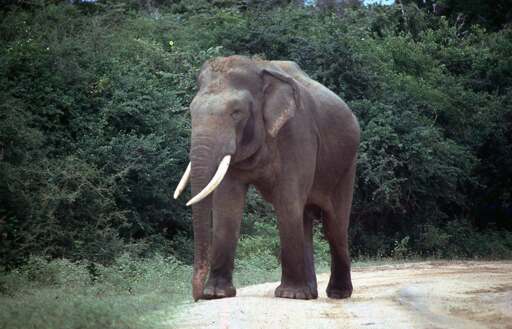
COLOMBO — The recent death of Kavantissa, a celebrated “tusker” in one of Sri Lanka’s human-elephant conflict hotspots, from a gunshot injury has sparked grief, anger, and a string of public protests. It’s also spurred debate about whether photographers who follow tuskers — elephants, typically male, with large tusks — also put the pachyderms at risk by overexposing them, or, at times, seeming to harass the animals. For veteran wildlife photographer and conservationist Ravindralal Anthonis, the debate reflects wider changes in wildlife photography. Anthonis has been identifying and naming individual tuskers decades before the advent of digital cameras or social media, documenting their lives through years of observation. He’s also served as president of Sri Lanka’s oldest conservation organization, the Wildlife and Nature Protection Society (WNPS), from 2005 to 2007, during which he championed several conservation initiatives. Now 80, Anthonis spoke with Mongabay contributor Malaka Rodrigo about how his childhood fascination with wildlife and a chance encounter shaped his pioneering work. He also offered a glimpse into an earlier era when wildlife photography was as much about patience and observation as capturing an image. The following interview has been lightly edited for length and clarity. Mongabay: You are among the early wildlife photographers in Sri Lanka. How and when did this interest in wildlife begin? Ravindralal Anthonis: My interest in wildlife began at a very young age. In 1955, when I was a student at St. Thomas’ College, Mount Lavinia, my mother gave me a book called Nine Man-Eaters…This article was originally published on Mongabay
From Conservation news via This RSS Feed.